
Abony Acquisition Corp. I’s Formation and Strategic Outlook for IPO Proceeds Deployment
Abony Acquisition Corp. I completed its IPO with $230 million gross proceeds, targeting business combinations in tech-related sectors within a 24-month timeframe.
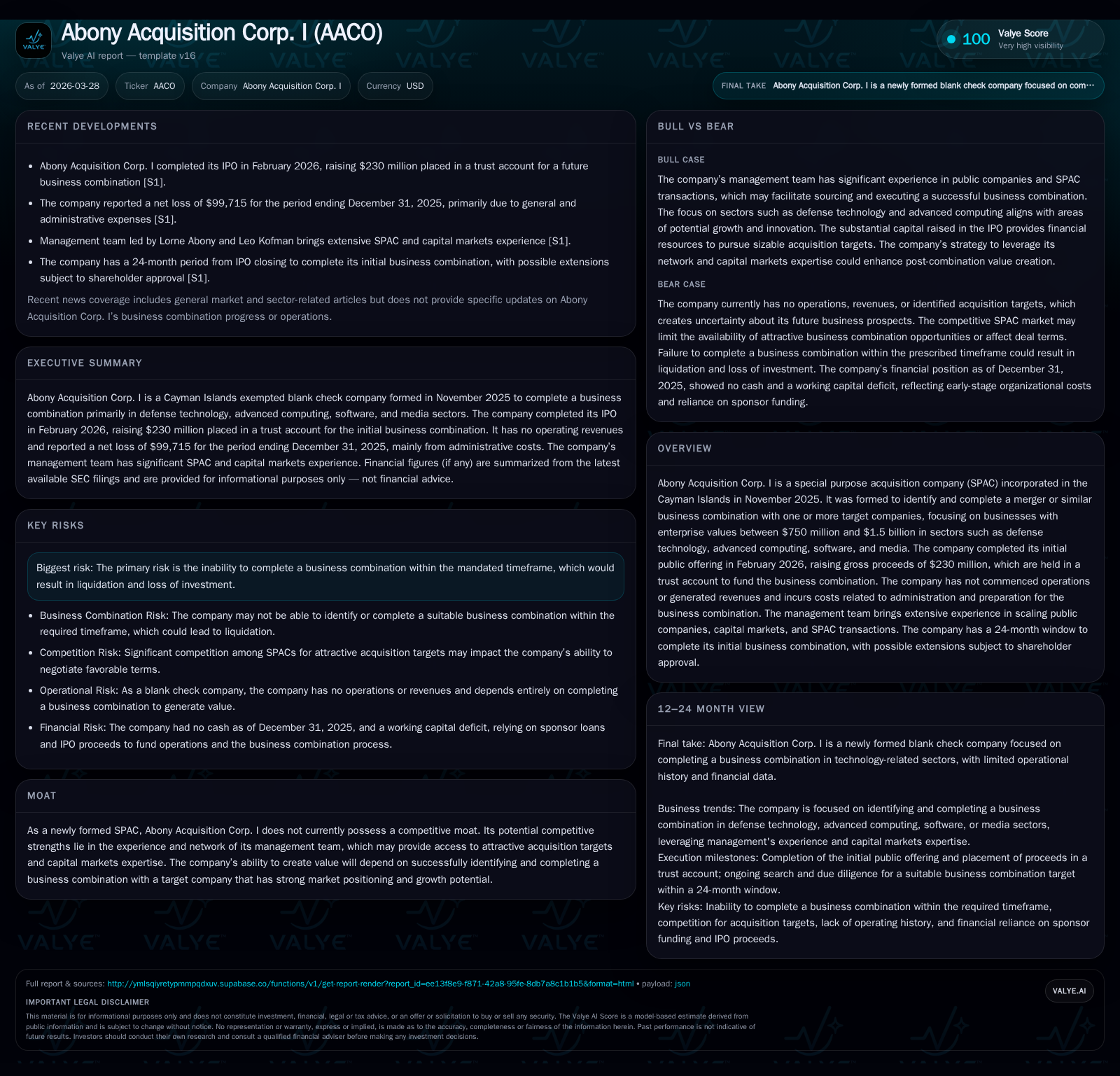
Abony Acquisition Corp. I (AACO) entered the public markets in early 2026 as a Cayman Islands-based SPAC focused on acquiring enterprises valued between $750 million and $1.5 billion in defense technology, advanced computing, software, and media. With $230 million raised and secured in a trust account from its February 2026 IPO, AACO is positioned to leverage its experienced management team's network and transaction expertise during the critical two-year window to complete a business combination. Its nascent operations have incurred typical start-up losses with no revenues yet realized, while careful structuring of fees and sponsor capital enhances preservation of trust funds. Investors should monitor progress toward target identification and deal execution milestones, given liquidation risk if no combination is consummated within the prescribed period.
Formation and IPO: Establishing Financial Foundations
Abony Acquisition Corp. I was incorporated on November 13, 2025, as a Cayman Islands exempted company formed as a special purpose acquisition company (SPAC). Its primary mandate is completing a merger or other business combination with targets generally valued between $750 million and $1.5 billion, focusing on defense technology, advanced computing, software, and media sectors [S1].
The company completed its initial public offering (IPO) on February 20, 2026. The offering comprised 23 million units priced at $10.00 each — each including one Class A ordinary share and one-third of one redeemable warrant exercisable at $11.50 per share [S1][S3]. Underwriters exercised their full over-allotment option adding 3 million units bringing gross proceeds to $230 million [S1]. Concurrently, the Sponsor and BTIG completed a private placement of 695,000 units at the same price generating approximately $7 million in gross proceeds [S1].
An aggregate amount of $230 million from net proceeds along with some private placement proceeds (offsetting deferred underwriting commissions) were deposited into a U.S.-based trust account managed by Continental Stock Transfer & Trust Company to preserve investor capital until used for an approved business combination [S1][S14]. This structure safeguards public shareholders’ investments by restricting premature use of funds.
Offering costs totaled about $13.3 million including a cash underwriting fee of $4.6 million paid immediately and a deferred underwriting fee of approximately $8.05 million payable only upon successful business combination completion [S1][S14][S17]. This aligns incentives to close deals without diluting trust funds prematurely.
Management Team Expertise and Strategic Targeting
AACO’s management brings extensive experience scaling public companies alongside deep capital markets and SPAC transaction knowledge [S1][S5]. Their backgrounds provide access to robust networks within targeted sectors—defense technology, advanced computing, software solutions, and media—enhancing deal sourcing particularly for proprietary or limited auction opportunities common in these industries.
This sector expertise aims to accelerate due diligence efficiency and maintain valuation discipline by leveraging long-standing relationships cultivated across market cycles. AACO’s strategy focuses on identifying businesses that fit enterprise value criteria and offer strategic potential for operational scalability post-combination.
Current Financial Snapshot Pre-Business Combination
From inception through December 31, 2025, AACO’s financial activity was limited to organizational setup and IPO preparations without operational revenues [F1][S1].
Historical performance (annual)
| FY |
|---|
| 2025 |
Source: SEC companyfacts cache [F1].
The net loss reflects general administrative expenses including legal compliance for listing requirements, accounting fees, audit preparations, plus costs financed via related-party promissory notes prior to IPO closure [F1][S1]. Current assets were approximately $40k before receipt of IPO proceeds.
Return on equity appears elevated due to negative equity early in the company’s life cycle; meaningful profitability metrics await post-business combination operating results [F1].
Risks of Non-Completion and Liquidity Considerations
AACO faces significant risk if it fails to consummate an initial business combination within the prescribed completion window—24 months post-IPO closing [S1][S16]. Failure triggers mandatory liquidation where trust account funds are returned pro rata to public shareholders less dissolution expenses.
This liquidation extinguishes shareholder interests entirely while warrants expire worthless by design [S18]. Sponsors waive rights to trust account liquidating distributions if no deal closes timely but may recover amounts loaned outside the trust account [S18].
Liquidity outside the trust account is limited intentionally since funds are reserved primarily for administrative expenses such as target identification or due diligence pre-deal [S10], exposing AACO operationally if these costs exceed budgets without sponsor loans.
Capital Structure, Fees, and Trust Account Overview
AACO employs a typical SPAC financial structure balancing upfront cash flows with alignment mechanisms:
- Cash underwriting fee: $4.6 million payable immediately upon IPO close.
- Deferred underwriting fee: approximately $8 million held in trust until released upon closing an initial business combination under specified conditions [S6][S14][S17].
Sponsor working capital loans totaling over $300k funded formative expenses pre-IPO; these were fully repaid at IPO closing [S7]. Post-IPO administrative fees approximate $25k monthly covering executive services plus office infrastructure provided by affiliates until consummation or liquidation ceases payments [S6][S7].
Funds held inside the trust account are invested conservatively in short-term U.S. government securities or equivalents safeguarding principal while accruing modest interest dedicated solely for future business combinations or refunding investors if no deal occurs [S1].
Future Growth Drivers: Industry Focus and Market Opportunities
AACO targets sectors known for sustained innovation paired with scalable revenue models—defense technology influenced by geopolitical dynamics; advanced computing benefiting from AI acceleration; disruptive software applications; digital media ecosystems reshaping consumption patterns [S1][S5].
The enterprise valuation range ($750M-$1.5B) balances meaningful scale with accessible niches where AACO’s team can leverage proprietary access beyond broad auctions. Thorough due diligence coupled with transactional agility aims to unlock synergistic value pre-transaction (deal structuring) and post-closing (integration leverage).
Milestones To Monitor: Business Combination Deadline and Deal Dynamics
While explicit forward guidance is absent due to regulatory constraints around SPAC disclosure before deal announcement, investors should watch for:
- Increased spending outside trust signaling active diligence or target selection,
- Announcements of letters of intent or exclusivity agreements indicating pipeline maturity,
- Proxy or tender offer filings adapted for combination approval,
- The approaching deadline circa February 2028 marking two years since IPO closure when combination must close or liquidation ensues.
These milestones directly affect shareholder outcomes given automatic redemption rights linked to vote outcomes or mandatory wind-down provisions if deadlines lapse without transaction closure.
Capital Allocation Strategy and Investor Returns Expectations
All invested proceeds held securely in trust are earmarked predominantly for consummating business combinations or subsequent working capital needs post-combination. Residual deployment may involve cash or equity/equity-linked instruments per negotiated transaction terms reflecting market conditions and target preferences [S1][S4][F1].
Given AACO's zero operating history beyond start-up expenses generating negative returns initially (net loss ~$100k), return on equity remains negative currently but anticipates normalization contingent upon acquiring operating companies with viable earnings profiles [F1].
No dividends or share buybacks occur pre-business combination as AACO currently has no commercial operations generating free cash flow; investor returns hinge exclusively on post-merger entity performance versus redemption rights protective floor approximating $10 per public share from trust assets less expenses [S4][F1].
Convertible working capital loans up to ~$1.5 million may convert into private units at post-merger pricing providing optionality aligning sponsor incentives with public shareholders after transaction consummation [S12].
This analysis synthesizes information available via official SEC filings through March 27, 2026 ([S1]-[S29]) supported by XBRL numeric datasets ([F1]). As a nascent SPAC recently launched into public markets, Abony Acquisition Corp. I depends heavily on management’s ability to source suitable acquisition targets within aggressive timelines while prudently managing administrative expenditures to preserve trust account assets critical for shareholder protection.
Readers should consider inherent uncertainties common across newly formed blank check companies including competitive deal pipelines affecting valuations alongside macroeconomic factors influencing acquisition integration post-business combination.
Disclaimer: This is research-only, informational analysis and not investment advice. It may include AI-generated interpretation and general industry context. Always verify important details using primary sources.

Comments