
BioXcel Therapeutics Leverages AI for Disruptive Neuroscience and Oncology Innovations
BioXcel Therapeutics integrates its EvolverAI platform to repurpose drug candidates in neuroscience and immuno-oncology, showing early commercial traction with IGALMI® amid ongoing financial and regulatory challenges.
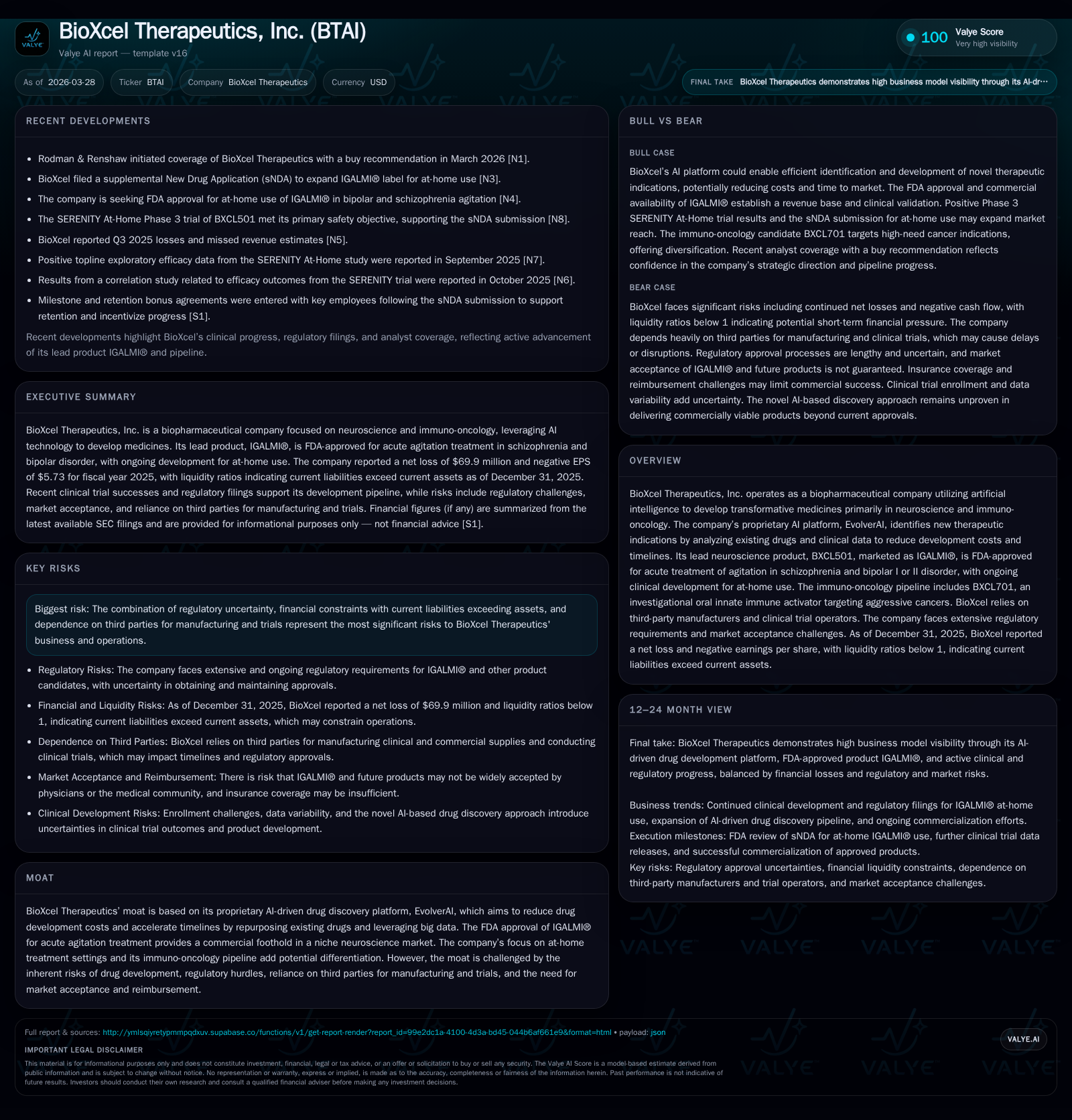
BioXcel Therapeutics operates at the intersection of artificial intelligence and biopharmaceutical development, primarily focusing on neuroscience and immuno-oncology. Its proprietary EvolverAI enables targeted drug repositioning, reducing traditional timelines and costs, exemplified by FDA approval and commercialization of IGALMI®, a sublingual dexmedetomidine film for agitation in schizophrenia and bipolar disorder. However, BioXcel continues to face significant operating losses, liquidity constraints, and execution risks linked to third-party dependencies and regulatory hurdles. The upcoming potential label expansion of IGALMI® for at-home use and progress in immuno-oncology trials offer key milestones to monitor.
Financial Evolution Amid Innovation: Tracking Past Performance
From fiscal years 2022 through 2025, BioXcel Therapeutics exhibited a consistent pattern of operating losses as it invested heavily in research and development to advance its pipeline. Notably, operating income losses narrowed from approximately $159.6 million in 2022 to about $50.5 million by the end of 2025, indicating meaningful operational improvement at roughly a 25% year-over-year reduction in losses [F1]. Net income followed this trend but with more volatility; after posting a $165.8 million loss in 2022, net losses increased by about 17% YoY to nearly $69.9 million in 2025 [F1]. This divergence suggests impacts from non-operating factors.
Operating cash flow improved commensurately from a negative $135.3 million in 2022 to about $57.6 million outflow at FY2025-end, a roughly 20% improvement year-over-year [F1]. Capital expenditures have been minimal, dropping from $139 thousand in 2022 to zero by the latest fiscal year, aligning with strategic cost containment efforts emphasized during the Clinical Reprioritization phase [S17].
Despite these improvements in cash burn rate, BioXcel's balance sheet signals financial pressure. Current assets stood at approximately $44.7 million against current liabilities of about $53.9 million as of December 31, 2025, resulting in a current ratio below one (0.83) [F1], which indicates short-term liquidity constraints.
Historical performance (annual)
| FY | Net ($mm) | CFO ($mm) | OpInc ($mm) | Capex ($) | Net YoY |
|---|---|---|---|---|---|
| 2025 | -70 | -58 | -50 | 0 | -17.3% |
| 2024 | -60 | -72 | -67 | 20000 | +66.7% |
| 2023 | -179 | -155 | -172 | 20000 | -8.0% |
| 2022 | -166 | -135 | -160 | 139000 |
Source: SEC companyfacts cache [F1].
Capital returns and efficiency (annual)
| FY | FCF ($mm) | ROE% |
|---|---|---|
| 2025 | -58 | 73.2 |
| 2024 | -72 | 64.0 |
| 2023 | -155 | 316.9 |
| 2022 | -135 | -215.9 |
Source: SEC companyfacts cache [F1].
Table source: SEC company facts snapshot [F1]
These trends underscore sustained investment into advancing BioXcel's pipeline amid financial headwinds requiring careful capital discipline.
EvolverAI’s Role in Accelerating Product Development Timelines
At the core of BioXcel’s innovation strategy lies EvolverAI—a proprietary artificial intelligence-driven discovery engine designed specifically for drug repositioning through sophisticated integration of big data analytics. EvolverAI constructs a labeled properties "knowledge graph" that maps entities such as neuropsychiatric symptoms, brain circuits implicated in disease states, molecular drug targets alongside pharmacologic profiles of existing medications [S13].
This AI platform enables rapid hypothesis generation by identifying novel therapeutic indications not originally targeted by existing compounds or suggesting potential new synergistic combinations for enhanced efficacy. The approach prioritizes molecules with demonstrated blood-brain barrier permeability critical for neuropsychiatric therapeutics success—a common challenge pharma faces but partially addressed here through biomarker-driven patient stratification insights.
Such integration allows BioXcel to accelerate clinical trial design phases by selecting enriched patient cohorts based on molecular markers or anticipated pharmacodynamic responses while shortening development timelines compared to traditional drug discovery processes. However, as noted internally [S17], strategic shifts have recently led the company to temper investment levels into its AI platform pending additional financing even as it remains foundational to its drug re-innovation vision.
Commercial Milestones: Progress With IGALMI® in Acute Agitation Treatment
BioXcel achieved a significant commercial breakthrough when the FDA approved BXCL501—marketed as IGALMI®—in April 2022 for acute treatment of agitation associated with schizophrenia or bipolar I or II disorder [S23]. IGALMI® employs sublingual dexmedetomidine formulated as an orally dissolving film enabling rapid onset without injections—a compelling alternative addressing limitations of intramuscular antipsychotics that are invasive and often sedative.
Commercial availability began shortly after approval with dose strengths calibrated for patient safety [S23]. Despite workforce reductions during the Clinical Reprioritization [S17], commercialization resources have been deliberately limited leading BioXcel to maintain market presence via lean distribution while exploring partnerships.
A critical next step emerged from the SERENITY At-Home pivotal Phase 3 trial completed successfully in August 2025 evaluating safety of IGALMI® used outside institutional settings—a move expected to expand access significantly by enabling patients suffering agitation episodes with supervision at home rather than hospitals [S23]. This trial outcome underpinned submission of a Supplemental New Drug Application (sNDA) filed in January 2026 seeking label extension into ambulatory settings. Approval here would represent notable expansion beyond current clinic-based indications [S23].
Nonetheless uncertainties remain around payer reimbursement frameworks and adoption by prescribers which can be slow given entrenched off-label antipsychotic use [S26]. Market education will require strategic support once additional indications are secured.
Pipeline Outlook and Development Hurdles in Immuno-Oncology
Beyond neuroscience advances through BXCL501/IGALMI®, BioXcel’s immuno-oncology subsidiary OnkosXcel is developing BXCL701—an investigational oral innate immune activator targeting aggressive cancers such as prostate and pancreatic malignancies [S23]. This agent seeks to modulate innate immunity pathways essential for anti-tumor response initiation where conventional checkpoint inhibitors may fall short.
BXCL701's oral administration presents clinical convenience potentially improving patient compliance during prolonged treatment courses. However,the pathway from early clinical trials faces scrutiny over endpoints reflective of immunologic activity versus durable remission signals demanding biomarker validation amidst complex tumor microenvironments [S7].
Operationally,BioXcel remains heavily reliant upon third-party contract research organizations (CROs)and manufacturers who execute material supply or trial conduct—exposing development timelines to risks from delays or non-compliance that could jeopardize regulatory goals [S5,S7]. Patient recruitment difficulties especially common for aggressive solid tumors combined with safety monitoring add further bottlenecks common in oncology biopharma.
Capital Structure, Liquidity Constraints and Growth Implications
Fiscal year-end metrics highlight BioXcel’s constrained financial position emerging from continuous operational losses despite improved cost control mainly post-Clinical Reprioritization [F1,S17]. End-2025 cash and equivalents were roughly $28.4 million covering limited runway given ongoing burn rates near $57 million annually on an operating cash flow basis [F1]. Current liabilities exceeded current assets yielding suboptimal liquidity ratios (~0.83), stressing short-term funding needs [F1,S4,S6].
Equity was negative nearing minus $95 million reflecting cumulative retained earnings deficits caused by multi-year losses overrunning paid-in capital contributions since inception [F1]. No dividends or share repurchases occurred due to prioritization on funding operations rather than shareholder returns [F1].
To manage working capital,the company has engaged registered direct offerings along with warrant issuances visible within filings signaling dilution risk should further equity raises be required [S4,S6,S8]. Financial flexibility remains limited making near-term fundraising or successful monetization events imperative for sustaining momentum across both neuroscience commercialization efforts and oncology pipeline development.
Third-Party Dependencies & Regulatory Risks
A core operational vulnerability arises from reliance on external vendors responsible for manufacturing APIs or finished drug formulations as well as conducting clinical studies supporting regulatory submissions [S5]. Supply chain disruptions or failure to meet Good Manufacturing Practices (GMP) standards could delay product availability impacting revenue realization notably under IGALMI®’s commercial launch phase.
Regulatory risk extends beyond initial FDA approval; IGALMI® remains subject to post-marketing commitments including pharmacovigilance requirements as well as evolving regulatory guidelines potentially affecting AI-driven development strategies embedded within EvolverAI frameworks [S5,S20]. Cross-border market expansions remain unexplored formally though could represent future opportunity contingent on licensing collaborations.
Cybersecurity concerns add another dimension given sensitive clinical trial data aggregated digitally via proprietary AI infrastructure creating exposure points amenable to breaches that might compromise intellectual property or patient confidentiality undermining competitive positioning [S5,S26].
Ongoing legal proceedings introduce potential contingencies that can drain management focus if adverse outcomes materialize although details remain undisclosed highlighting typical biopharma risk profile encompassing intellectual property disputes or healthcare compliance claims.
Investor Considerations: Key Upcoming Catalysts & Reviews
Though explicit forward-looking guidance is absent ([N1],[N2]), several catalysts warrant close attention:
- FDA review timeline decision regarding sNDA application extending IGALMI® use into at-home treatment settings could materially expand addressable patient populations currently restricted largely to institutional interventions [S23,N1]
- Progress reports or interim data readouts from BXCL701's immuno-oncology clinical trials will inform risk/reward calculus given endpoint uncertainties common in this segment [N1]
- Amendments within credit facilities or equity offerings may signal shifts in liquidity status directly impacting runway forecasts given constrained cash buffers [S4,S6]
- Potential licensing deals or partnerships emerging either for IGALMI® international rollout or collaborative co-development arrangements may provide leverage in commercial scale-up post-reprioritization efforts [S17,N1]
- Updates surrounding AI platform deployment including restoration of R&D investment following recent curtailments could signal reacceleration of discovery pipelines beyond lead candidates discussed herein.
In summary,BioXcel Therapeutics embodies an innovative model harnessing artificial intelligence not merely conceptually but as a practical tool reshaping drug repositioning paradigms tailored toward neuropsychiatry and immunotherapy frontiers. Encouraging commercial strides made via IGALMI® demonstrate tangible success yet underpinning financial resource pressures alongside substantive execution risks remind observers that translating disruptive science into sustainable business value remains inherently challenging requiring vigilant oversight.
This analysis is intended solely for informational purposes regarding BioXcel Therapeutics' business model and financial condition as reflected in publicly available filings and recent news without constituting any investment advice.
Disclaimer: This is research-only, informational analysis and not investment advice. It may include AI-generated interpretation and general industry context. Always verify important details using primary sources.

Comments