
Empery Digital’s Shift from EVs to Bitcoin Treasury Faces Profitability and Liquidity Strains
Transitioning from electric vehicles, Empery Digital embraces a Bitcoin-focused treasury strategy while grappling with heavy losses and operational risks.
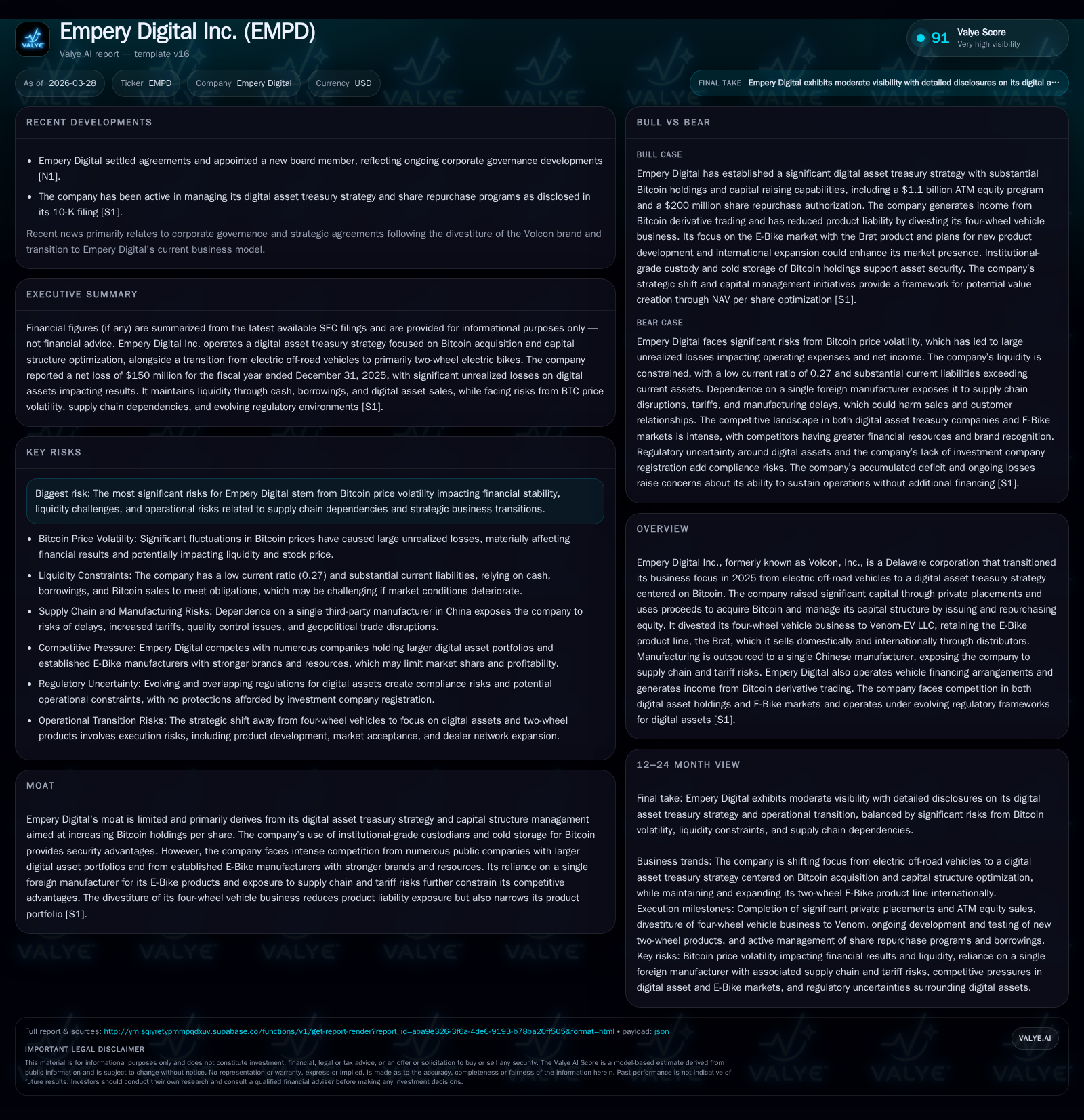
Empery Digital Inc. moved from electric off-road vehicles to digital asset treasury management centered on increasing Bitcoin holdings. Despite raising $501 million through equity and carrying a substantial Bitcoin portfolio, the company reported shrinking revenues and deepening losses in fiscal 2025. Structural challenges include limited product offerings, reliance on a single Chinese manufacturer, and sensitivity to Bitcoin price volatility, all raising liquidity concerns. Its capital allocation prioritizes Bitcoin accumulation and share repurchases funded partly by debt, but operating cash flows remain negative amid ongoing transition risks.
Company Overview and Strategic Shift
Empery Digital Inc., previously Volcon, Inc., underwent a fundamental transformation during 2025, refocusing its business away from manufacturing electric off-road vehicles towards operating a digital asset treasury strategy predominantly centered on accumulating Bitcoin (BTC). This strategic pivot was marked by a comprehensive rebranding completed in July 2025 when the company adopted its current name, Empery Digital Inc., simultaneously changing its Nasdaq ticker symbol from VLCN to EMPD [S1][S10].
The shift was catalyzed by private placement equity financings completed in July 2025 that raised gross proceeds approximating $501 million, including $28 million paid directly in Bitcoin. Net proceeds after expenses ($452 million) were immediately deployed to acquire Bitcoin holdings and establish crypto treasury operations. This move pivots Empery from an operating enterprise focused on selling electric vehicles towards functioning as a publicly traded entity managing a large-scale digital asset portfolio [S1][S10].
Historical Financial Performance
Empery's financial trajectory reflects the strategic transition's disruptive impact. The revenue shrank precipitously from $4.04 million in FY2024 to just under $975 thousand in FY2025—a drop of approximately 76%, signaling severe contraction in its product sales revenue base amid business divestitures and scaled-back vehicle operations [F1]. Operating income slumped commensurately, delivering losses expanding from about $27.0 million in FY2024 to over $153.4 million in FY2025, underscoring both lower sales and elevated costs linked to restructuring and digital asset operations [F1]. Net losses mirrored this deterioration, advancing from roughly $45.5 million loss in FY2024 to about $150 million loss last year [F1].
Operating cash flows remained negative over this period—rising slightly worse from -$16.0 million (FY2024) to nearly -$17.8 million (FY2025)—while capital expenditures aggressively decreased as the firm shifted focus from manufacturing assets towards cryptocurrency holdings [F1]. Equity swelled markedly to approximately $269.2 million at the end of FY2025 compared with near breakeven levels one year prior, reflecting capital raises supporting BTC investments [F1].
Historical performance (annual)
| FY | Rev ($mm) | Net ($mm) | CFO ($mm) | OpInc ($mm) | Rev YoY | Net YoY |
|---|---|---|---|---|---|---|
| 2025 | 1 | -150 | -18 | -153 | -75.9% | -229.7% |
| 2024 | 4 | -46 | -16 | -27 | +23.8% | -1.0% |
| 2023 | 3 | -45 | -30 | -30 | -28.3% | -31.7% |
| 2022 | 5 | -34 | -34 | -32 |
Source: SEC companyfacts cache [F1].
Capital returns and efficiency (annual)
| FY | FCF ($mm) | ROE% |
|---|---|---|
| 2025 | -18 | -55.7 |
| 2024 | -16 | -111651.6 |
| 2023 | -31 | 229.6 |
| 2022 | -34 | -5391.3 |
Source: SEC companyfacts cache [F1].
Revenue and net income show significant decline and volatility amid strategic transition [F1].
Future Growth Prospects
Empery's future growth prospects are primarily tied to its evolving digital asset strategy rather than traditional product sales expansion; however, it retains a residual consumer-facing vehicle operation focusing on the Brat E-Bike, which represents its only remaining product line post divestiture of its four-wheel vehicle business to Venom-EV LLC [S1][S9]. The company plans international expansion of the Brat through distributors across Mexico, Caribbean markets, New Zealand, and potentially Europe if regulatory approvals permit [S8][S12]. A new E-Bike model slated for launch in late H2-2026 may contribute incremental unit volume subject to successful testing and cost viability [S9].
Central to growth is the company's intent to optimize capital structure aimed at maximizing BTC per share—a value metric designed to appeal to investors favoring exposure to cryptocurrency markets via an institutional-grade corporate vehicle leveraging issuance advantages such as ATM sales programs authorized up to $1.1 billion [S10]. Empery also plans continued use of share repurchases when stock trades below net asset value (NAV), currently defined as BTC holdings plus cash less debt divided by adjusted shares outstanding [S10][S14].
Challenges stem from intense competition against larger publicly traded firms with more substantial digital asset portfolios and deeper liquidity buffers alongside well-known E-Bike brands with broader distribution networks [S1]. Furthermore, reliance on a single Chinese supplier for manufacturing exposes Empery to supply chain disruptions, tariff escalations, and geopolitical tensions that could stifle product availability or inflate costs adversely affecting margins [S11][S15][S25]. Regulatory uncertainties around cryptocurrencies globally also pose material operational risks.
Forecasts and Milestones
Although explicit revenue or earnings guidance has not been issued publicly, key developments warrant monitoring: progress on new E-Bike model certification slated for second half of calendar year 2026; expansion pace of international Brat distributor agreements; volume and valuation fluctuations of Bitcoin holdings; debt facility renewals due August 2026; ongoing share repurchase activities scaled up from prior levels; and remediation efforts around previously disclosed internal control material weaknesses [S9][S10][N1][S1]. Any successful scaling of cryptocurrency derivative trading income beyond historical gains (~$2M since digital asset strategy inception) would represent incremental upside albeit within volatile bitcoin market conditions [S10].
Capital Allocation and Returns
The cornerstone of Empery’s capital deployment is accruing additional Bitcoin holdings funded through equity issuance programs—including private placements that garnered over half a billion dollars—and opportunistic ATM sales totaling approximately $1.5 million so far at an average price near market levels [S10]. Concurrently, the firm authorizes share buybacks up to $200 million following expansions approved early-2026; these repurchases have consumed roughly $136 million funded partially via two credit facilities comprising up to $150 million borrowing capacity with approximately $95 million drawn secured against nearly 2,900 BTC as collateral [S10][S13][S21].
The operating business relating to E-Bikes and inventory financing currently cannot self-sustain operating expenses nor interest payments obliging continued external funding or bitcoin liquidation as needed [S20]. For fiscal year-end December 31, 2025, Empery reported negative free cash flow approximating -$18M (operating cash flow minus capex) despite reduced capital expenditures reflective of diminished tangible product investment [F1]. No dividends have been declared or paid historically nor are expected given prevailing losses and reinvestment priorities [S18].
The company’s approximate return on equity stands deeply negative at about -56%, driven by significant net losses relative to equity swollen by recent capital infusions primarily earmarked for digital assets rather than core operations profitability [F1]. This underlines structural profitability challenges inherent in transitioning business models.
Risk Factors Summary
Among principal risks confronting Empery Digital are:
- Bitcoin Price Volatility: Given substantial bitcoin holdings constitute most assets reported on the balance sheet, sharp crypto price swings materially impact reported results and liquidity access from financing secured by these assets [S13][S20][S21].
- Liquidity Constraints: The need for timely equity or debt financing amidst uncertain BTC market conditions poses default risks on existing obligations; margin calls on bitcoin-backed loans add urgent liquidity pressures [S13][S19][S21].
- Supply Chain Dependence: Concentration with PXID in China exposes production timetables and cost structure to tariffs, labor shortages, international trade policies, or disruptions such as port delays [S11][S15][S25].
- Product Portfolio Narrowing: Selling its four-wheel vehicle division limits revenue diversity leaving scant contribution from E-Bikes which face fierce competition with larger OEMs possessing more established brands [S1].[N1]
- Internal Control Deficiencies: Material weaknesses in internal financial reporting controls identified since multiple years remain unresolved—raising concerns over financial accuracy and reporting timeliness which can erode investor confidence [S1].
- Regulatory Uncertainty: Shifting U.S., state-level and international regulations affecting cryptocurrencies create operational compliance complexity with potential enforcement consequences impacting business continuity [S5][S18][S25].
- Market Listing Risks: Historical low stock prices triggered Nasdaq non-compliance notifications though temporarily rectified; persistent issues could lead to delisting reducing trade liquidity and capital access avenues significantly [S6].
- Litigation Exposure: As typical for emerging companies involved in novel sectors, lawsuits or governmental probes present financial drains regardless of merit; outcomes unpredictable but could impair resources or delay strategic initiatives [S7][S15].
- Dependence on Key Personnel & Board Composition: Governance changes including recent board member appointments coupled with activist shareholder pressures can disrupt strategic implementation consistency and operational focus [N1][S17].
Industry Context (Analysis)
The nascent niche combining digital asset treasury management with residual consumer electric mobility offerings places Empery into an unusual hybrid category fraught with uncertainties absent clear industry benchmarks. Cryptocurrency custodianship requires robust security measures which the company addresses via institutional-grade cold storage—providing some differentiation—but competitors’ larger scale portfolios pose intrinsic competitive barriers.
Meanwhile, the global E-Bike market is characterized by rapid innovation cycles led by well-capitalized incumbents focusing aggressively on battery management technology improvements alongside regulatory certification agility facilitating wider geographic reach—a realm where Empery’s constrained resources limit its competitive positioning.
What To Watch Going Forward (Analysis)
Investors should follow:
- Updates regarding new E-Bike models development progress including certification timing.
- Trajectory of international expansion through distributor network growth.
- Quarterly Bitcoin price valuations embedded within financial disclosures due their outsized impact on net asset values.
- Whether ongoing share repurchase activities persist and at what scale relative to market price and NAV.
- Progress on internal control remediation as a proxy for reporting quality improvements.
- Developments concerning liquidity management including repayment or refinancing of the $95 million debt facility maturing in August 2026.
Conclusion
Empery Digital’s transformation from electric vehicle manufacturer to digital asset treasury vehicle embodies a high-stakes strategic redirection exposing it to flagship industry volatility combined with legacy product-line challenges. The company is supported by significant capital raises facilitating Bitcoin accumulation but operates under substantial operating losses, liquidity considerations, and corporate governance pressures. Product concentration risks alongside supply chain dependencies compound execution uncertainties. Success depends on favorable cryptocurrency market conditions, effective capital structure management, and timely introduction of scalable two-wheel vehicle products bolstered by expanding global distribution.
This report is provided solely for informational purposes without any investment advice or recommendations. Readers should perform their own due diligence before making any financial decisions.
Disclaimer: This is research-only, informational analysis and not investment advice. It may include AI-generated interpretation and general industry context. Always verify important details using primary sources.

Comments