
Hoyne Bancorp’s Historical Roots and Emerging Growth Trajectory in Cook County Banking
Hoyne Bancorp transitions from its 138-year local banking legacy towards a publicly held entity with a diversified loan portfolio targeting Cook County’s evolving market.
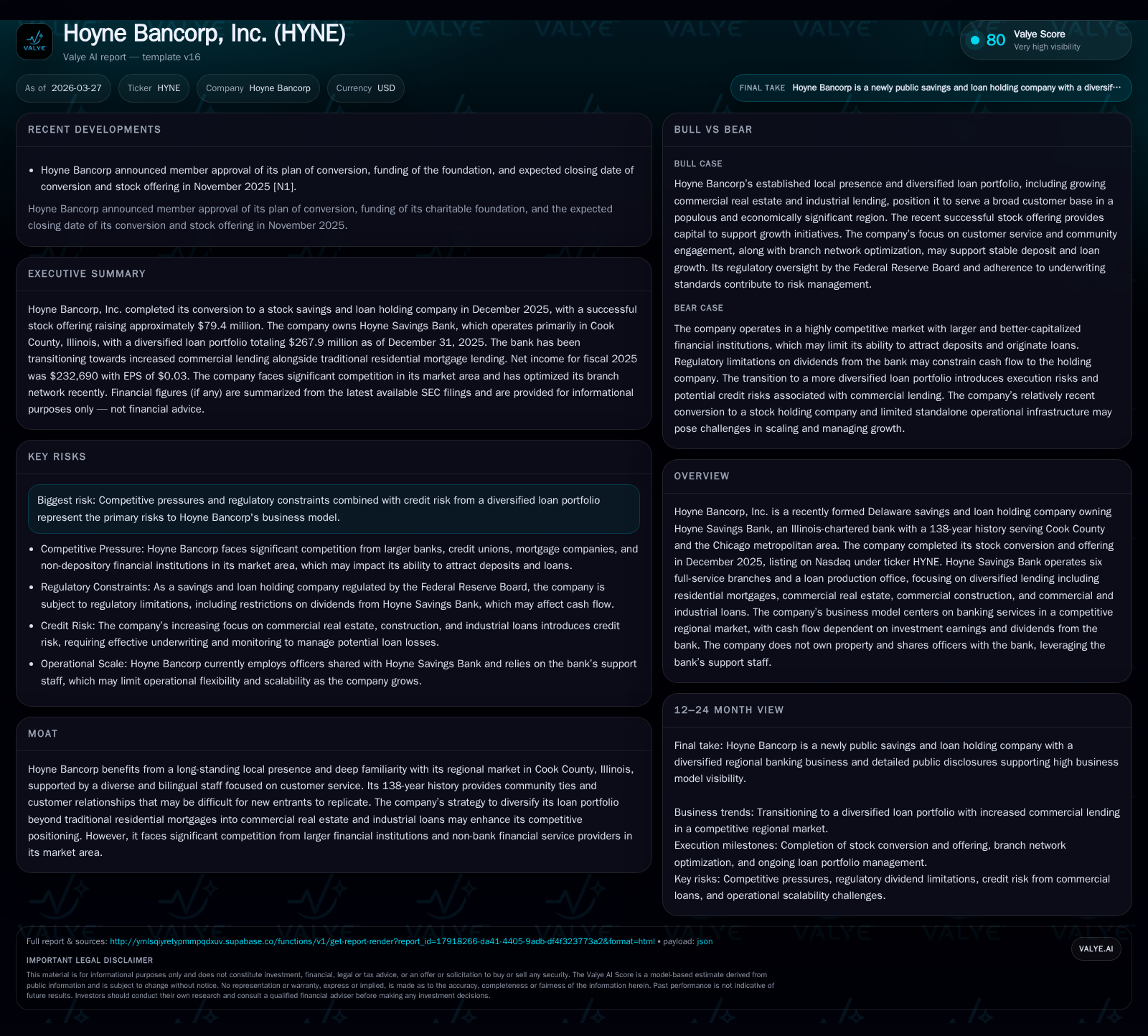
Founded in 1887, Hoyne Bancorp recently completed its stock conversion, creating a holding structure centered around Hoyne Savings Bank. The company has leveraged its long-standing community connections to maintain steady growth historically but now faces intensified competition and regulatory scrutiny. Its strategic shift towards expanded commercial real estate, construction, and industrial loans reflects an effort to diversify risk and capture new revenue streams. Monitoring capital adequacy, asset quality, and loan growth will be critical as Hoyne adapts to its new public ownership and competitive pressures.
From Legacy to Public Listing: Historical Growth and Drivers
Historical performance (annual)
| FY |
|---|
| 2025 |
Source: SEC companyfacts cache [F1].
Hoyne Bancorp, Inc., incorporated in Delaware in June 2025, marks the latest chapter in the nearly century-and-a-half history of Hoyne Savings Bank—an Illinois-chartered institution founded in 1887 serving Chicago's Cook County area. In December 2025, Hoyne completed its stock conversion from a mutual holding structure to a savings and loan holding company listed on Nasdaq under ticker HYNE. This transition involved issuing approximately 7.9 million shares at $10 each, generating gross proceeds of $79.4 million that bolster the company’s equity base [S1].
Legacy growth for Hoyne Savings Bank had been measured but consistent, leveraging long-standing community ties supported by bilingual staff dedicated to local customer service. As of December 31, 2025, Hoyne’s total assets stood near $489 million with stockholders’ equity over $161 million [S1],[F1]. This equity foundation supports a loan portfolio primarily concentrated in residential mortgages throughout its regional footprint but is evolving substantially.
Diversification in Lending: Commercial Real Estate and Industrial Loan Expansion
The year-end 2025 figures display a noticeable pivot from pure residential mortgage lending toward a more balanced composition that includes significant commercial exposure:
| Loan Category | Amount (USD '000) | % of Total Loans |
|---|---|---|
| One to Four Residential | $109,123 | 39.5% |
| Commercial Real Estate | $76,338 | 27.6% |
| Commercial Construction | $46,124 | 16.7% |
| Commercial & Industrial | $23,169 | 8.4% |
| Home Equity Lines | $5,431 | 1.9% |
This breakdown reflects a strategic emphasis on income-producing commercial real estate such as retail and multifamily properties alongside construction projects that support regional development [S18],[S24]. The average commercial loan size approximates $1.1 million and credit policies require underwriting based on debt coverage ratios and borrower business performance metrics [S26].
While diversification enhances earning potential by expanding interest income sources beyond traditional fixed-rate residential products, it introduces complexity inherent in underwriting commercial risk—such as dependence on project cash flows and collateral valuations sensitive to economic cycles [S20]. However, Hoyne has prudently maintained zero delinquencies over 30 days within these commercial categories as of year-end 2025 [S20], which suggests cautious risk management amid the expansion.
Capital Structure and Dividend Strategy Post-Conversion
Post-conversion, Hoyne Bancorp's capital framework is underpinned by the recent equity infusion from its public offering without initiating any buybacks so far [S1],[S4],[F1]. The savings bank subsidiary holds regulatory capital comfortably above minimum requirements including Tier 1 leverage ratios near or exceeding the federally set thresholds for community banks of similar size (assets below $10 billion) [S16].
Deposits constitute approximately two-thirds of funding sources with nearly half being core deposits—non-certificate deposit accounts that tend to be stable—solidifying liquidity position [S6],[S16]. Dividend payments from the bank are subject to Illinois state regulations limiting distributions; thus, while these dividends are principal cash inflows for the holding company, pacing remains conservative affecting immediate shareholder returns [S16].
Regulatory Landscape and Risk Factors Impacting Future Growth
Operating as an Illinois-chartered savings institution under Federal Reserve Board supervision subjects Hoyne Bancorp to stringent capital requirements and dividend restrictions designed for safety and soundness but which restrict operational flexibility during growth phases [S3],[S28].
Competitive pressures loom given proximity to major national banks and rising fintech entrants capturing market share through digital offerings with scale advantages—a challenge for a regional bank emphasizing branch network service and localized relationships.
Credit risk remains elevated due to loan portfolio diversification into segments inherently less secure than traditional residential mortgages including construction loans reliant on successful project completion and commercial loans dependent on borrower performance exposed to macroeconomic shifts [S28],[S20].
Asset Quality and Credit Loss Provisions: Managing Emerging Credit Risks
Hoyne employs the Current Expected Credit Loss (CECL) standard with quarterly reviews incorporating macroeconomic forecasts alongside historical loss experience tailored by loan segment characteristics [S8],[S17],[S19]. The allowance for credit losses was approximately $2.68 million against net loans of about $268 million at December 31, reflecting roughly one percent coverage commensurate with conservative loss expectations for the diversified portfolio.
Non-performing assets remain low at about 0.24% of total assets but have risen compared with prior year levels due largely to real estate owned from foreclosed branch properties totaling around $729,000—a reflection of strategic branch consolidations rather than core operational credit deterioration [S8],[S27]. Ongoing monitoring will be essential given the latent risks tied especially to construction and commercial real estate sectors.
Forecast Indicators and Key Milestones: What to Monitor Next
Although explicit forward guidance is absent, key indicators include:
- Consistency in loan growth particularly within commercial real estate and industrial sectors without degraded underwriting standards.
- Deposit trends maintaining or growing core deposit ratios that preserve stable funding.
- Regulatory developments impacting dividend capacity or capital requirements.
- Trends in non-performing assets relative to changing economic conditions locally.
- Potential acquisitions or expansion activities leveraging the new holding company structure. These milestones will collectively inform assessments of whether Hoyne’s strategic pivot attains sustainable growth margins amid competitive headwinds.
Cash Flow Dynamics and Returns on Equity in Early Public Period
The initial post-conversion period reveals modest profitability consistent with early-stage public entities undergoing business model adjustments. Net income for fiscal year ending December 31, 2025 registered at approximately $233 thousand yielding an ROE near 0.1%, signaling nascent earnings performance relative to equity employed [F1].
Free cash flow stands positive at nearly $202 thousand indicating operational cash generation sufficient for incremental reinvestment though no dividend payouts or share repurchases have yet been undertaken reflecting retention for growth capital or balance sheet strengthening needs [F1],[S4].
Disclaimer: This analysis is based solely on publicly filed reports up to March 2026 without including speculative forecasts or investment recommendations. It aims to provide an informed overview grounded in Hoyne Bancorp’s financial disclosures.
Disclaimer: This is research-only, informational analysis and not investment advice. It may include AI-generated interpretation and general industry context. Always verify important details using primary sources.

Comments