
National Bankshares’ Turnaround: Analyzing the Surge in Profitability and Strategic Expansion
National Bankshares reversed a challenging earnings trend through strategic acquisition, credit discipline, and capital management amid competitive Virginia banking markets.
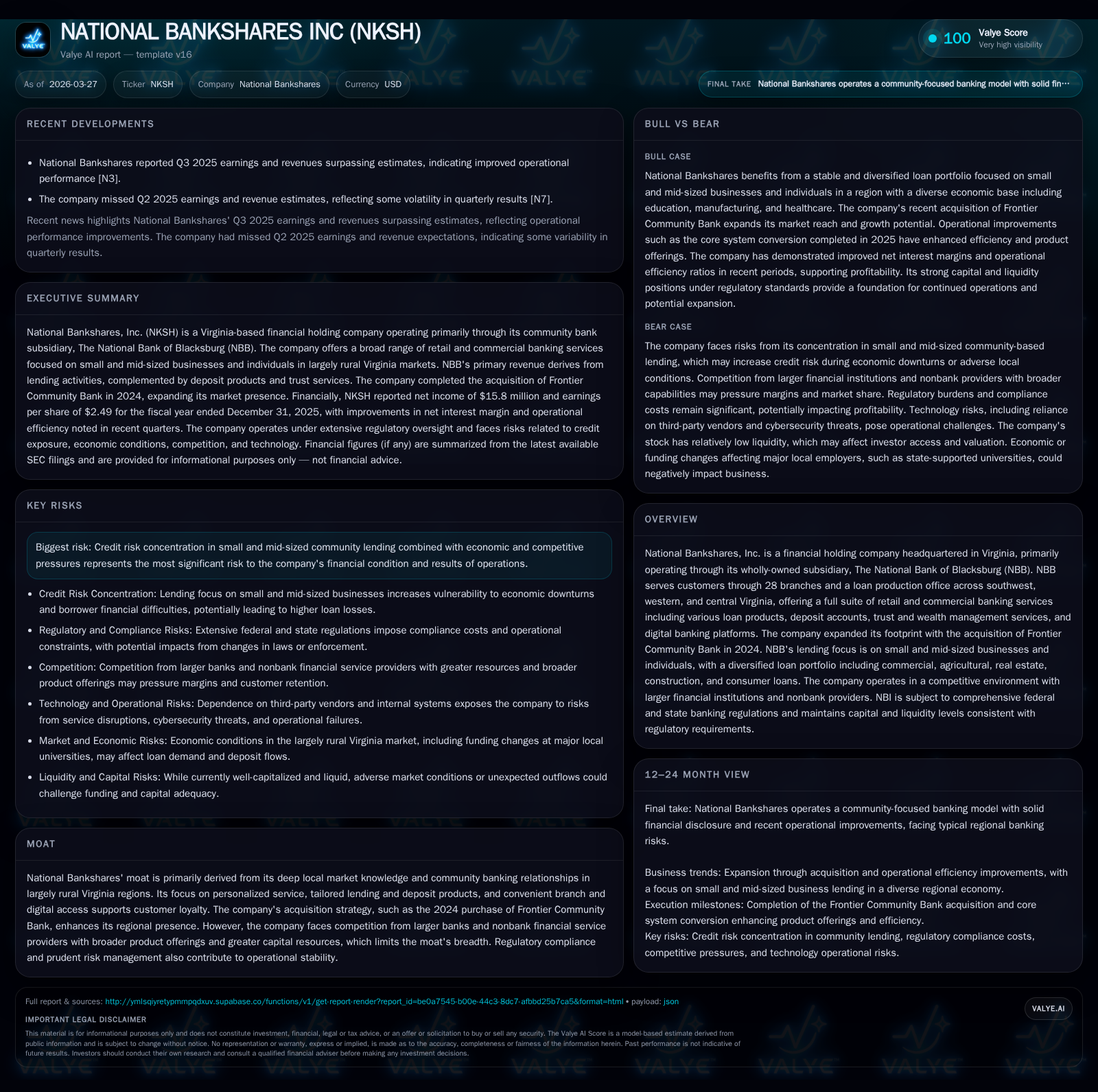
National Bankshares, Inc. reported a net income more than doubling in FY2025 compared to FY2024, driven largely by its 2024 acquisition of Frontier Community Bank and improved operating efficiencies. The company’s loan portfolio remains focused on small and mid-sized businesses across rural and regional Virginia markets, with robust credit risk controls complemented by a recently appointed Chief Lending Officer emphasizing lending quality. Liquidity and capital metrics remain strong with a well-capitalized balance sheet supporting deposit growth despite some contraction post-acquisition. Dividend payments remain stable, though share buybacks have paused amid income volatility. Going forward, monitoring credit loss allowance adequacy and local economic conditions will be crucial to sustaining this turnaround trajectory.
Historical Performance: Earnings Revival and Operating Cash Flow Dynamics
National Bankshares experienced pronounced earnings volatility over recent years with a nadir in FY2024 followed by a sharp recovery in FY2025. Net income increased from $7.62 million in FY2024 to $15.83 million in FY2025, representing a robust year-over-year increase of approximately 107.6%, rebounding from prior challenges exacerbated by integration expenses related to the Frontier Community Bank acquisition completed mid-2024 [F1]. This reversal underscores improved operational efficiency and revenue synergies emerging post-acquisition.
Operating cash flow mirrored this improvement, nearly doubling from $9.44 million in FY2024 to $17.89 million in FY2025, highlighting robust cash conversion from core banking activities amid stable capex spending that rose moderately by 18.6% year-on-year to support branch upgrades and technology enhancements [F1]. The firm reported an approximate return on equity of 8.6% for FY2025 — indicative of recovering profitability relative to its equity base that grew via retained earnings and acquisition-related equity issuance.
Historical performance (annual)
| FY | Net ($mm) | CFO ($mm) | Capex ($) | Net YoY |
|---|---|---|---|---|
| 2025 | 16 | 18 | +107.6% | |
| 2024 | 8 | 9 | -51.4% | |
| 2023 | 16 | 16 | 1492000 | -39.5% |
| 2022 | 26 | 30 | 1258000 |
Source: SEC companyfacts cache [F1].
Capital returns and efficiency (annual)
| FY | Div ($mm) | Buybacks ($mm) | FCF ($mm) |
|---|---|---|---|
| 2025 | 10 | ||
| 2024 | 9 | ||
| 2023 | 15 | 0 | 14 |
| 2022 | 9 | 6 | 28 |
Source: SEC companyfacts cache [F1].
*Capex YoY computed between FY23 vs FY22 only since no FY24 capex data available.
Loan Portfolio Composition and Credit Risk Management in a Rural Market
National Bankshares' loan portfolio is dominated by lending to small- and mid-sized businesses alongside residential mortgages — characteristics typical of community banks servicing rural Virginia regions [S1]. The Company underwrites commercial loans concentrated on sectors including agriculture and light manufacturing representative of its locales such as Giles County’s Celanese facility or Pulaski County’s Volvo plant [S18]. Given the intrinsic capital limitations of smaller borrowers and localized economic sensitivities inherent in rural areas reliant on manufacturing and universities like Virginia Tech or Radford University in Montgomery County, elevated credit risk is a persistent challenge [S8,S20].
Eighty-three percent of loans are secured by real estate collateral located predominantly within the Company’s footprint — exposing NKSH to regional real estate market fluctuations [S8]. While housing values have been relatively stable regionally post-pandemic compared to national trends, any localized downturn could impair collateral value adversely.
The allowance for credit losses (ACLL) remained steady at approximately $10.5 million as of September 30, 2025 representing about 1.04% of total loans net of fees — consistent with prior periods but with an ACLL coverage ratio exceeding fourfold on nonperforming loans (over ~450%), suggesting conservative provisioning given observed asset quality metrics [S22]. This prudent reserve stance aims to mitigate potential default risks especially for loans originated post-pandemic that may have incomplete economic cycle experience.
Expansion via Acquisition: Frontier Community Bank’s Integration Impact
The June 1st, 2024 acquisition of Frontier Community Bank (FCB), itself a Virginia state-chartered institution headquartered in Waynesboro with multiple branches nearby NBB’s existing network,[S1,S18] substantially enhanced National Bankshares’ regional market presence across southwest and central Virginia corridors.
Post-acquisition results incorporate FCB's loan assets and deposit base starting mid-2024 adding geographic breadth balanced across communities anchored by major universities such as University of Virginia near Charlottesville — expanding NBB's serviceable market beyond its historical strongholds.[S18]
The integration also facilitated operational synergies through overlapping infrastructure rationalization including shared ATM networks and cross-selling wealth management services via National Bankshares Financial Services subsidiary.[S1]
Importantly, the acquisition enabled additional branch openings including a notable new Roanoke location rolled out during early 2025 alongside renovations at Lynchburg address points — efforts signaling ongoing investment in physical accessibility notwithstanding digital banking service capabilities.[S1]
Current Capital Base, Liquidity Position, and Funding Strategy
NKSH maintains strong liquidity buffers reflected in its loan-to-deposit ratio standing around the internally targeted ~65%, which is comfortably below industry norms allowing flexibility for loan demand fluctuations without overreliance on wholesale funding.[S4,S9]
As of late Q3-2025 balances indicated approximately $40 million drawn FHLB advances with an additional substantial capacity (~$260 million) available alongside nearly $188 million borrowing headroom at the Federal Reserve Discount Window — vehicle security is supported by pledged securities mitigating counterparty risk concerns.[S5]
Common Equity Tier I (CET1) capital ratio was robust at approximately 16.55% at September-end reflecting strong capitalization well above regulatory minimums required for “well-capitalized” designation which allows full access to purchased deposits or critical funding lines without limitations.[S6]
Securities portfolios are actively managed with laddered maturities aligned with expected funding needs optimizing yield while preserving liquidity—a nuanced balancing act given rising interest rate environments depress unrealized gains but support net interest margins where managed effectively.[S6,S9]
Stress testing under contingency plans confirms adequacy under hypothetical deposit runoff or liquidity shock scenarios providing confidence around sound asset-liability management.[S4]
Dividend Policy and Shareholder Returns: Stability Amid Fluctuations
Despite earnings swings over recent years linked partially to acquisition-related costs and volatile economic conditions impacting borrower performance,[F1] National Bankshares maintained relatively stable dividend payouts totaling approximately $9.6 million paid out in FY2025 comparable to prior years [$9.26M FY24] — reflecting commitment to returning capital while preserving earnings reinvestment capacity.
Conversely share repurchases have been suspended since fiscal year ended December 31st, 2022 after executing substantial buybacks totaling over $6 million previously.[F1] This cessation indicates disciplined capital deployment prioritizing balance sheet strength during uncertain macroeconomic conditions rather than opportunistic buybacks.
With an approximate return on equity (ROE) near 8.6% based on latest net income against equity base,[F1] NKSH appears positioned cautiously yet steadily improving shareholder returns aligned with community bank sector norms where ROEs often hover mid-single digits.
Regulatory Environment and Risk Factors Influencing Future Prospects
Operating within a highly regulated regime that includes OCC federal oversight as well as state banking laws restricts operational flexibility but enforces prudence.[S13,S21]
Key regulatory pressures involve capital conservation buffers limiting dividend distributions absent sufficient retained earnings,[S21] mortgage lending compliance including anti-discrimination standards,[S21] as well as evolving climate change risk assessment expectations potentially impacting collateral valuations or requiring additional disclosures.[S8]
Credit risk concentration toward smaller businesses susceptible to economic volatilities is a persistent challenge addressed through ongoing allowance for credit losses (ACLL) calibrations which require complex subjective judgments incorporating historical loss data and forward-looking local economic forecasts under CECL methodology.[S8,S17]
Failure to maintain adequate ACLL could result in adverse earnings impacts or regulatory actions.[S8] Moreover competitive dynamics from larger banks or fintech entrants applying broader product suites compel continuous innovation while deepening relationship banking leveraging local market knowledge remains NKSH’s core differentiation.[S20]
Leadership Shift in Credit Strategy: Implications for Loan Growth Trajectory
The appointment of Jason Pospichal as Executive Vice President and Chief Lending Officer effective March 25th signals strategic focus on strengthening underwriting rigor alongside targeted loan growth initiatives post-FCB integration.[S3]
Pospichal's experience presumably bolsters capabilities around portfolio diversification balancing risk through more granular borrower segmentation or introducing layered credit approval frameworks calibrated for rural market nuances.
Enhanced leadership focus suggests potential moderation or refinement of the modest organic loan growth (~3%) realized organically post-acquisition amid rising rate environments presenting borrower affordability constraints.[S22,S12]
This function will be pivotal as seasoning acquired loan assets' performance underwrites future risk assessments influencing provisioning levels impacting reported results.
Outlook and Key Indicators to Monitor Beyond FY2025
While explicit forward financial guidance remains undisclosed there are several key indicators warranting surveillance:
- Evolution of the allowance for credit losses relative to actual charge-offs especially among recently originated commercial/agricultural segments lacking full business cycle experience[S2,S22];
- Stability or growth trends in deposit balances particularly following integration effects possibly influenced by competitor moves or changing interest rate dynamics[S2];
- Progression toward realizing cost synergies from FCB acquisition while managing branch network expansion plans including digital channel enhancements[S1];
- Local economic developments affecting major employers like Virginia Tech or Radford University impacting borrower health;
- Regulatory developments surrounding climate-related financial disclosures that may increase compliance costs or asset valuation uncertainties[S8];
- Monitoring changes in interest rate environment affecting net interest margin compression risks versus asset repricing opportunities[S9].
Overall National Bankshares is positioned with sound fundamentals post-turnaround but must navigate inherently volatile community banking risks prudently amid slower rural economic growth trajectories.
Disclaimer: This report is based solely on publicly available information including SEC filings up to March 27th, 2026 ([F1],[S#]) without reliance on nonpublic data or proprietary forecasts. It does not constitute investment advice but aims to provide informed analysis grounded strictly on documented evidence.
Disclaimer: This is research-only, informational analysis and not investment advice. It may include AI-generated interpretation and general industry context. Always verify important details using primary sources.

Comments