
Tenon Medical Navigates Early Growth Amid Persistent Losses and Nasdaq Compliance Challenges
Tenon Medical’s innovative SI joint fusion devices target a growing but competitive market, balancing clinical progress with financial and regulatory pressures.
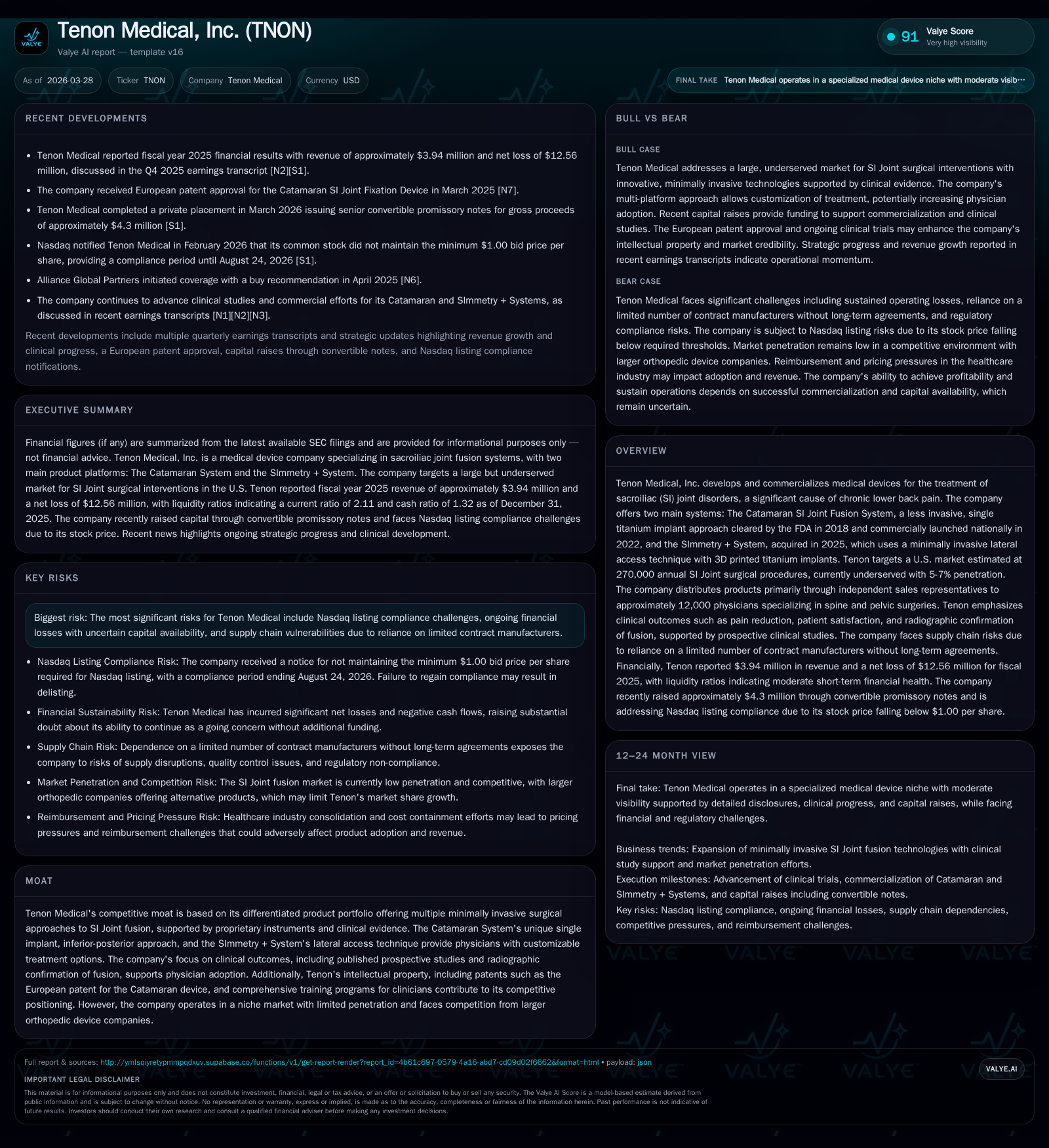
Tenon Medical, Inc. develops minimally invasive implants for sacroiliac joint disorders with a focus on the U.S. market. Following FDA clearance in 2018 and a national launch of its Catamaran system in 2022, the company expanded its portfolio through the 2025 acquisition of the SImmetry + system. Revenue grew over 20% in fiscal 2025 to $3.94 million, yet the company continues to report significant operating losses driven by commercialization and R&D investments. Recent convertible note financing provides capital but adds financial constraints amid Nasdaq bid price compliance concerns and ongoing regulatory risks.
Company Background and Product Overview
Tenon Medical, Inc., headquartered in Los Gatos, California since mid-2021, focuses on medical devices for treating sacroiliac (SI) joint disorders—a contributor to chronic lower back pain [S1]. Its flagship product, the Catamaran SI Joint Fusion System, received FDA clearance in 2018 and was nationally launched in October 2022. The device uses a single titanium implant delivered via a minimally invasive inferior-posterior approach designed to simplify SI joint fusion procedures.
In August 2025, Tenon acquired assets from SiVantage/SIMPL Medical including the SImmetry + SI Joint Fusion System [S1]. This lateral access system employs orthopedic fusion principles such as joint decortication and bone graft placement combined with rigid fixation.
Market Context
The U.S. market for SI Joint fusion is estimated at roughly 270,000 eligible annual procedures . However, procedural penetration remains low at approximately 5-7%, highlighting adoption challenges during competition.
Tenon targets approximately 12,000 specialized spine and pelvic surgeons via an independent sales representative model supported by clinician education programs aimed at primary SI Joint procedures, revisions, and adjunctive fusion applications [S1].
Historical Financial Performance
The following table summarizes key financial metrics over the past four fiscal years ([F1]):
Historical performance (annual)
| FY | Rev ($mm) | Net ($mm) | CFO ($mm) | OpInc ($mm) | Rev YoY | Net YoY |
|---|---|---|---|---|---|---|
| 2025 | 4 | -13 | -11 | -13 | +20.4% | +8.2% |
| 2024 | 3 | -14 | -10 | -14 | +11.9% | +12.2% |
| 2023 | 3 | -16 | -12 | -16 | +323.7% | +17.6% |
| 2022 | 1 | -19 | -12 | -19 |
Source: SEC companyfacts cache [F1].
Capital returns and efficiency (annual)
| FY | FCF ($mm) | ROE% |
|---|---|---|
| 2025 | -11 | -249.1 |
| 2024 | -10 | -229.0 |
| 2023 | -2002.7 | |
| 2022 | -13 | -302.6 |
Source: SEC companyfacts cache [F1].
Revenue grew over twentyfold from FY22 through FY25 as commercialization progressed; however, operating losses remain substantial despite modest improvement year-over-year.
Operating cash flow remains negative with free cash flow approximating -$11 million in FY25 after accounting for capital expenditures [F1]. This reflects continued investment into R&D and commercial infrastructure.
Capital Structure and Liquidity Position
At December 31, 2025, Tenon held $3.76 million in cash and equivalents versus current liabilities of $3.21 million, yielding a current ratio above two [F1]. Equity declined from nearly $6 million at the end of FY24 to just over $5 million at FY25 close due largely to cumulative net losses [F1].
In March 2026, Tenon issued senior convertible promissory notes with an aggregate principal amount of approximately $5.2 million and gross proceeds near $4.3 million after discounts [S1], [S20]. These notes mature September 11, with an optional extension to December and include conversion rights into common stock at discounted prices plus incremental interest if extended.
The financing imposes covenants restricting further debt incurrence or share repurchases, reflecting limited operational flexibility amid capital constraints [S20]. WallachBeth Capital LLC acted as placement agent earning a ~7% fee on proceeds.
Regulatory Environment and Risks
Tenon's products are regulated under FDA's medical device framework with clearance obtained via section 510(k) pathways [S1]. Marketing activities must adhere strictly to cleared indications; promotion of off-label uses could trigger enforcement actions including fines or warning letters .
The company engages clinicians through consulting agreements while ensuring compliance with federal healthcare fraud and abuse laws such as anti-kickback statutes and false claims provisions; violations risk severe penalties including exclusion from federal health programs .
Manufacturing relies entirely on contract manufacturers who have not yet undergone FDA inspection as of filing dates; this dependence introduces supply chain risk [S13], [S21].
Product liability exposure is inherent given surgical implant use; insurance coverage exists but may not fully mitigate potential claim costs or reputational damage [S9].
Future Growth Prospects
Growth opportunities stem from expanding adoption within the underpenetrated SI joint fusion market segment (~5-7% penetration) . Tenon's multi-platform approach combining Catamaran’s single implant technology with SImmetry + lateral access system aims to address diverse clinical needs.
Additional drivers include ongoing clinician education efforts, prospective clinical studies validating patient outcomes, intellectual property protections such as European patents for Catamaran technology, and potential reimbursement enhancements recognizing cost-effectiveness.
However, competitive pressures from larger orthopedic device companies along with pricing challenges due to healthcare provider consolidation pose headwinds [S15]. Regulatory compliance demands further constrain promotional agility.
Capital limitations restrict aggressive scaling of sales forces or R&D without sustained funding or improved cash flows.
Milestones and Watchpoints
Key developments to monitor include:
- Progress toward Nasdaq minimum bid price compliance by August 24, 2026 deadline to avoid delisting risk [S20].
- Commercial integration and sales traction of the SImmetry + system post-acquisition.
- Publication of clinical data supporting efficacy versus competitors impacting payer coverage.
- Outcomes of FDA inspections for contract manufacturing partners affecting supply stability.
- Potential future capital raises or strategic partnerships alleviating liquidity pressures.
Capital Allocation and Returns Analysis
Tenon has not reported dividends or share repurchases; capital allocation prioritizes reinvestment into product development and commercialization consistent with early-stage medtech profiles [S1].
Based on FY25 data, approximate return on equity is deeply negative around -249%, reflecting ongoing unprofitability during growth phase [F1]. Negative free cash flow underscores continued heavy investment commitments without current operating profitability.
Conclusion: Innovation Amid Financial Challenges
Tenon Medical combines clinical innovation addressing a relevant spine surgery niche with differentiated technology platforms rooted in recognized orthopedic principles. Nonetheless, significant ongoing losses paired with constrained liquidity buffered temporarily by convertible debt issuance highlight financial fragility amid Nasdaq compliance pressures. Operating within a complex regulatory environment alongside strong competition necessitates sustained capital availability for commercialization execution and regulatory adherence. How Tenon balances surgeon adoption growth against cost management will be pivotal for transitioning early revenue momentum into sustainable profitability over time.
This report compiles publicly available information without providing investment recommendations or forecasts beyond documented facts.
Disclaimer: This is research-only, informational analysis and not investment advice. It may include AI-generated interpretation and general industry context. Always verify important details using primary sources.

Comments