
Macy’s Inc. Financial Pulse: Growth Trends and Capital Priorities
Analyzing Macy’s recent financial trajectory, operational improvements, and capital deployment strategies amid an evolving retail landscape.
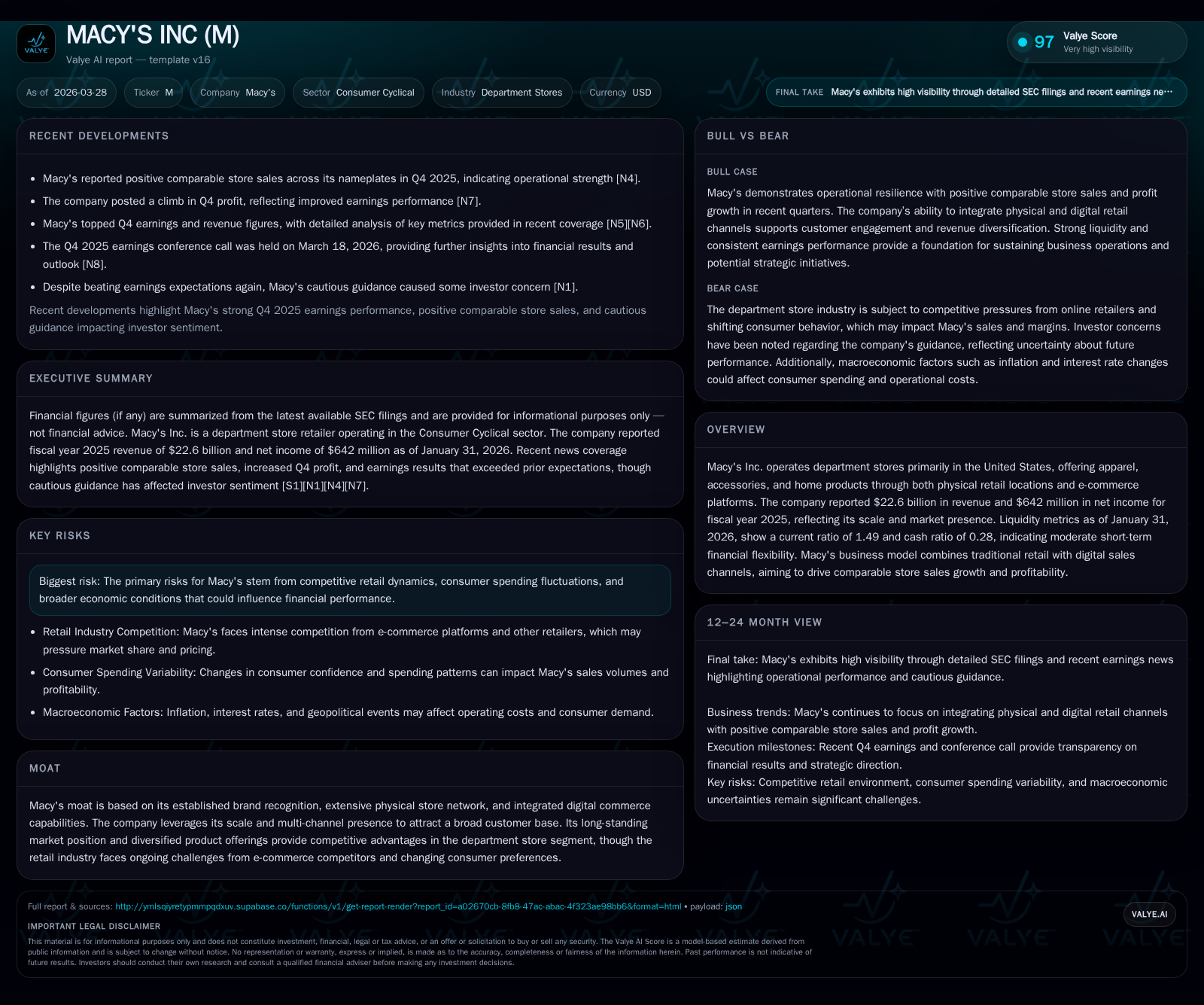
Macy’s Inc. delivered a modest revenue contraction paired with solid earnings growth for fiscal year 2025, underpinned by improved operating leverage and disciplined cost management. The company’s established omnichannel presence supports stable comparable store sales despite broader retail headwinds. Looking ahead, Macy’s expects steady comp growth and digital channel expansion while maintaining a strong free cash flow profile that enables ongoing dividends and accelerated share buybacks. Governance changes signal strategic board streamlining, but risks from competitive dynamics and economic variability remain tangible.
Historical Performance and Key Drivers of Profitability
Macy's Inc. reported a nuanced FY2025 performance characterized by a slight top-line contraction alongside notable profit expansion. Revenue ended at $22.62 billion, down 1.7% compared to $23.01 billion in FY2024 [F1]. Despite this dip, operating income increased substantially by 13.3%, climbing from $909 million to $1.03 billion year-over-year. Net income rose 10.3% to $642 million from the prior year’s $582 million [F1]. This earnings momentum was driven largely by improved operating leverage—where cost efficiencies more than offset the modest revenue decline.
Operating cash flow also strengthened, reaching $1.43 billion (+11.9% YoY), supported by tighter working capital management, even as capital expenditures dropped 28% to $373 million facilitating free cash flow expansion [F1]. The net income margin improvement reflected enhanced gross margin management and significant SG&A efficiency initiatives that bolstered profitability notwithstanding subdued revenue growth.
Historical performance (annual)
| FY | Rev ($bn) | Net ($mm) | CFO ($mm) | OpInc ($mm) | Rev YoY | Net YoY |
|---|---|---|---|---|---|---|
| 2025 | 22.6 | 642 | 1430 | 1030 | -1.7% | +10.3% |
| 2024 | 23.0 | 582 | 1278 | 909 | -3.6% | +454.3% |
| 2023 | 23.9 | 105 | 1305 | 382 | -91.1% | |
| 2022 | 1177 | 1615 | 1730 |
Source: SEC companyfacts cache [F1].
Capital returns and efficiency (annual)
| FY | Div ($mm) | Buybacks ($mm) | FCF ($mm) |
|---|---|---|---|
| 2025 | 197 | 250 | 1057 |
| 2024 | 192 | 1 | 760 |
| 2023 | 181 | 38 | 674 |
| 2022 | 173 | 601 | 727 |
Source: SEC companyfacts cache [F1].
Revenue reflects a gradual decline since FY2023 while operating income showed marked improvement starting FY2024.
Revenue Dynamics: Growth Plateau and Its Underlying Factors
The slight revenue slide over recent years stems primarily from sector-wide challenges facing department stores amid changing consumer behavior and e-commerce competition [N2],[N4]. Macy’s has managed these dynamics through robust comparable store sales (comp sales) growth across its nameplates as detailed in Q4 reports, which partially offset declines in non-comparable or slower-growing segments [N2,N4,F1]. This performance evidences effective omnichannel integration effects wherein Macy's leverages physical stores as experiential hubs complemented by e-commerce platforms.
However, the plateaued top line signals underlying headwinds: traffic softness in brick-and-mortar outlets remains an industry-wide challenge despite gradual recovery in certain markets, while channel mix shifts increasingly favor digital sales channels demanding continuous platform investment [N2,N4]. Macy’s ability to sustain comp sales growth amid such pressures demonstrates resilience but also highlights the fragility of top-line momentum given persistent retail disruption risks.
Operational Leverage Fueling Earnings Expansion
Operational gains represent the centerpiece of Macy's earnings expansion narrative. The company achieved approximately 13% operating income growth despite flat revenues due to increased SG&A efficiency, refined inventory turnover, and better gross margin management strategies articulated during earnings calls [N1,S3,F1]. Supply chain optimizations combined with targeted expense discipline have reduced structural costs enabling higher profitability on stable revenues.
Sector terms such as ‘operating leverage’ aptly describe Macy's capacity to translate static sales figures into rising profits through enhanced cost control frameworks and productivity improvements at scale—reaffirmed by adjusted EBITDA margin improvements detailed in company disclosures [N1,S3]. This approach mitigates some top-line vulnerabilities while reinforcing fundamental business health.
Future Outlook: Growth Catalysts and Headwinds
Looking forward into fiscal year 2026, Macy's projects continued comparable store sales growth supported by accelerated channel shift toward digital platforms and further omnichannel synergies highlighted in recent guidance release [N1,N13,S3]. The company indicates strategic digital investments will compound gains alongside expectations of foot traffic normalization post-COVID disruptions.
However, caution prevails stemming from ongoing macroeconomic uncertainty—including inflationary pressures and interest rate tightening—that could dampen consumer discretionary spending patterns vital to Macy’s core apparel and home goods segments [N1,N13,S3]. Moreover, competitive intensity remains high with pure-play e-commerce retailers continuing to vie aggressively for market share.
Capital Allocation Focus: Dividends, Buybacks, and Cash Flow Generation
Capital allocation forms a critical pillar of Macy’s financial strategy manifested through consistent dividend payments coupled with a significant buyback acceleration during FY2025 . Dividends paid rose slightly to $197 million while share repurchases surged markedly from $1 million in FY2024 to $250 million in FY2025 reflecting confidence backed by robust free cash flow generation (~$1.06 billion after capex) [F1].
This enhanced shareholder return profile aligns with a reported approximate ROE of 13.2%, illustrating effective capital redeployment fuelled by operational cash flow strength and moderate reinvestment levels [F1]. The approach balances sustaining liquidity with rewarding shareholders amid prevailing retail uncertainties.
Corporate Governance Shifts and Executive Leadership Context
Recent corporate governance developments include planned board member retirements—notably Richard Clark, Douglas W. Sesler, and Tracey Zhen—with the Board approved to reduce overall size from thirteen to ten members effective at the May 2026 Annual Meeting [S3,S16]. These departures are explicitly stated as non-contentious decisions unrelated to operational disputes or policy disagreements.
The streamlined board composition is intended to enhance decision-making agility aligned with strategic priorities without indicating substantive shifts in executive leadership or company direction beyond reported facts.
Key Risks Shaping Strategic Execution
Macy's public SEC filings delineate comprehensive risk factors emphasizing competitive retail disruption threats including e-commerce encroachment, evolving consumer sentiment volatility tied closely to economic cycle fluctuations, inflationary cost impacts on margins, potential regulatory changes affecting labor or trade practices, and exposure to inventory obsolescence risks inherent in fashion merchandising cycles [S4,S5,S6].
These calibrated risk disclosures underscore operational execution challenges complicating Macy’s efforts to sustain profitable growth while adapting business models responsive to shifting market realities.
Investor Takeaways: Financial Health and Market Position
In summary, Macy’s maintains a formidable brand moat founded on a broad physical footprint integrated well with expanding ecommerce operations providing multi-channel penetration advantages crucial for sustained relevance within department stores [N1,F1,S3]. Financially resilient metrics such as rising net income margins along with stronger free cash flow conversion underpin its current health despite nominal revenue headwinds.
Yet prudent investor analysis should weigh these strengths against cautious guidance tone reflecting external uncertainties around consumer behavior variability and macroeconomic pressures—factors likely shaping near-term performance trajectories without clear visibility on magnitude or duration.
This analysis synthesizes publicly disclosed financial results alongside regulatory filings and recent news coverage; it is intended solely for informational purposes without offering investment advice or recommendations.
Disclaimer: This is research-only, informational analysis and not investment advice. It may include AI-generated interpretation and general industry context. Always verify important details using primary sources.

Comments