
Serina Therapeutics’ Clinical Trials and Capital Moves Signal Next Phase in Parkinson’s Fight
Serina Therapeutics progresses SER-252 through critical regulatory milestones while bolstering capital resources amid operational and clinical challenges.
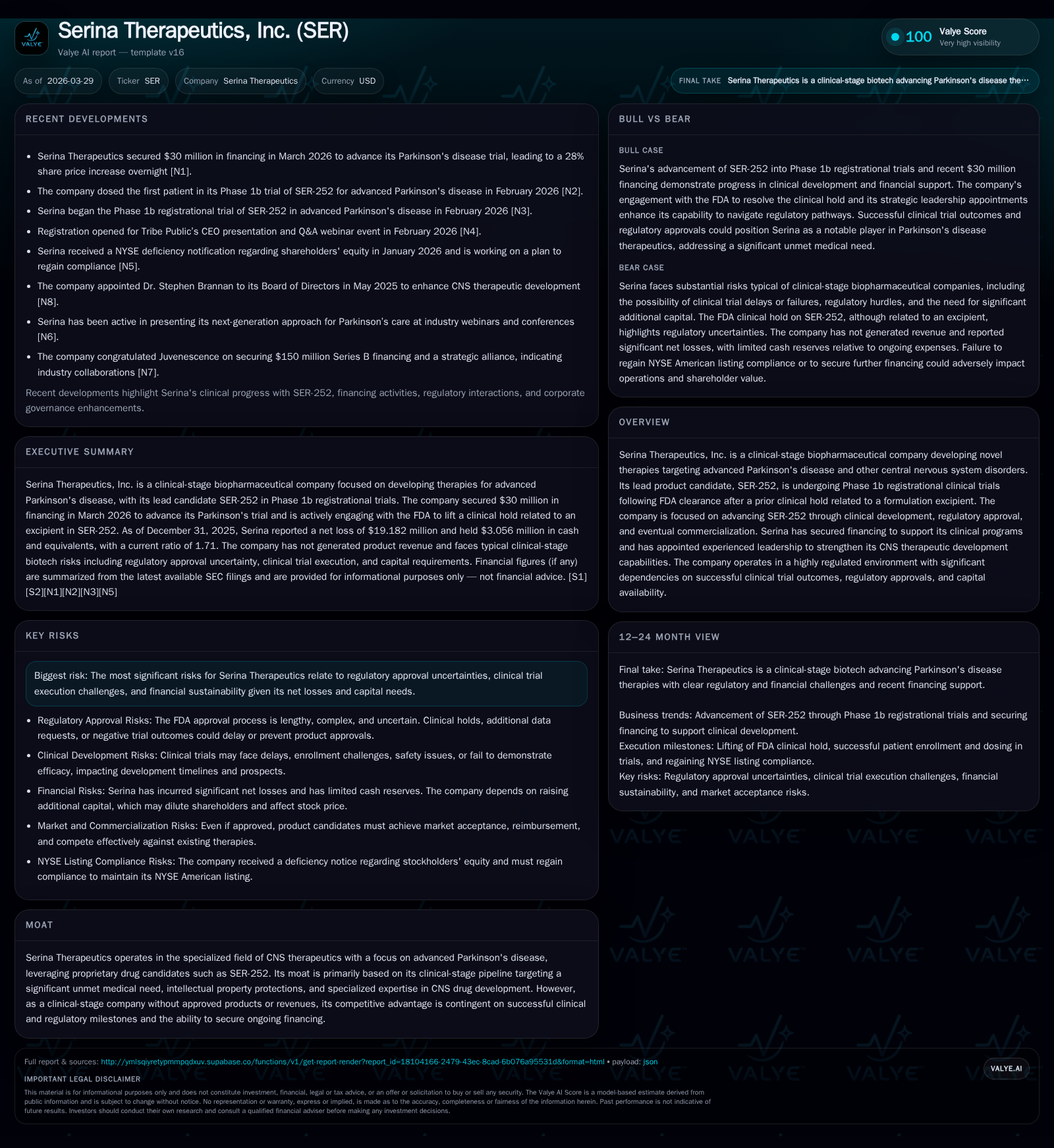
Serina Therapeutics, a clinical-stage biopharma company targeting advanced Parkinson’s disease, recently secured FDA clearance to resume its pivotal Phase 1b trial for its lead asset, SER-252, following a clinical hold related to an excipient. The company has ramped up clinical and regulatory activities in early 2026, including dosing the first patient in this registrational study. Concurrently, Serina closed a $30 million financing round to fund continued development and operations. Despite intensifying operating losses and significant cash burn, Serina’s strategic steps position it at an inflection point for unlocking future value contingent on successful trial results and ongoing capital management.
Foundations of Serina’s Clinical Growth Trajectory
Serina Therapeutics’ financials from FY2022 through FY2025 illustrate increasing operating losses aligned with advancing its lead program SER-252 for advanced Parkinson's disease [F1].
In FY2025, operating income declined by approximately 40.9% year-over-year to a loss of $24.0 million from $17.0 million in FY2024 [F1]. Net income loss widened by 72.2%, increasing from $11.1 million in FY2024 to $19.2 million in FY2025 [F1]. This trend reflects escalating R&D expenses consistent with initiating registrational trials.
Operating cash flow remained deeply negative at nearly -$17.9 million in FY2025, with minimal capital expenditures ($59k), indicating that cash burn is primarily driven by research activities rather than fixed asset investments [F1].
A clinical hold announced by the FDA in November 2025 related to an excipient formulation delayed progress but did not concern the active drug substance or mechanism of action [S6]. The hold was lifted by January 2026 enabling patient dosing to begin in the Phase 1b registrational trial [N2][N3][S16]. This sequence underscores how regulatory interactions materially influenced Serina’s developmental timeline.
Regulatory Dynamics Shaping SER-252's Development Pathway
The FDA clinical hold stemmed from safety questions about a common excipient rather than the active pharmaceutical ingredient, requiring additional data submission [S6][S7]. Such holds are typical when formulation components prompt scrutiny without implicating therapeutic efficacy.
Serina engaged promptly with regulators, resulting in clearance of the IND application for SER-252 by January 2026 [S16]. However, the company highlights ongoing risks relating to FDA staffing levels and resource constraints that may affect review timing [S7].
Potential advisory committee reviews at NDA submission could further influence approval probabilities despite being non-binding [S7]. Thus, while the excipient-related hurdle was overcome, the regulatory pathway remains complex with inherent uncertainties typical of CNS drug development.
Capital Augmentation to Sustain Clinical Advancements
To support operations post-clearance, Serina completed a $30 million private placement financing by March 2026 [N1][S15][S17][S29].
The financing included common stock sales and issuance of pre-funded and redeemable warrants priced at $2.25 and $5.00 per share respectively, alongside amendments to a senior unsecured convertible promissory note bearing 10% interest that ceased further borrowing obligations upon closing [S15][S19].
This infusion more than doubles liquidity from approximately $3.1 million cash at December 31, 2025 [F1], but introduces dilution risks through warrants and convertible note conversions—a key consideration for shareholders balancing capital needs against ownership concentration.
Given Serina’s near-zero equity position at fiscal year-end (-$37k) reflecting accumulated losses relative to invested capital [F1], access to capital markets remains critical for sustaining costly CNS development endeavors.
Financial Performance Trends Reflecting R&D Intensity
Historical performance (annual)
| FY | Net ($mm) | CFO ($mm) | OpInc ($mm) | Net YoY |
|---|---|---|---|---|
| 2025 | -19 | -18 | -24 | -72.2% |
| 2024 | -11 | -17 | -17 | +24.7% |
| 2023 | -15 | -8 | -10 | -41.5% |
| 2022 | -10 | -6 | -7 |
Source: SEC companyfacts cache [F1].
Capital returns and efficiency (annual)
| FY | ROE% |
|---|---|
| 2025 | 51843.2 |
| 2024 | -1738.1 |
| 2023 | -270.7 |
| 2022 | 60.8 |
Source: SEC companyfacts cache [F1].
These figures show deepening operating losses as Serina intensified clinical R&D spending; net losses reflect both operational costs and non-cash items typical at this stage of development.
Negative cash flows highlight reliance on external financing; negligible capex indicates focus on trial-related expenses over fixed assets [F1].
Upcoming Clinical Milestones and Investor Watchpoints
Serina is advancing registrational Phase 1b single ascending dose cohorts for SER-252 with initial patient dosing achieved in early Q1 2026 [N2][N3]. While no explicit future guidance is provided publicly—common among early-stage biotechs—key near-term events include cohort completions providing pivotal safety and efficacy data.
Future FDA communications regarding study design or additional data requests could materially affect valuation given prior hold experience [S7]. Any advisory committee feedback during NDA phases remains uncertain but could act as a catalyst.
Ongoing capital management will be crucial given rapid cash burn; investors should monitor announcements of further financing activity impacting capital structure.
Risk Profile: Regulatory, Operational, and Financing Variables
Serina discloses multiple risks inherent in CNS biopharmaceutical innovation:
- Regulatory Uncertainty: Long and unpredictable approval processes with potential for additional trials or manufacturing changes; reliance on FDA resources adds variability .
- Clinical Trial Complexity: Enrollment challenges and protocol amendments common in CNS studies can increase costs and timelines .
- Financial Sustainability: Market dynamics expose share price to dilution risk from planned offerings ($13.3M ATM noted previously) plus warrant exercises; persistent high cash burn necessitates prudent capital deployment balanced against shareholder dilution concerns [S4][S29].
These factors require continuous investor vigilance focusing on execution discipline alongside proactive regulatory engagement.
Strategic Outlook on Market Positioning in CNS Therapeutics
Serina’s competitive edge lies in its focused pipeline addressing advanced Parkinson's disease—an area with significant unmet needs especially targeting neurodegeneration pathways directly.
Proprietary chemistry embodied by SER-252 supported by intellectual property protections offers differentiation if developmental progress continues unimpeded through registrational trials into commercialization stages.
Still early-stage without product revenues or commercial infrastructure yet reliant on successful trial outcomes plus substantial capital inflows typifies small-cap biotech risk profile.
Balancing innovation intensity with stringent regulatory diligence alongside prudent financing strategies aligning scientific progress with investor expectations remains essential.
In summary: Serina Therapeutics stands at a critical juncture defined by clinical advancement post-FDA clearance combined with execution of new capital campaigns vital to sustain momentum toward potential market entry.
This analysis synthesizes filed SEC disclosures alongside recent market news without providing investment recommendations.
Disclaimer: This is research-only, informational analysis and not investment advice. It may include AI-generated interpretation and general industry context. Always verify important details using primary sources.

Comments