
BTCS Inc. Expands Ethereum-Focused Blockchain Infrastructure Amid Continued Net Losses
BTCS Inc. drives growth through validator operations, block building, and decentralized finance on Ethereum while managing operational and regulatory risks.
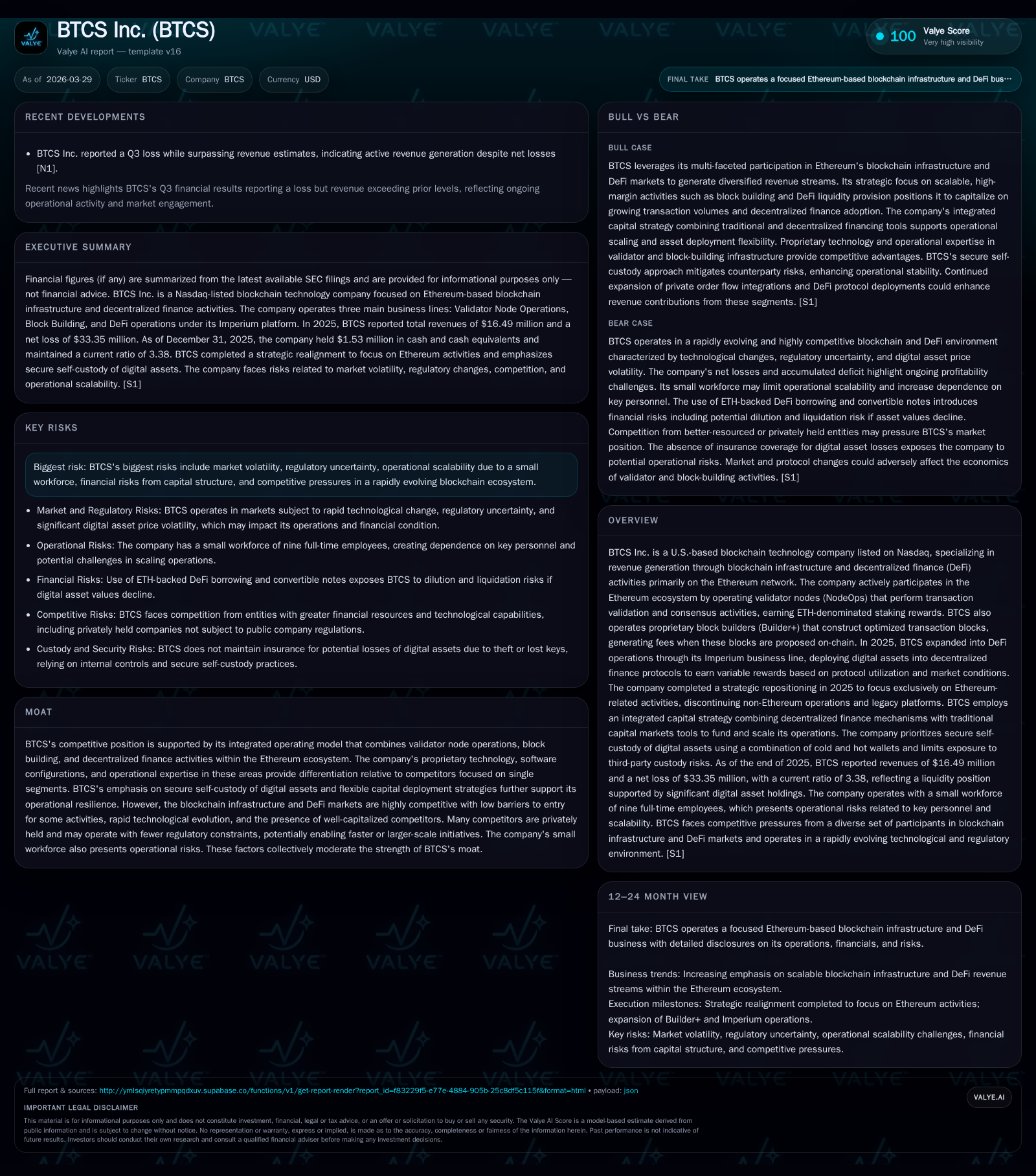
BTCS Inc., a Nasdaq-listed blockchain technology company, achieved a significant revenue increase from $4.1 million in 2024 to $16.5 million in 2025 by expanding its Ethereum-centric validator node operations, block-building services, and DeFi activities under the Imperium platform. Despite this growth, the company reported a net loss of approximately $33.3 million in 2025 and continued negative operating cash flows, reflecting ongoing investments and market volatility. The company maintains a strong liquidity position supported by substantial current assets primarily composed of digital assets and employs a capital allocation strategy balancing equity raises, convertible notes, and DeFi borrowing. BTCS operates with a lean team while facing competitive pressures and evolving regulatory challenges.
Company Overview
BTCS Inc. is a Nasdaq-listed U.S.-based blockchain technology company focused on revenue generation within the Ethereum network ecosystem. It operates actively across three complementary business lines: Validator Node Operations ("NodeOps"), Block Building ("Builder+"), and Decentralized Finance activities under the Imperium brand. Rather than passively holding Ethereum (ETH) tokens, BTCS strategically deploys them to support revenue-generating infrastructure services.
Historical Growth and Performance
BTCS has demonstrated rapid revenue growth aligned with strategic capital reallocation toward Ethereum-centric operations:
Historical performance (annual)
| FY | Rev ($mm) | Net ($mm) | CFO ($mm) | Capex ($) | Rev YoY | Net YoY |
|---|---|---|---|---|---|---|
| 2025 | 16 | -33 | -10 | 12759 | +304.8% | -2523.8% |
| 2024 | 4 | -1 | -4 | 2648 | +204.1% | -116.3% |
| 2023 | 1 | 8 | -4 | 5276 | +149.2% | |
| 2022 | -16 | -1 | 5408 |
Source: SEC companyfacts cache [F1].
Capital returns and efficiency (annual)
| FY | Div ($mm) | FCF ($mm) | ROE% |
|---|---|---|---|
| 2025 | 3 | -10 | -23.9 |
| 2024 | -4 | -3.7 | |
| 2023 | 0 | -4 | 29.9 |
| 2022 | 1 | -1 | -170.3 |
Source: SEC companyfacts cache [F1].
The more than threefold revenue increase in 2025 reflects expanded validator node operations and new DeFi deployments via Imperium [F1][S10]. However, net losses deepened significantly due to ongoing investment costs and market volatility impacting digital asset valuations.
Operating cash flows have been negative over multiple years indicating continued reinvestment or liquidity demands [F1]. Capital expenditures increased notably in 2025 compared to prior years likely supporting infrastructure enhancements necessary for scaling blockchain operations [F1][S21].
Share repurchases resumed with $4 million retired during 2025 under an authorized program aimed at enhancing shareholder value amidst volatile share prices [F1][S7][S14]. Dividends were paid for the first time recently totaling nearly $2.7 million in the year.
Business Model & Operating Segments
BTCS’s integrated model revolves around three primary pillars leveraging ETH as operational capital:
Validator Node Operations (NodeOps): Operating Ethereum validator nodes that perform transaction validation and consensus duties securing network finalization while earning ETH-denominated staking rewards including protocol-defined incentives plus transaction fees [S10].
Block Building (Builder+): Proprietary block builders optimize transaction ordering within blocks to maximize fee capture opportunities via MEV (maximal extractable value). Revenue is generated when constructed blocks are successfully proposed on-chain by external validators; associated payments made to these validators represent direct costs [S10][S6].
Decentralized Finance Operations (Imperium): Launched in 2025 as a complementary segment deploying ETH and stablecoins into decentralized lending and liquidity protocols generating variable yields dependent on market utilization [S10].
This integrated "DeFi/TradFi Flywheel" enables dynamic capital allocation between staking/block building versus leveraged DeFi exposures providing operational flexibility but also exposure to market fluctuations.
Competitive Environment & Differentiation
Ethereum infrastructure is highly competitive involving diverse participants ranging from independent operators to institutional-grade firms backed by substantial resources.
Validator competition centers on uptime reliability and operational excellence since rewards are protocol-fixed rather than price-driven.
Block building competes intensely within MEV ecosystems where latency reductions and algorithmic sophistication are critical; technological advantages can erode rapidly due to network upgrades or new entrants [S4][S6].
Imperium’s DeFi liquidity provision faces competition from various market participants including funds and trading firms; open permissionless protocols increase competitive pressures compressing returns over time.
BTCS differentiates through integrated operation of all three segments coupled with proprietary technology stacks and secure self-custody practices despite operating with a small employee base which poses scalability challenges amidst aggressive competitors often privately held without public reporting requirements [S23][S24].
Capital Structure & Liquidity Position
As of December 31, 2025 BTCS reported robust current assets totaling approximately $214 million largely consisting of digital assets including staked ETH ($30.7M), DeFi protocol assets ($177.7M), stablecoins ($1.54M), treasury holdings ($2.39M), plus cash (~$1.53M) against current liabilities near $63 million resulting in a strong current ratio above 3x supporting runway for growth investment if managed prudently [F1][S8][S19].
Non-current liabilities include convertible notes payable of about $11.8 million along with significant short-term loans payable through DeFi lending protocols totaling approximately $61.5 million illustrating reliance on crypto-native financing methods that carry liquidation risks if ETH price declines sharply [F1][S9][S11].
Capital raising efforts featured substantial equity issuance under an at-the-market program generating gross proceeds exceeding $139 million during calendar year 2025 enhancing balance sheet capacity but contributing dilution amid ongoing losses requiring capital infusion for operations [S14][F1].
Digital assets are primarily self-custodied internally balancing cold storage security with limited hot wallets essential for operational agility minimizing counterparty risk; however no insurance coverage exists for digital asset loss or theft representing material risk exposure [S28].
Risks & Regulatory Landscape
Key risks disclosed by BTCS encompass:
- Digital Asset Price Volatility: Revenues derive heavily from ETH-denominated staking rewards and DeFi deployments; market swings can materially affect results including collateral liquidation risk on borrowed positions [S1].
- Regulatory Evolution: Digital asset infrastructure faces ongoing regulatory scrutiny worldwide potentially increasing compliance costs or restricting certain activities; enforcement actions targeting staking or DeFi protocols could adversely affect profitability and operations [S13][S29].
- Operational Constraints: Limited headcount managing complex multi-segment infrastructure heightens personnel risk impacting agility versus better-resourced competitors [S23].
- Third-party Dependencies: Reliance on external validators for block proposals plus dependencies on decentralized protocols expose BTCS to service disruptions or regulatory constraints affecting execution capabilities [S24].
- Cybersecurity Exposure: Absence of insurance for digital asset losses necessitates rigorous internal controls but residual vulnerability remains significant given cyber threat landscape [N/A].
- Litigation Exposure: No material active proceedings currently but potential legal risks remain inherent due to emerging technology nature and evolving regulations [S27].
Outlook Considerations
Future performance will depend on sustained Ethereum network adoption driving higher transaction volumes benefiting staking rewards plus expanded block builder fee capture; successful scaling of Imperium’s variable yield strategies amid competitive crypto markets; prudent capital management balancing equity dilution against debt/liquidation risks; proactive regulatory compliance adapting to evolving frameworks; continued R&D investment enhancing block-building optimization; addressing operational scalability by retaining specialized blockchain personnel.
Management has not provided explicit financial guidance but investors should monitor quarterly disclosures for progress on validator node expansion metrics; Builder+ fee generation trends particularly from private order flow integrations; yield sustainability from Imperium deployments; strategic partnerships or technology upgrades enhancing competitive positioning.
Conclusion
BTCS exemplifies a public small-cap blockchain operator aggressively transitioning toward an Ethereum-focused model integrating secured consensus services with advanced transaction optimization and innovative DeFi liquidity deployments supported by endogenous ETH holdings rather than passive asset accumulation alone.
This approach produced notable top-line acceleration exceeding triple-digit annual growth recently yet remains accompanied by sustained net losses underscoring the capital-intensive nature of scaling blockchain infrastructure amid volatile markets.
Stakeholders should weigh BTCS’s momentum and technical integration against financial volatility linked to digital asset dependence alongside operational challenges posed by limited workforce scale coupled with evolving regulatory complexities within a highly competitive environment.
This analysis is based solely on publicly available financial statements and regulatory filings through March 29th, 2026.
Disclaimer: This is research-only, informational analysis and not investment advice. It may include AI-generated interpretation and general industry context. Always verify important details using primary sources.

Comments