
Arcadia Biosciences Transitions to Beverage Brand Focus amid Ongoing Losses and Legal Challenges
After divesting its wheat traits unit, Arcadia Biosciences relies on Zola coconut water with growth offset by regulatory risks and negative cash flow.
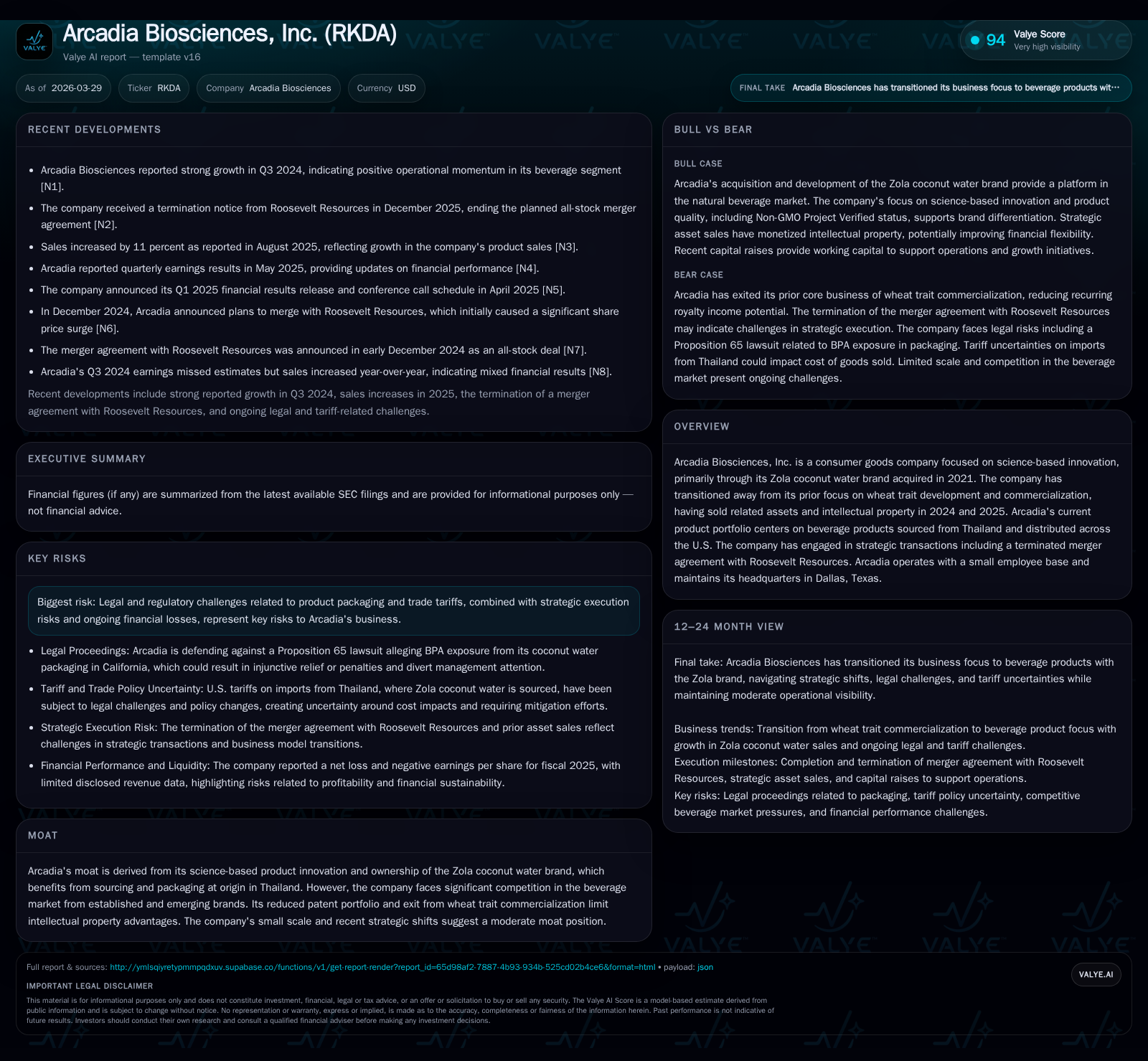
Arcadia Biosciences, formerly a biotech company focused on wheat trait development, has transformed into a consumer goods entity centered around its Zola coconut water brand sourced from Thailand. The company sold off its wheat-related intellectual property in 2024 and 2025, marking a strategic pivot away from agriculture biotech. While Q3 2024 showed strong growth, the firm remains unprofitable with operating losses shrinking but still substantial as of 2025. Regulatory risks loom, including product packaging litigation under California’s Proposition 65 and ongoing tariff uncertainties affecting cost of goods. The company’s capital structure reflects recent equity raises but limited cash reserves and no dividends or buybacks. With a small workforce and moderate competitive moat, Arcadia’s future hinges on execution in the competitive beverage market.
Historical Growth and Business Transformation
Arcadia Biosciences initially built its profile through science-driven agricultural biotechnology innovation, particularly focused on developing wheat traits to enhance nutritional profiles and crop performance. Historically, revenues reflected this mixed business model integrating trait licensing, royalty income, and direct commercial sales — with top-line figures reported as approximately $5.4 million in FY2015 before dropping below $4 million by FY2017 as the company transitioned (see table below) [F1].
The critical inflection came in mid-2021 when Arcadia acquired the Zola coconut water brand's assets from third parties, signaling a deliberate pivot toward consumer packaged goods (CPG), specifically beverages sourced directly from Thailand where coconuts are grown and packaged at origin. This shift is underscored by the complete divestiture of wheat-related assets — selling the non-GMO Resistant Starch durum wheat trait to Corteva Agriscience for $4 million in May 2024 [S1][S11], followed by the GoodWheat brand sale to Above Food for $3.7 million shortly thereafter.
This marked exit from agricultural patents ended expected future royalty streams linked to wheat innovations while enabling Arcadia to monetize intellectual property and inventory tied to grain products early — a move reflecting both strategic refocus and liquidity needs.
Historical performance (annual)
| FY | Net ($mm) | CFO ($mm) | OpInc ($mm) | Capex ($) | Net YoY |
|---|---|---|---|---|---|
| 2025 | -2 | -5 | -2 | 0 | +66.8% |
| 2024 | -7 | -10 | -4 | 16000 | +49.7% |
| 2023 | -14 | -15 | -14 | 5000 | +9.1% |
| 2022 | -15 | -14 | -19 | 72000 |
Source: SEC companyfacts cache [F1].
Capital returns and efficiency (annual)
| FY | FCF ($mm) | ROE% |
|---|---|---|
| 2025 | -5 | |
| 2024 | -10 | -113.1 |
| 2023 | -15 | -108.9 |
| 2022 | -14 | -73.1 |
Source: SEC companyfacts cache [F1].
Note: Revenue details post-2017 are not explicitly disclosed; operating metrics illustrate loss trends.
Current Business Model and Market Positioning
Arcadia's primary product is Zola coconut water — a natural beverage positioned as hydrating and nutrient-rich with variants including original with pulp and flavored options like espresso and pineapple. The product is Non-GMO Project Verified and typically contains around 60 calories per serving, aligning it within premium functional beverage categories.
Distribution channels encompass grocery retailers and foodservice providers across the U.S., leveraging supply chain integrations rooted in Thai sourcing where coconuts are harvested and packed onsite before shipment.
Despite this repositioning toward CPG beverages — sectors where brand equity and shelf placement are decisive — Arcadia operates with only eight employees covering management through operations to finance/legal support [S10]. Such lean staffing reflects both scale limitations and cost control priorities but raises questions about capacity for rapid scaling or execution of broad market penetration campaigns.
The company's patent portfolio has been significantly pared down following asset sales; as of late-2025 it holds only two pending patent applications alongside a reduced stable of issued patents mainly tied to earlier wheat trait work no longer central to its strategy [S10].
Financial Performance Trends: Seeking Profitability Amid Losses
While explicit recent revenue figures are sparse beyond historical data through FY2017 [$4M], publicly available reports indicate strong relative growth in beverage sales during Q3 CY2024 [N1]. Nevertheless, operating losses persist albeit on a declining trajectory: getting tighter from nearly negative $14 million in FY2023 down to approximately negative $2.5 million for FY2025 [F1]. Net losses echoed this improvement but remained material at about negative $2.3 million last fiscal year.
Operating cash flow continues negative around $4.7 million for FY25 after zero capital expenditures that year suggests constrained reinvestment but moderated cash burn compared to prior periods exceeding negative $15 million CFOs [F1]. The balance sheet reflects diminished cash reserves of just $259K at year-end coupled with modest current assets near $6.36M supporting near-term obligations far exceeding current liabilities of roughly $2.06M (current ratio ~3.09), indicating operational liquidity albeit within tight confines given limited cash.
No dividends or share repurchase programs are underway; instead capital allocation focuses on managing working capital needs facilitated partially by private equity transactions executed in early 2026 where inducement agreements led key option holders to exercise warrants raising gross proceeds over $2 million at discounted share prices [S20][S23][S24]. These efforts underscore ongoing funding challenges typical of small-scale specialty CPG firms transitioning from legacy biotechnologies.
Growth Drivers and Constraints Ahead
Growth prospects principally hinge on expanding Zola's footprint in the competitive coconut water segment—a category experiencing steady demand growth but dominated by larger well-capitalized brands like Vita Coco or emerging natural alternatives . Arcadia’s advantage stems partly from direct sourcing in Thailand ensuring supply chain quality control plus proprietary packaging techniques enhancing product freshness.
Constraints include:
- Market competition necessitating investment in marketing and distribution expansion that could strain resources given small workforce size.
- Legal headwinds such as active Proposition 65 litigation alleging California law violations due to Bisphenol A exposure from canned packaging pose reputational risks plus potential financial penalties or forced product reformulation costs [S4][S5].
- Tariff challenges stemming from U.S.-Thailand trade disputes impact input costs; while the original IEEPA-based tariffs invalidated by Supreme Court ruling have been replaced by alternative trade measures imposing ~10% global import duties creating ongoing pricing uncertainties [S7][S8].
- Absence of recurring licensing income post-wheat IP divestiture leaves core revenue dependent exclusively on consumer sales performance with slim margin buffers amid negative EBITDA trends.
Strategic Milestones: Terminated Merger & Capital Moves
An anticipated all-stock merger agreement with Roosevelt Resources signed December 2024 was ultimately terminated by Roosevelt at end-2025 after failing closing conditions without breakup fees paid by either side signaling mutually abortive but amicable disengagement [S13][S29]. This termination halted expected consolidation benefits such as operational synergies or expanded product portfolios.
Subsequent capital raises through option inducement agreements during January-February 2026 demonstrate proactive management attempts to stabilize finances; these included reduction of option exercise prices attracting participating investors injecting over $2 million gross proceeds into working capital setups without altering dividend policies or initiating buybacks [S20][S22][S23][S24].
Returns Profile: Persistent Negative Equity Gains
Despite improving net loss levels relative to historical peaks (-37% approximate ROE derived using latest net income / equity figures), Arcadia remains well outside profitability territory typical for growth-oriented transition businesses facing fierce consumer market dynamics [F1]. Operating cash flows have yet to invert positive signifying continued net cash outflows impacting shareholder value generation absent additional strategic shifts or profitable product expansion.
Legal Risks & Regulatory Environment
Beyond trade tariffs’ uncertainty impacting imported finished goods costs settled in Thailand facilities lies notable regulatory scrutiny around packaging materials under California’s Proposition 65 law targeting carcinogenic substances including BPA allegedly present in some packaging containers used by Arcadia's coconut water products sold within that state—a litigation environment shared across many peer beverage companies engaged similarly—posing potential injunctions or costly compliance burdens should adverse rulings emerge despite Company denials of liability currently at discovery stage [S4][S5].
The company also faces possible future legal challenges arising from prior intellectual property transactions though these remain immaterial currently but illustrate ongoing governance complexity associated with prior biotech incumbency shift toward pure CPG operations [S6].
Competitive Moat Assessment
Arcadia’s moat now centers primarily on its science-driven innovation heritage transmuted into artisanal beverage craftsmanship with high-quality sourcing—elements supporting moderate brand differentiation against commoditized competitors but lacking scale advantages or deep IP protections which had anchored previous wheat trait operations.
This narrower moat combined with small operational scale requires diligent marketing execution alongside agile supply chain management especially amid tariff volatility which could reconfigure pricing structures unexpectedly.
Outlook & What To Watch (Analysis)
Absent explicit forward guidance or milestone targets beyond early-stage private placement notes currently available up through March-26-2026 filings ([N1],[S3]), monitoring should focus on:
- Quarterly revenue trajectories attributable specifically to Zola branded products versus broader ancillary sales.
- Progress or resolutions regarding Proposition 65 litigation since prolonged legal proceedings entail material balance sheet risks.
- Impact metrics tied to U.S.-Thailand tariff negotiations including any announced exemptions benefiting beverage classifications relevant for cost pass-through capabilities.
- Additional capital raises or partnership announcements signaling enhanced financial runway extension beyond small-cash buffer scenarios apparent today.
- Any new product introductions or expanded distribution partnerships aimed at bolstering shelf presence versus established peers.
- Management commentary clarifying whether further debt financing might be introduced or equity dilution managed conservatively given prior inducement resets last quarter.
This report summarizes company information based solely on official SEC filings up through March-26-2026 and public news sources available as of March-29-2026 without forward-looking predictions nor investment advice.
Disclaimer: This is research-only, informational analysis and not investment advice. It may include AI-generated interpretation and general industry context. Always verify important details using primary sources.

Comments