
Liberty Global Ltd. Charts Recovery Through Strategic Acquisitions and Network Expansion
Liberty Global leverages recent transactions and network scale to boost revenue amid lingering profitability challenges.
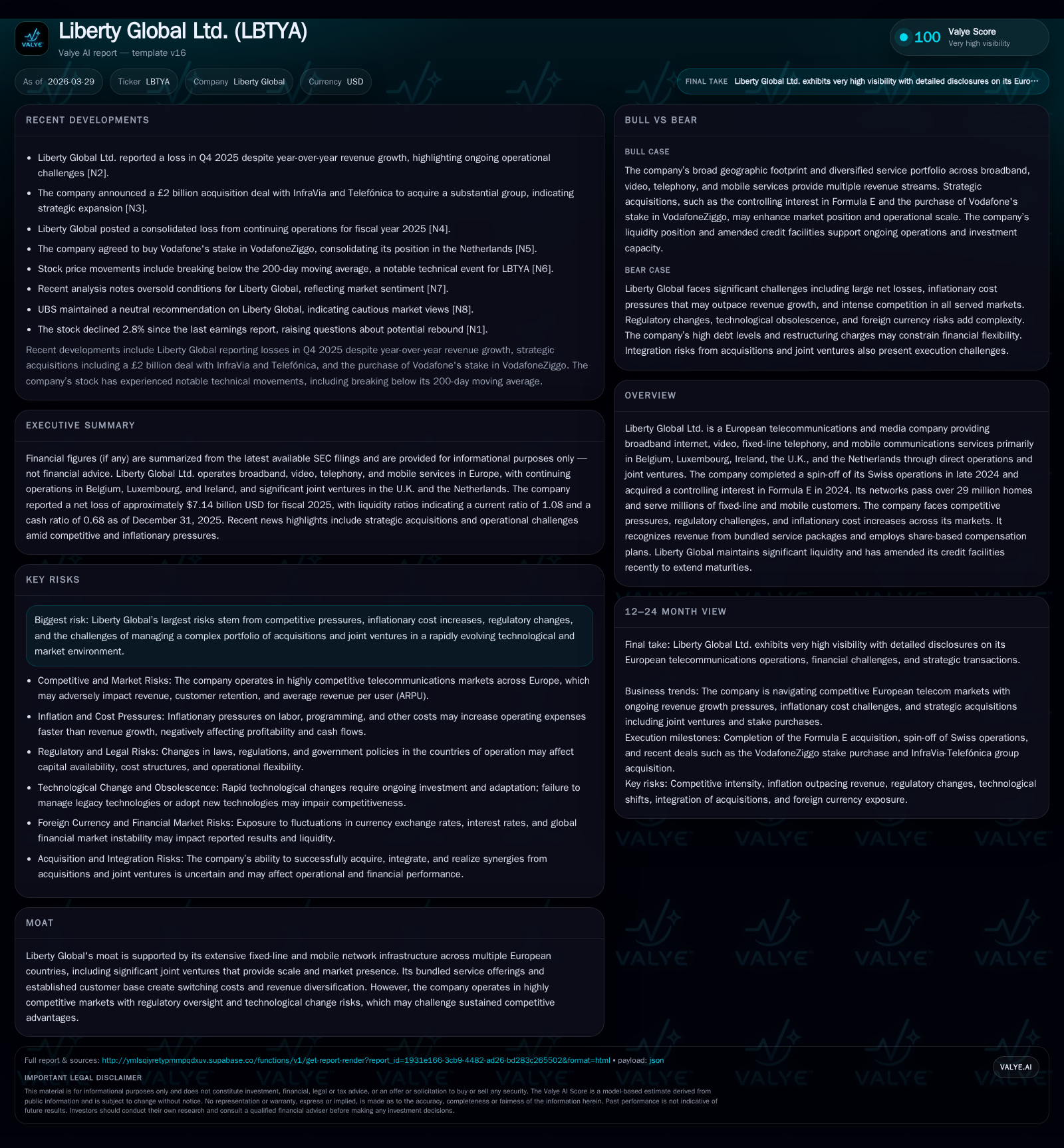
Liberty Global Ltd. experienced a dramatic rebound in revenue over recent years following strategic acquisitions including Formula E and a key stake consolidation in VodafoneZiggo. Despite improved operating income margins, net losses remain sizeable due in part to high capex and integration costs. The company’s extensive European infrastructure footprint, combined with amended credit facilities, provides a platform for future growth but regulatory pressures and inflationary cost inflation constrain near-term operating leverage.
Financial Recovery Trajectory: Revenue Growth Leverages Scale but Profitability Lags
Liberty Global Ltd.’s financial history over the last several years paints a story of volatile performance punctuated by bold growth moves. From fiscal year (FY) 2018 through FY2019, revenue exploded from approximately $2.95 billion to $11.54 billion—a staggering surge exceeding 290% year-over-year—largely attributable to substantial acquisitions that expanded the company’s operational scale dramatically [F1]. However, this top-line momentum did not translate into sustained profitability.
Operating income figures remained negative through FY2025 but showed marked improvement, narrowing losses by more than half from -$48.2 million in FY2024 to -$23.3 million in FY2025 [F1]. Yet the net income outlook is more sobering with a reported loss of approximately $7.14 billion in FY2025 compared to a $2.24 billion profit the prior year, resulting in an adverse swing driven principally by integration costs, impairments related to acquisitions, share-based compensation expenses, and other one-time charges embedded within net results [F1],[N4].
Operating cash flow also contracted sharply last year by over 40% to roughly $1.21 billion as cash generated was stretched thin amidst operating pressures and elevated capital expenditures (capex). Indeed, capex soared nearly 48% year-over-year reaching $1.34 billion in FY2025—the highest level seen within the examined period—reflecting intensified investment into network rollout projects and technology upgrades [F1],[S12],[S29]. This sharp uptick contributed to a marginally negative free cash flow posture estimated at -$132 million (operating cash flow minus capex) which signals ongoing liquidity demands tied primarily to infrastructure expansion.
Equity contraction is also evident with shareholders’ equity falling from $22.4 billion in FY2022 down to under $9.7 billion by FY2025 as accumulated losses eroded net asset values; this results in an approximate negative Return on Equity (ROE) near -73%, illustrating how substantial capitalization remains challenged by recurring losses despite operational recovery efforts [F1].
Historical performance (annual)
| FY | Net ($bn) | CFO ($bn) | OpInc ($mm) | Capex ($mm) | Net YoY |
|---|---|---|---|---|---|
| 2025 | -7.1 | 1.2 | -23 | 1343 | -418.1% |
| 2024 | 2.2 | 2.0 | -48 | 909 | +155.4% |
| 2023 | -4.1 | 2.2 | -244 | 1386 | -375.0% |
| 2022 | 1.5 | 2.8 | 147 | 1303 |
Source: SEC companyfacts cache [F1].
Capital returns and efficiency (annual)
| FY | Buybacks ($mm) | FCF ($mm) | ROE% |
|---|---|---|---|
| 2025 | 192 | -132 | -73.3 |
| 2024 | 690 | 1124 | 18.1 |
| 2023 | 1495 | 780 | -21.3 |
| 2022 | 1703 | 1535 | 6.6 |
Source: SEC companyfacts cache [F1].
Note: Revenue YoY for FY2025 calculated against FY2018 reflecting restructuring of business scope; other YoY figures compare sequential years where available.
Growth Engine: Impact of Formula E Acquisition and Market Footprint Shifts
Late in calendar year 2024, Liberty Global acquired a controlling interest in Formula E, marking its entry beyond traditional telecommunications toward innovative content ownership that could complement its existing video distribution services [N3],[S6]. This acquisition enables Liberty to capitalize on the rising global appeal of electric motorsport entertainment while potentially leveraging advertising and streaming synergies across its broadband platforms.
Furthermore, subsequent announcements early in 2026 detailed plans for Liberty Global to acquire Vodafone's stake in VodafoneZiggo—a joint venture firmly entrenched in the Netherlands market—transitioning it toward greater direct control over its Dutch operations [N5]. Such consolidation efforts are poised to enhance operational efficiencies and offer incremental revenue streams as direct ownership typically permits faster decision-making versus minority JV arrangements.
The spin-off of Swiss operations completed in late 2024 refocused Liberty’s geographic concentration on Belgium/Luxembourg via Telenet; Ireland through VM Ireland; plus U.K. and Netherlands mainly served through noncontrolling joint ventures like VMO2 and VodafoneZiggo respectively ,[S6]. Combined networks cross more than 29 million homes with nearly 45 million mobile subscribers under contract—a scale rarely matched amongst pan-European competitors—bolstering Liberty’s bundled service appeal which integrates broadband internet, video content, fixed telephony, and mobile offerings under one umbrella.
Despite potential integration complexity inherent in multiple acquisitions across diverse jurisdictions—which introduces execution risk regarding synergy realization—Liberty has emphasized focus on accelerating cross-selling opportunities while optimizing cost structures inside joint ventures subject to various shareholder alignments [S7],[N3].
Competitive Landscape and Regulatory Factors Affecting Operating Metrics
Liberty operates within fiercely competitive markets characterized by rapid technological evolution and vigilant regulators enforcing consumer protections that limit pricing power ,[S5],[S7]. For instance, ARPU pressure persists due to consumer substitution trends favoring standalone broadband or mobile packages over traditional video bundles as streaming alternatives proliferate.
In Belgium specifically, regulatory mandates require opening broadband networks for third-party access—pressuring exclusivity advantages essential for premium bundling strategies—as well as spectrum allocation policies defining how wireless capabilities expand within crowded frequency bands [S7]. Moreover, inflationary impacts spike labor costs alongside surging programming fees—especially retranmission rights—that cumulatively erode margin optimism despite attempts at passing some increases onto customers through tariff adjustments bounded by competitive realities.
Additionally, MVNO arrangements such as those partnering with Three (Hutchison) at VM Ireland substitute outright spectrum holdings by leasing capacity but can complicate cost pass-through models when vendor mark-ups diverge from original assumptions [S10],[S2]. The pervasive uncertainty surrounding economic cycles within high-cost European countries compounds this dynamic whereby discretionary spending tightens even amid growing subscriber bases.
Future Outlook: Opportunities and Constraints from Market Dynamics and Innovation
Looking ahead, Liberty Global faces both headwinds and pathways stemming largely from its technological roadmap integration success with new acquisitions plus evolving user behavior trends documented recently [S2],[N3]. Increasing mobile broadband penetration coupled with fiber rollouts offers expanded service tiers; however legacy copper retirements still demand intermediate funding before full digital migration benefits reach maturity.
Risks include potential delays or cost overruns related to integrating Formula E assets within broader commercial frameworks or unlocking value from VodafoneZiggo stake consolidation pending regulatory approvals—all factors investors should monitor though explicit forward guidance remains limited post-FY25 reporting cycle [N3]. Further innovation pressures emerge as consumer preferences shift toward personalized digital experiences requiring investment into AI-enabled customer platforms balanced against escalating operational expenses triggered by inflation spikes noted since early-2025.
Capital Allocation Review: Debt, Dividends, Buybacks, and Liquidity Management
From a capital structure perspective, Liberty maintains substantial liquidity buffers with cash plus equivalents at just above $2.08 billion at end-FY25 alongside current assets slightly exceeding liabilities resulting in a current ratio around 1.08—indicative of stable short-term coverage ability amidst ongoing negative profitability trends [F1].
Notably, recent amendments effective February 2026 bifurcated revolving credit facilities extending final maturity dates respectively to May 31, 2029 and May 31, 2032 enabling a staggered debt repayment schedule that alleviates near-term refinancing risks while incorporating sustainability-linked clauses aligned with ESG criteria increasingly demanded by financial counterparties [S11],[S13],[S24].
Dividend payments have persisted but remain conservative relative to cash generation capacities given ongoing capex intensity needed for network upgrades; likewise share buybacks declined sharply last year from $690 million down to $192 million reflecting cautious capital deployment priorities focused on balance sheet stability rather than aggressive capital return programs during transitional earnings periods [F1].
Capital discipline underpins management's commitment to sustaining next-gen network investments critical for long-term competitive advantage despite present-day compression on free cash flow caused by accelerated infrastructure buildout requirements required across heterogeneous regulated markets.
Network Infrastructure as Moat: Asset Footprint and Joint Ventures Empower Scale
At the core of Liberty Global’s enduring moat lies its extensive network infrastructure — fixed-line broadband systems integrated with wide-ranging mobile communication assets spanning Belgium/Luxembourg through wholly owned Telenet subsidiaries; Ireland via VM Ireland MVNO partnerships; plus significant noncontrolling stakes within U.K.’s VMO2 JV as well as Netherlands’ VodafoneZiggo JV patients providing blended exposure across key Western European tech corridors .
The combined networks pass over an estimated 29 million homes covering urban and suburban territories prized for high bandwidth demand while serving nearly 45 million mobile subscribers translates into noteworthy economics of scale facilitating bundling strategies that entrench customer loyalty by raising switching costs via seamless integrated offerings across telephony modalities.
Such footprint diversity balances regulatory heterogeneity between countries — blending direct ownership where possible with influential minority control stakes allowing flexibility amid shifting antitrust or sector-specific policies important when spectrum licenses or cross-ownership limits mandate caution against full consolidation attempts.
Ongoing investments aiming at enhancing fiber-to-the-home penetration rates alongside upgrades incorporating latest spectrum utilization techniques sustain barriers for new entrants unable to match both capital intensity capability plus programming/content partnerships imperative for maintaining premium video product lines bundled into comprehensive telecom packages favored by consumers wary of piecemeal providers.
Disclaimer: This report is intended solely for informational purposes based on currently available data as of March 29, 2026 (including SEC filings up to date) without any forecasts or recommendations on security transactions or investment positions regarding Liberty Global Ltd., accordingly users should consult financial advisors before making any investment decisions.
Disclaimer: This is research-only, informational analysis and not investment advice. It may include AI-generated interpretation and general industry context. Always verify important details using primary sources.

Comments