
Cross Timbers Royalty Trust's Income Driven by Oil and Gas Production Dynamics with Limited Operational Leverage
The Trust's distributable income depends on net profits from oil and gas properties operated primarily by XTO Energy, facing commodity price swings and production declines.
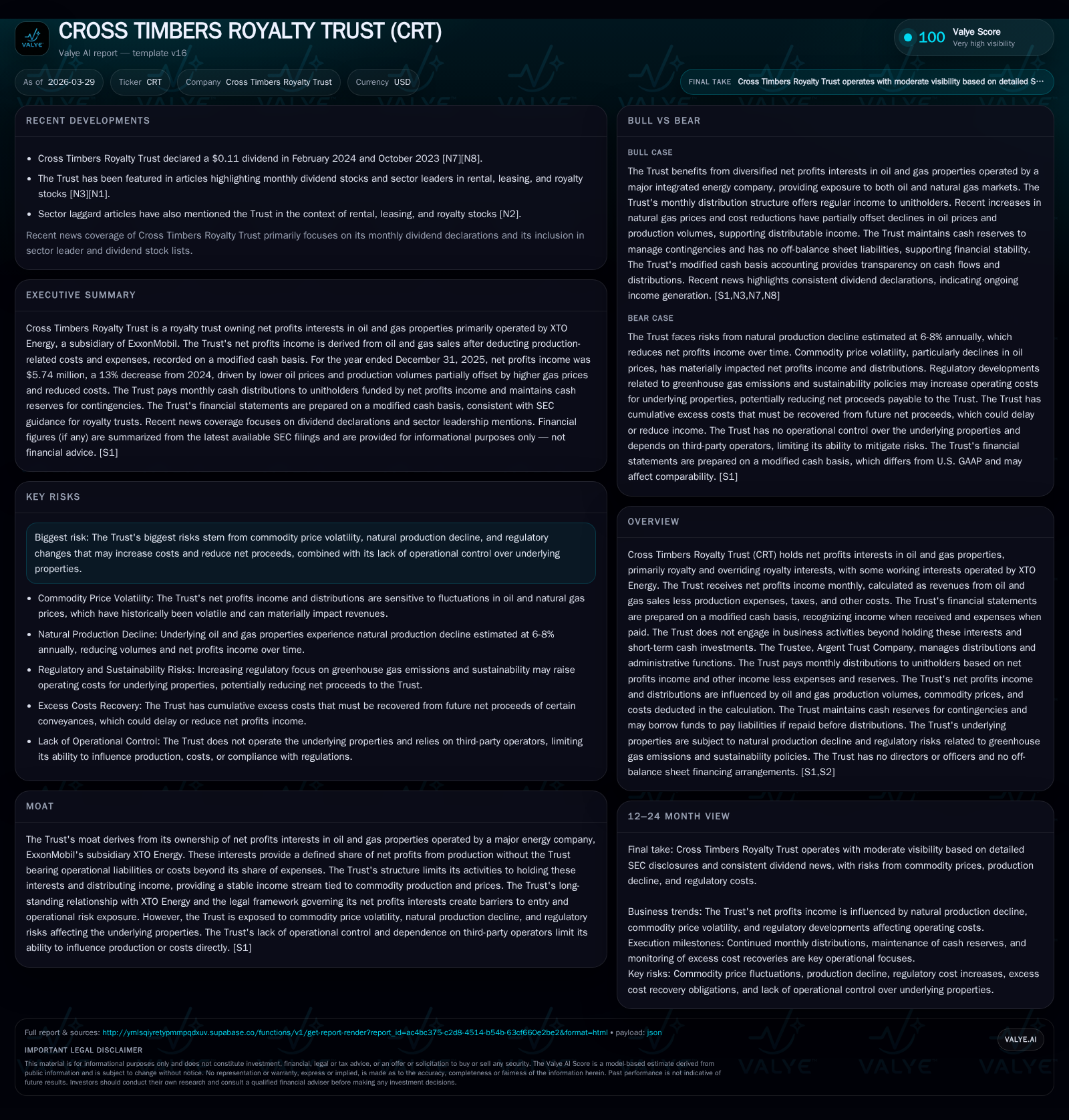
Cross Timbers Royalty Trust (CRT) holds net profits interests in oil and gas properties largely operated by ExxonMobil’s subsidiary XTO Energy, generating income based on revenues less costs. Over recent years, CRT’s revenues and net profits income have declined slightly due to natural production decline and lower oil prices, though some offset came from higher gas prices. The Trust distributes monthly cash flows after expenses, with no debt or capital expenditure obligations. With its limited operational role and exposure to commodity markets, CRT’s growth depends mainly on oil and gas price trajectories and production trends from underlying assets. Key risks include commodity price volatility, regulatory shifts, and ongoing natural production depletion.
Overview
Cross Timbers Royalty Trust (CRT) operates as a passive royalty trust entity holding net profits interests carved from oil and gas properties mainly located in Texas and Oklahoma that are owned or operated by XTO Energy, a subsidiary of ExxonMobil. CRT does not operate these assets but receives monthly net profits income calculated as gross revenues from hydrocarbon sales minus associated costs such as production expenses, taxes, overhead charges, and transportation fees. Argent Trust Company has served as Trustee since December 2022, managing distributions to unitholders.[S1][S24][S25]
The Trust follows a modified cash basis accounting method where revenue is recognized when received rather than when earned, which can introduce timing effects into reported financial results.[S1]
Historical Performance and Drivers
Recent annual results show a modest decline in core financial metrics driven by natural production declines and commodity price fluctuations.
| Year | Net Profits Income ($M) | Distributable Income ($M) | Admin Expense ($k) | Trust Corpus ($M) | Avg Oil Price ($/Bbl) | Avg Gas Price ($/Mcf) | Oil Volume ('000 Bbls) | Gas Volume ('000 Mcf) |
|---|---|---|---|---|---|---|---|---|
| 2024 | 6.56 | 5.68 | 946 | 2.43 | 75.68 | 3.97 | ~165 | ~1,217 |
| 2025 | 5.74 | 4.49 | 847 | 2.16 | 65.85 | 4.40 | ~148 | ~1,100 |
(Source: [S1], [S15], [S23])
Production volumes for both oil and gas decreased roughly 10% from full year 2024 to 2025—oil volumes fell from approximately 165 thousand barrels to about 148 thousand barrels while gas volumes declined similarly from over one million to just above one million Mcf. These declines align with an estimated natural depletion rate of approximately 6–8% annually.[S15][S14]
Average realized oil prices softened by about $10 per barrel year-over-year reaching $65.85 in calendar year ’25 compared to $75.68 in ’24. Conversely, natural gas prices firmed about 11%, rising to $4.40 per Mcf.[S15]
Costs deducted for net profits income calculations declined significantly—from $9.8 million in ’24 to $8.0 million in ’25—primarily reflecting lower development spending (down nearly $1.3 million), reduced taxes and transportation costs,[S16][S17] partially offset by some increases in other cost categories.
Quarterly data reveal timing nuances including recognition of out-of-period revenues impacting particularly the gas segment.[S16][S19]
Growth Outlook
Growth potential is tightly linked to factors outside the Trust’s operational control: underlying production profiles managed by XTO Energy, commodity price movements for crude oil and natural gas, and regulatory changes affecting operating costs.
Natural reservoir depletion in mature fields generally predicts ongoing volume declines absent new drilling or enhanced recovery efforts which the Trust cannot initiate due to its passive ownership structure.[S1][S24]
Commodity prices remain volatile but NYMEX forward curves suggest some upside potential relative to recent quarters.[S15]
Budgeted development expenses for underlying properties are modest (~$0.09 million gross for ’26), indicating limited near-term capital expansion plans.[S16]
Regulatory risks related to emissions policies may increase operator costs which reduce net proceeds payable to the Trust,[S7][S10] potentially compressing future distributable income.
Milestones / What To Watch
The Trust provides monthly distribution announcements via SEC filings; tracking these alongside commodity price trends will be critical.
Key factors include:
- Crude oil price trajectory relative to NYMEX benchmarks.
- Natural gas seasonal fluctuations affecting volumes and pricing.
- Changes in development budgets or operating costs announced by operators.
- Regulatory developments impacting carbon-related costs passed through deductions.[S7,S10]
- Trends in sales volumes indicating accelerated declines or stabilization.
- Trustee disclosures regarding cash reserves or distribution adjustments.[S3]
No formal long-term guidance is provided; investors should monitor filings closely for updates.[S3]
Capital Allocation & Returns
CRT distributes essentially all net profits income after administrative expenses as monthly cash distributions.
The Trust carries no debt nor engages in share/unit repurchases.[S22][S29]
Distributions totaled approximately $4.49 million in calendar year ’25 down from $5.68 million in ’24 reflecting declines tied primarily to lower volume and price realizations.[S23]
Administrative expenses remained relatively steady ($0.85 million annually), while the Trustee maintains an expense reserve fund ($1.45 million at year-end ’25) to manage contingencies.[S23]
The Trust corpus amortizes annually consistent with reserve depletion—a reduction of about $274 thousand occurred during ’25 supporting anticipated asset shrinkage over time.[S29]
Cash flow generation comfortably covers liabilities without reliance on external financing.
Risk Profile & Structural Considerations
CRT’s investment moat lies in its sizeable net profits interests secured decades ago in producing oil & gas properties operated by a major energy company (XTO Energy), offering a relatively predictable revenue stream without direct operational risk borne by the Trust.
Key risks include:
- Commodity price volatility impacting revenue unpredictably.
- Natural production decline reducing volumes absent operator-driven enhancements.
- Regulatory risks such as carbon taxes that may raise operating costs upstream of distributions.
- Lack of operational control limiting ability to influence production or cost management.
- Legal/environmental issues tied to underlying assets currently not material but monitored.[S13]
Summary
Cross Timbers Royalty Trust provides investors exposure to legacy upstream energy cash flows through royalty-like interests without direct operational involvement or capital expenditure requirements beyond amortization of acquired interests. Its financial profile reflects typical characteristics of mature hydrocarbon assets—steady but declining production coupled with sensitivity to commodity prices. Future returns depend critically on external factors: commodity market cycles, operator efficiency at underlying properties controlled by ExxonMobil affiliates, and evolving regulatory frameworks affecting extraction economics. Investors seeking direct operational growth leverage will find limited opportunity here due to the trust’s passive structure; however CRT offers participation in established resource cash flow streams underpinned by contractual arrangements insulated from operator risk except normal commodity exposure.
This analysis is based exclusively on publicly available SEC filings as of March 27, 2026.
Disclaimer: This is research-only, informational analysis and not investment advice. It may include AI-generated interpretation and general industry context. Always verify important details using primary sources.

Comments