
Kyverna Therapeutics Accelerates CAR T-Cell Development with Capital Strength Amid Clinical and Regulatory Hurdles
The clinical-stage biotech focuses on B-cell-driven autoimmune disorders, balancing innovation with funding needs and regulatory risks.
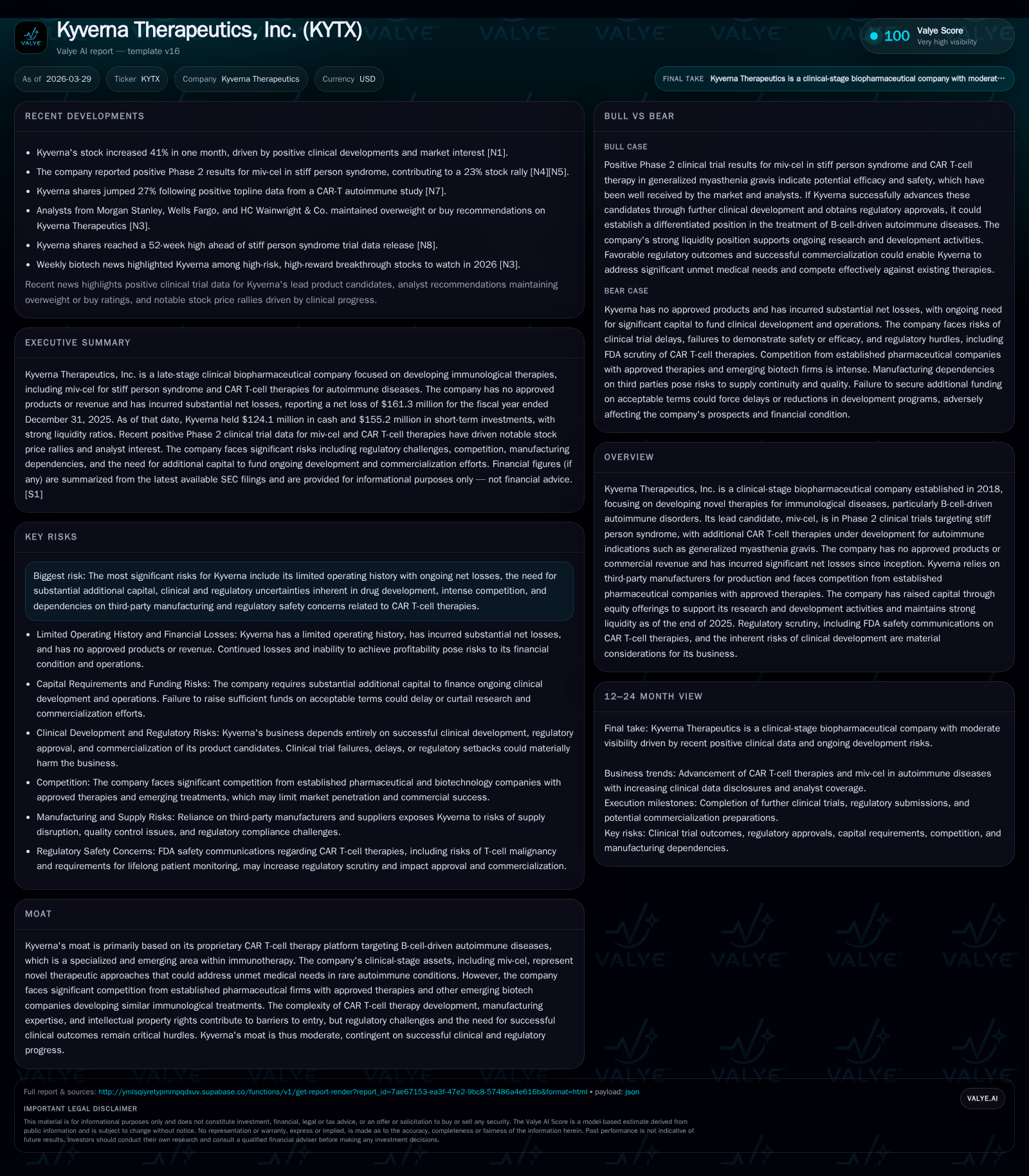
Kyverna Therapeutics remains firmly in the clinical stage without commercial products, emphasizing its proprietary CAR T-cell platform targeting rare autoimmune diseases. The company’s lead candidate, miv-cel, is in Phase 2 for stiff person syndrome, with other candidates for conditions like generalized myasthenia gravis. While Kent’s net losses deepened in 2025, strong liquidity from recent equity raises supports ongoing R&D. Nonetheless, significant regulatory uncertainties especially around CAR T therapies’ safety profiles and competitive pressures pose material challenges ahead.
Company Overview
Kyverna Therapeutics, Inc., founded in 2018, is a Delaware-based clinical-stage biopharmaceutical company specializing in novel therapies for B-cell-driven autoimmune diseases. The company's lead candidate, miv-cel, a CAR T-cell therapy, is undergoing Phase 2 clinical trials targeting stiff person syndrome (SPS), a rare neurological disorder. Additional CAR T-cell programs are progressing preclinically or early clinically for related autoimmune indications such as generalized myasthenia gravis (MG). Kyverna's business model relies heavily on its proprietary cell therapy platform to address significant unmet needs in these immunological niches.
Historical Financial Performance
As is typical for clinical-stage biotechs without commercial products, Kyverna's financials reflect sustained investment in R&D alongside operational losses. According to the latest fiscal year ended December 31, 2025 ([F1]), the company recorded an operating loss of approximately $170 million and a net loss of $161 million. This represents worsening losses compared to 2024 (-19% operating income YoY; -26.5% net income YoY) driven largely by expanding clinical trial activities and platform development costs.
Operating cash flow remained negative at $154 million for 2025, deteriorating by over one-third year-over-year as Kyverna intensified investment into its pipeline. Capital expenditures were minimal at $5,000 in 2025 versus $2.2 million the prior year—a typical pattern given reliance on third-party manufacturing rather than in-house facilities.
Despite these losses, liquidity remains solid with cash and equivalents of $124 million and a strong current ratio near 7.75 ([F1]), backed by recent equity offerings totaling upwards of $64 million gross proceeds since early 2025 [S13]. This financial cushion underpins ongoing operations during zero revenue generation.
Historical performance (annual)
| FY | Net ($mm) | CFO ($mm) | OpInc ($mm) | Capex ($mm) | Net YoY |
|---|---|---|---|---|---|
| 2025 | -161 | -154 | -170 | 0 | -26.5% |
| 2024 | -127 | -114 | -143 | 2 |
Source: SEC companyfacts cache [F1].
Capital returns and efficiency (annual)
| FY | FCF ($mm) | ROE% |
|---|---|---|
| 2025 | -154 | -69.4 |
| 2024 | -116 | -47.8 |
Source: SEC companyfacts cache [F1].
Table: Selected Financials for Kyverna Therapeutics (Source: [F1])
Business Model and Operating Structure
Kyverna operates without any commercial manufacturing assets of its own; production is outsourced to third-party Contract Manufacturing Organizations (CMOs). This strategy conserves capital but creates risk exposure regarding supply chain reliability and cost escalation. Given the complexity of autologous CAR T-cell therapies—requiring personalized collection, genetic modification, expansion, and reinfusion—manufacturing partners must meet stringent quality standards under Good Manufacturing Practices (GMP).
The company aims to differentiate itself through its specialized focus on B-cell-mediated autoimmune conditions—a relatively untapped segment compared to oncology-focused CAR T developers. Kyverna's intellectual property portfolio centers on its engineered cell therapy constructs and methods specific to these immune dysregulation diseases.
Industry Context and Competitive Positioning
Autoimmune diseases caused by aberrant B-cell activity represent sizable unmet medical needs with limited approved curative therapies. Traditional treatments often include broad immunosuppressants or biologics that provide partial symptom control but not durable remissions.
Emerging CAR T-cell therapies offer potentially transformative effects by selectively depleting pathogenic B-cells. However, this area remains nascent with substantial risks—including severe adverse events such as cytokine release syndrome or secondary malignancies—which have prompted recent FDA warnings even among approved oncology CAR T products ([S27]).
Kyverna competes against both large pharmaceutical companies with established immunomodulatory drugs and other biotech firms pursuing similar cellular therapy approaches. The difficulty lies not only in developing safe and effective products but also scaling manufacturing and navigating evolving regulatory frameworks tailored to advanced gene and cell therapies.
Future Growth Prospects
Pipeline advancement will principally drive Kyverna's growth trajectory:
- Miv-cel: Progression through Phase 2 trials in stiff person syndrome could validate therapeutic potential against this debilitating disease lacking effective treatments [N/A]. Positive data would support pivotal studies.
- Pipeline Expansion: Early-stage candidates targeting generalized myasthenia gravis indicate strategic intent to broaden pipeline applications within B-cell-driven autoimmunity.
- Regulatory Milestones: Potential to pursue accelerated FDA approval pathways exists given the severity of target indications; however regulatory scrutiny may intensify after recent CAR T safety signals ([S27]).
- Manufacturing Scale-Up: Ensuring consistent quality supply from CMOs at scale will be essential prior to commercialization.
Significant limitations include volatile clinical trial outcomes typical of novel modalities and uncertain reimbursement scenarios once approved given pricing pressures across immunotherapies ([S9]). The company's niche positioning offers some insulation yet also constrains market breadth.
Key Risks
- Clinical Execution: No product has yet demonstrated definitive clinical efficacy or safety benchmarks sufficient for approval; trial enrollment hurdles could cause delays ([S1]).
- Regulatory Environment: FDA investigations into CAR T therapy-related T-cell malignancies raise concerns about safety thresholds that may delay approvals or impose restrictive labeling ([S27]).
- Financing Needs: Ongoing R&D investment necessitates further capital raises; inability to secure favorable financing terms could disrupt development programs ([S1], [S13]).
- Intellectual Property: Limited patent protection outside U.S. reduces global exclusivity; litigation risk from competitors challenging patents exists ([S6], [S28], [S29]).
- Third-Party Dependencies: Reliance on external manufacturers introduces supply risks and less control over critical production processes ([N/A]).
- Legal Challenges: Pending securities class action and derivative lawsuits pose management distraction and potential financial liability ([S20], [S16]).
Capital Allocation & Returns Metrics
Kyverna has not generated revenue or profitability since inception nor does it pay dividends or repurchase shares ([F1], [S24]). The company's approximate return on equity for fiscal year ending December 31, 2025 was negative ~69% reflecting deep net losses relative to shareholders’ equity base ([F1]). Free cash flow remains negative at roughly $154 million annually given persistent high burn rates related to R&D expenditure.
Equity financings constitute the primary source of capital infusion maintaining balance sheet flexibility; no material debt beyond secured loan facilities with Oxford Finance LLC encumbering corporate assets was noted ([S7], [S17]). The company retains discretion under a shareholder-approved stock incentive plan increasing share reserves annually which may dilute ownership further as talent retention requires stock awards ([S24]).
What to Watch Next (Analysis)
Given absence of explicit forward guidance post-2025 fiscal results release ([S3]), observers should monitor:
- Clinical data readouts from Phase 2 miv-cel trials for efficacy/safety signals that would initiate pivotal development or partnerships.
- Regulatory updates particularly FDA stance on CAR T-cell safety labeling requirements influencing timing/feasibility of filings.
- Further equity raises or strategic collaborations signaling capital sufficiency or pathway shifts.
- Legal proceedings’ developments affecting corporate governance or settlement impact.
- Manufacturing capacity milestones ensuring readiness for eventual commercial-scale supply.
Conclusion
Kyverna Therapeutics exemplifies the dual-edged nature of innovative cell therapy development within rare autoimmune disease spaces: promising scientific rationale combined with substantial operational execution risk amid a challenging regulatory environment. Its current financial profile mirrors typical clinical-stage biotech dynamics—robust cash balances from public markets sustain an intensifying spend profile absent revenue flow. Success hinges pivotally on translation of Phase 2 data into clear clinical benefit while navigating evolving FDA safety expectations surrounding CAR T platforms.
Investors and stakeholders should weigh Kyverna’s specialized pipeline against inherent industry risks including time-consuming trials, capital demands, competitive intensity from larger players with approved products, unresolved regulatory uncertainties especially over long-term safety concerns relating to genetically modified autologous cell therapies.
This memorandum summarizes publicly filed information sourced predominantly from Kyverna Therapeutics’ Form 10-K dated March 26, 2026 , supplemented by referenced numerical data from SEC XBRL companyfacts filings [F1]. It does not constitute investment advice but provides an analytical overview intended for internal informational purposes.
Disclaimer: This is research-only, informational analysis and not investment advice. It may include AI-generated interpretation and general industry context. Always verify important details using primary sources.

Comments