
General Purpose Acquisition Corp.: Foundations of a Blank Check Player with Sponsor-Locked Capital
GPAC's financial footing as a newly public blank check company is solid but constrained by sponsor share lock-ups and execution risks inherent to its acquisition mandate.
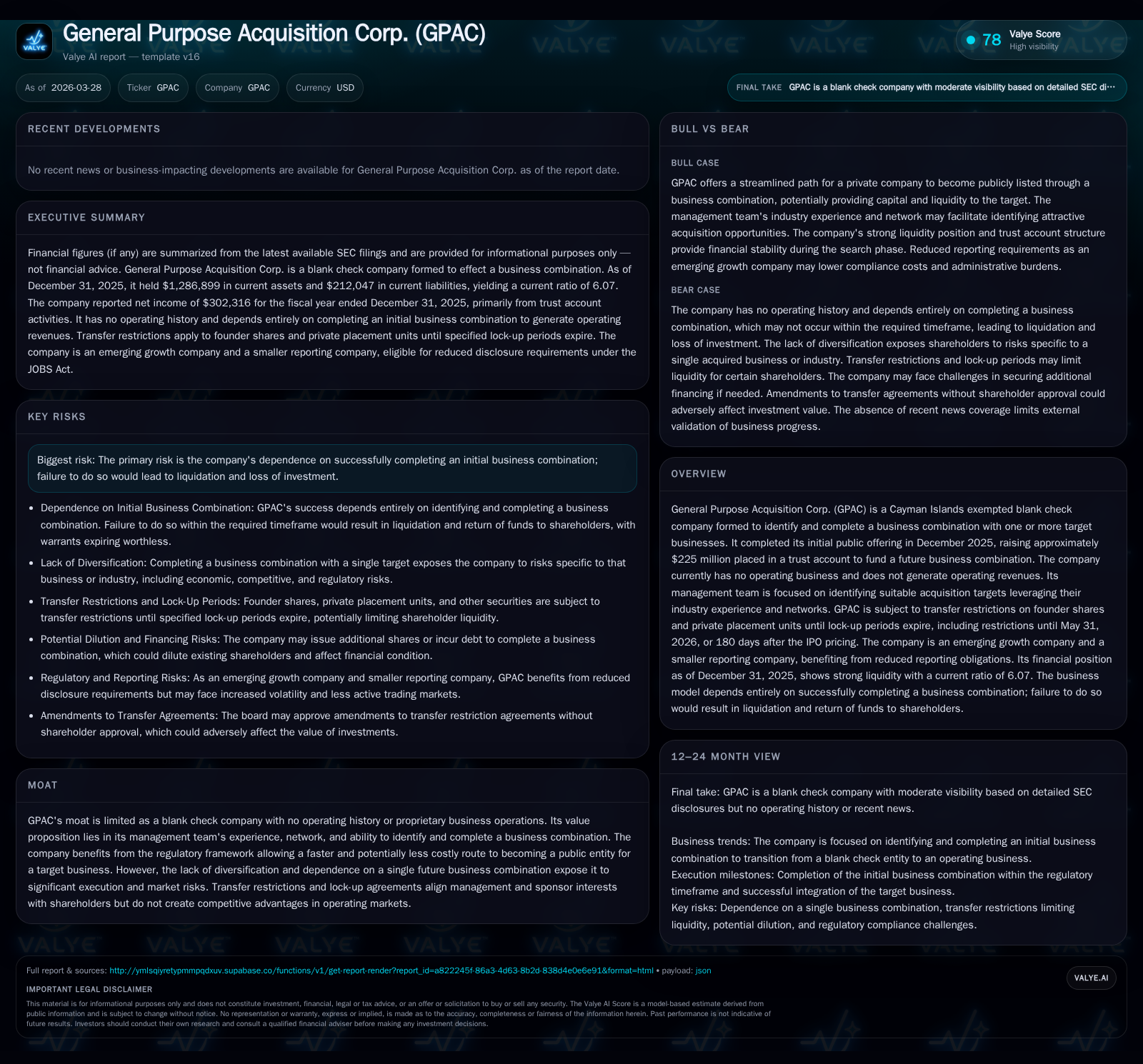
General Purpose Acquisition Corp. (GPAC) launched in December 2025 with an IPO raising roughly $225 million held in trust, positioning itself as a pure acquisition vehicle without operating revenues. Its management team’s networks form the core value proposition, while founder and private placement shares remain under transfer restrictions until mid-2026, aligning sponsor incentives with shareholders but limiting liquidity. The company faces typical SPAC risks, chiefly the successful completion of its initial business combination or else liquidation ensues. Capital structure remains conservative pre-deal with no material debt and no plans for dividends or buybacks prior to business combination.
Early Financial Footprint: IPO Proceeds and Initial Balance Sheet Strength
GPAC's financial foundation is that of a classical special purpose acquisition company, completing its initial public offering in December 2025 raising approximately $225 million, all placed into a trust account specifically earmarked for a future business combination [S1][F1]. This trust account safeguards investor proceeds, insulated from ordinary operational uses until an acquisition transaction closes or the company liquidates if no transaction occurs within 24 months.
As of December 31, 2025, GPAC reported current assets totaling approximately $1.29 million against current liabilities around $212 thousand, resulting in a strong current ratio of roughly 6.07 [F1]. This liquidity profile underscores the company's ability to fund its search for and diligence on prospective targets without pressing short-term solvency concerns. Being an "emerging growth company" under SEC regulations affords GPAC streamlined reporting obligations and extended transition periods on accounting standards, allowing operational focus during its formative phase [S1]. However, it also means less disclosure than established public peers.
Limited Operating History: A Pure Acquisition Vehicle’s Growth Profile
Reflecting its blank check structure, GPAC has no operating revenues and minimal operating expenses limited mostly to administrative costs resulting in an operating loss of roughly $338 thousand for FY2025 [F1]. Notably, the net income figure shows a positive $302 thousand due primarily to financial income rather than core operating activity — highlighting the absence of organic growth drivers pre-business combination.
This profile is expected and typical for SPACs: no traditional growth metrics apply in this stage as the company's value derives solely from its ability to execute a profitable initial business combination that unlocks equity value beyond the trust account holdings.
Sponsor Share Lock-Up Constraints and Management Incentive Alignment
Central to GPAC’s structural dynamics are transfer restrictions binding founder shares (Class B) and private placement units purchased by insiders and affiliates. These securities are subject to lock-up agreements preventing transfer or sale until at least May 31, 2026 — approximately 180 days after the IPO pricing date [S1][S23][S24]. The underwriting agreement further constrains management from disposing of shares without underwriter consent within this period.
These provisions align management's incentives closely with those of public shareholders during the critical early period post-IPO by preventing immediate monetization of their stakes. While this promotes commitment toward consummating an initial business combination and stabilizes share price expectations initially, it simultaneously reduces market liquidity for these insiders' holdings until expiry.
Exceptions exist for permitted transfers such as certain gifts within families or sales connected directly with the initial business combination consummation at original purchase prices — standard terms in SPAC sponsor arrangements [S23]. The potential for board-approved amendments without shareholder consent introduces some governance uncertainty that may affect valuation perceptions.
Key Risks Surrounding the Initial Business Combination Execution
The overarching strategic risk for GPAC remains the successful identification, negotiation, and closure of an initial business combination within mandated timelines—failure triggers liquidation per SEC rules resulting in return of trust funds minus expenses and loss of investment returns [S5][S8][S9].
Further complexity arises from possible dilution mechanisms embedded in GPAC's charter documents. The company may issue additional Class A ordinary shares or preference shares at prices below $10 or prevailing market value upon completing a transaction, which could erode existing shareholders' interests significantly [S4][S26]. Moreover, anti-dilution provisions may cause founder shares conversion ratios into Class A shares that amplify dilution effects post-merger.
Post-business combination leverage is currently absent but can be introduced through notes or debt instruments financing acquisitions or operations. Such leverage could constrain profitability through interest burdens and limit strategic flexibility [S4][S10][S14].
Regulatory hurdles also present risks where cross-border transactions trigger reviews by bodies such as CFIUS due to sponsor affiliations with non-U.S. persons—potentially delaying deals or imposing conditions [S8][S21]. Additionally, litigation risk exists concerning disclosures or disputes arising from proxy solicitations related to the deal approval process though no material litigation exists currently [S9].
Capital Structure Dynamics and Liquidity Position Before Deal Announcement
GPAC’s capital structure includes authorized maximum issuances of up to 300 million Class A ordinary shares and 30 million Class B ordinary shares, though only tens of millions have been issued so far with approximately 23.6 million Class A shares outstanding post-IPO along with 5.75 million founder shares [S7]. No preference shares have been issued yet.
Warrants outstanding grant holders rights to exercise at $11.50 per share with potential redemption rights exercisable by GPAC if share prices exceed threshold levels — mechanisms native to SPAC capital structures intended to protect warrant holders’ upside albeit creating possible conflicts since cashless exercises reduce new share counts received versus cash exercises [S1][S3][S7].
Importantly, there is no meaningful debt on GPAC’s balance sheet currently; however, issuance remains feasible after the business combination closes depending on strategy employed for funding or expansion needs [S10][S11][S15]. This conservative stance fits typical SPAC pre-deal prudence ensuring capital preservation.
Forecast Horizon: Metrics to Watch Pre- and Post-Business Combination
Although GPAC has not provided explicit forward guidance or milestones publicly regarding target announcements or deal timelines [N/A], investors should monitor key inflection points including:
- The lifting of sponsor lock-up restrictions around May 31, 2026—potentially increasing insider sale activity.
- Warrant holder behavior relating to exercise decisions especially near redemption thresholds impacting dilution potential.
- Announcements regarding definitive agreements for initial business combinations—timing pressures build as the mandatory deal deadline approaches.
- Disclosures related to any amendments of contractual agreements affecting governance or redemption rights.
- Market reactions around preliminary deal terms given ever-changing regulatory backdrop including geopolitical considerations affecting cross-border targets.
These factors collectively frame the near-term value realization mechanics pivotal for assessing post-combination equity trajectories.
Capital Allocation Approach: Trust Account Holdings, Dividends, and Share Buybacks
By design, funds raised at IPO ($225 million approx.) are quarantined in a trust account solely to finance acquisition(s) or return proceeds upon liquidation; usage prior to business combination for dividends or repurchases is strictly prohibited [S6][S17][S20]. As such, shareholders receive no direct returns such as dividends during this phase; any accretive gains depend entirely on deal success.
Management and sponsors lack commitments or plans for share buybacks ahead of deal completion though private purchases from selling shareholders might occasionally occur subject to regulatory compliance including Rule 10b-18 safe harbor provisions if applicable [S18][S23][S27]. This restricted capital allotment framework maintains dedicated deal-funding resources while aligning stakeholder interests toward consummating transactions without dissipating value prematurely.
Post-deal dividend policies remain uncertain depending on acquired entity characteristics but pre-combination returns typically revolve around trust-account principal protection rather than yield generation—a sector-native expectation grounded in SPAC trust mechanics.
Historical Financial Summary (FY2025)
Historical performance (annual)
| FY |
|---|
| 2025 |
Source: SEC companyfacts cache [F1]. Note: GPAC has only FY2025 data available following its December 2025 IPO; thus year-over-year comparisons are not applicable. Operating loss reflects administrative expenditures typical of pre-combination SPACs; positive net income derives mainly from financial activities unrelated to operating performance.[F1]
This analysis adopts a measured stance recognizing General Purpose Acquisition Corp.'s position as a recently formed blank check vehicle leveraging sponsor expertise under well-defined structural constraints. Its capital base stands robust with over $220 million designated toward transactional pursuits shielded within trust accounts. Sponsor locked founder shares mitigate premature selling risks yet constrain liquidity. Core uncertainties implicate execution risk tied fundamentally to closing an initial business combination within SEC-mandated timeframes amid dilution contingencies borne by anti-dilution features and warrant redemption clauses. Absence of operational earnings necessitates scrutiny emphasizing governance evolution around lock-up expiries and transaction announcements as critical catalysts shaping value realization pathways going forward.
This document is intended solely for informational purposes reflecting data disclosed through official filings as of March 28, 2026. It does not constitute investment advice nor endorsement affirmations regarding any securities discussed herein.
Disclaimer: This is research-only, informational analysis and not investment advice. It may include AI-generated interpretation and general industry context. Always verify important details using primary sources.

Comments