
Presurance Holdings Navigates Strategic Refocus and Capital Challenges Amid Concentrated Market Exposure
The company’s pivot to specialty homeowners insurance is accompanied by ongoing capital support, regulatory remediation, and operational dependencies on third-party administrators.
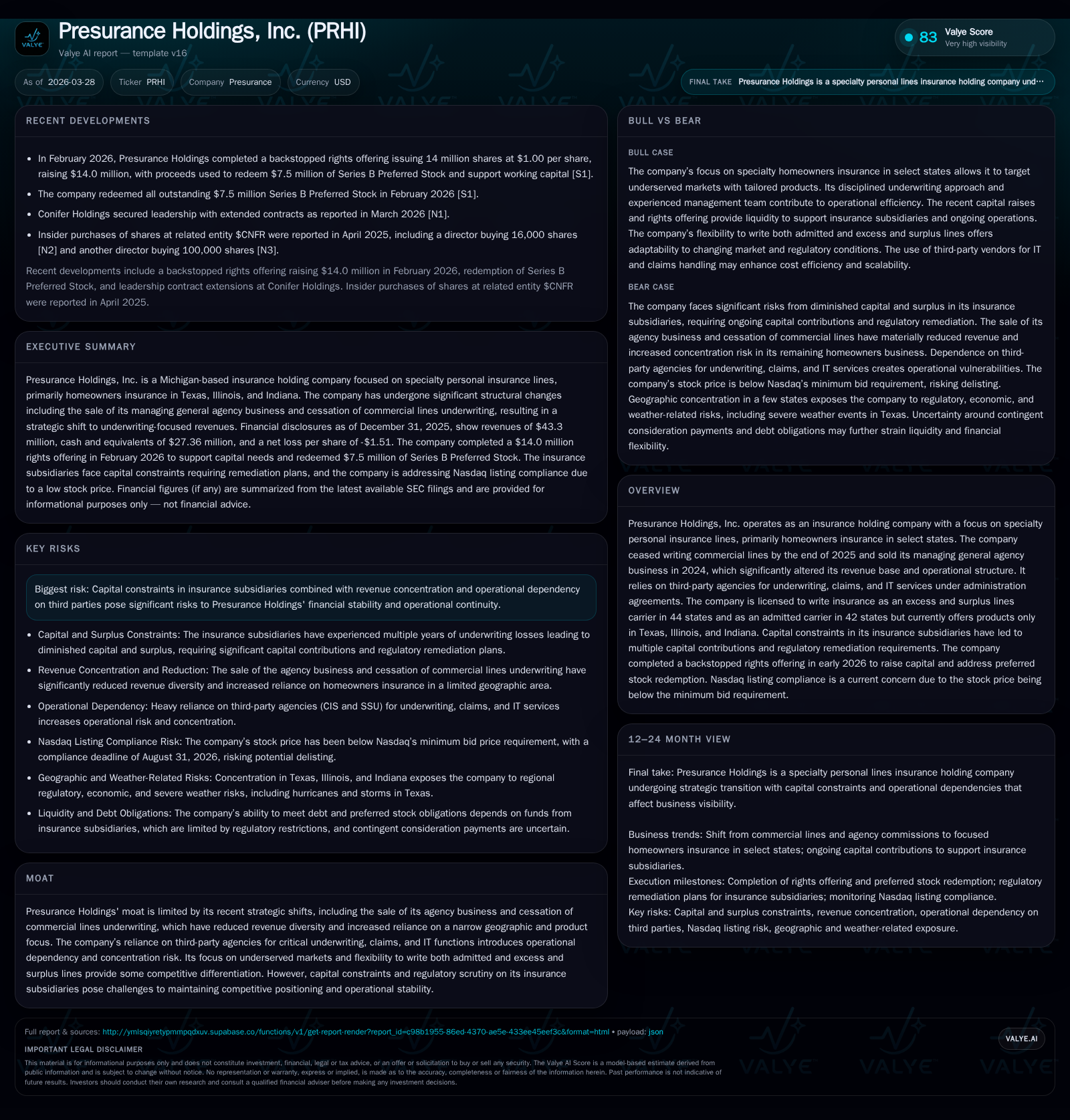
Presurance Holdings, formerly Conifer Holdings, has restructured its operations by exiting commercial lines and divesting its managing general agency business, resulting in a revenue decline of over 35% year-over-year through 2025. The company now focuses exclusively on specialty personal homeowners insurance concentrated primarily in Texas, Illinois, and Indiana. Its insurance subsidiaries continue to face capital constraints requiring multiple injections, with Triassic Insurance Company operating under Michigan’s Company Action Level. Operational functions such as underwriting and claims administration are outsourced to third parties following the sale of CIS. In February 2026, Presurance raised $14 million through a backstopped rights offering, partly used to redeem Series B Preferred Stock. Going forward, growth depends on stabilizing underwriting results within a narrow product set while managing regulatory capital requirements and concentrated risk exposure.
Company Background and Strategic Transformation
Presurance Holdings Inc., a Michigan-based insurance holding company formerly known as Conifer Holdings, has undergone significant operational restructuring [S1]. The company exited its commercial lines business by year-end 2025 and sold its managing general agency subsidiary Conifer Insurance Services (CIS) in August 2024 [S12]. These changes narrowed Presurance's focus exclusively to specialty personal homeowners insurance.
CIS historically managed critical functions such as underwriting authority, claims administration, IT infrastructure, billing, and agent commissions [S9]. Following the divestiture, these functions have been outsourced under contracts to third-party administrators, reducing internal staff levels but increasing operational reliance on external partners [S9].
Historical Financial Performance
Presurance has faced continued underwriting losses primarily driven by legacy commercial lines exposures [F1], [S11]. The financial performance reflects this trajectory:
Historical performance (annual)
| FY | Rev ($mm) | CFO ($mm) | OpInc ($mm) | Rev YoY |
|---|---|---|---|---|
| 2025 | 43 | -26 | -35.6% | |
| 2024 | 67 | -37 | -31.9% | |
| 2023 | 99 | -13 | -31 | -5.8% |
| 2022 | 105 | -40 | -28 |
Source: SEC companyfacts cache [F1].
*Declines between FY24 and FY25 correlate with the CIS sale and commercial lines wind-down [F1], [S12]. Although operating losses remain significant, there is some improvement post-restructuring.
Capital Structure and Liquidity
Capital adequacy remains a key challenge for Presurance’s insurance subsidiaries [S11], [S26]. Triassic Insurance Company (TIC), the primary underwriting entity after restructuring, was within Michigan's Company Action Level as of December 31, 2025, with an RBC ratio of approximately 236%, necessitating submission of remediation plans to regulators [S11].
The Parent Company supported TIC through multiple capital contributions including $16 million during late 2024/early 2025 and an additional $3 million in February 2026 [S11].
At the Parent level, Presurance issued Series B Preferred Stock raising $7.5 million in early 2025 and Series C Preferred Stock for $8 million in December 2025 [S11]. The February 2026 backstopped rights offering generated gross proceeds of $14 million at $1 per share; part of these proceeds redeemed all outstanding Series B Preferred Stock ($7.5 million), with remaining funds supporting working capital [S1], [S7].
Outstanding senior unsecured notes totaled approximately $12.9 million at year-end with fixed coupon obligations limiting financial flexibility amid uncertain access to new debt or hybrid capital due to withdrawal from credit rating processes [S6], [S17].
Product Concentration and Market Focus
Following strategic exits, Presurance writes only specialty homeowners insurance products primarily distributed through Sycamore Specialty Underwriters (SSU), an MGA it no longer controls [S10]. Gross written premium is heavily concentrated geographically: approximately 79% from Texas with smaller portions from Illinois (3%) and Indiana (3%) as of December 31, 2025 [S10]. Commercial line premiums have effectively run off.
This geographic concentration increases exposure to localized catastrophe risk and regulatory changes within these states' admitted or excess & surplus markets where TIC operates both admitted and E&S policies [S10]. Reliance on a single MGA for distribution further concentrates operational risk.
Operational Dependencies
Post-sale of CIS, critical operational functions including underwriting discipline enforcement, claims management, billing, policy administration systems, and premium collections are conducted by third-party MGAs or claims administrators under binding authority agreements [S9], [S22].
While outsourcing reduces fixed costs, it introduces risks related to oversight quality control and continuity if these relationships change or terminate unexpectedly. The company's internal staff is minimal (~12 employees), limiting direct control over core insurance functions [S9].
Claims Reserves and Adverse Development
Legacy commercial lines experienced significant adverse reserve development totaling over $42 million during 2024-25 for TIC alone [S11], [S25]. This necessitated incremental capital infusions which strained financial resources.
Future reserve adequacy remains a material risk factor that could require further capital or trigger regulatory action impacting equity value.
Regulatory Environment & Legal Risks
As an insurance holding company domiciled primarily in Michigan with subsidiaries licensed across multiple states, Presurance operates under extensive solvency regulation aimed chiefly at protecting policyholders rather than shareholders [S14], [S20], [S26]. Minimum Risk Based Capital requirements must be maintained; failure results in remedial regulatory actions.
TIC's status within Michigan's Company Action Level requires ongoing remediation plans as of December 31, 2025 [S11], [S26]. Additionally, shareholder litigation concerning preferred stock sales adds governance uncertainty amid transformation efforts [S15].
Growth Outlook Considerations
Growth prospects are constrained absent stabilization of statutory capital positions alongside improvements in underwriting profitability within a narrow homeowners product line distributed via limited channels.
Management highlights flexibility afforded by writing both admitted and excess & surplus policies allowing pricing responsiveness across markets but geographic concentration amplifies catastrophe risk exposure [S10].
Expansion into additional states or product lines would require addressing operational capacity limitations given the lean internal structure post-CIS sale.
Monitoring remediation progress under Michigan’s RBC regime alongside reserve development trends will be critical indicators for future stability.
Milestones to Monitor
- Compliance with Nasdaq minimum bid price rule by August 31, 2026 following notification regarding share price deficiency as of March 3, 2026 [S1], [S7].
- Quarterly updates on reserve developments especially related to legacy commercial line runoff portfolios.
- Effectiveness of MGA-driven distribution model integration amid inflationary cost pressures affecting property lines claims.
- Additional capital raising activities or deleveraging efforts impacting shareholder dilution or credit profile stability.
- Progression of shareholder litigation challenging past financing transactions impacting governance dynamics.
Capital Allocation & Returns Summary
No dividends have been declared recently reflecting liquidity constraints coupled with regulatory limitations restricting dividend payments from insurance subsidiaries necessary for solvency maintenance [F1], [S6].
Operating cash flows remain negative; the latest available CFO was -$13.4 million in FY2023 with free cash flow similarly negative when accounting for capex trends which remain minimal but steady at low levels [F1]. Equity infusions rather than internal cash generation have supported balance sheet stability recently.
Historical share repurchases ceased years ago consistent with preservation priorities during periods of operating loss absorption [F1].
Return metrics illustrate ongoing challenges; approximate ROE was -289% at FY2025 based on net income relative to equity base underscoring persistent unprofitability despite restructuring efforts [F1].
Overall focus remains on maintaining going concern status amidst operating losses while navigating recapitalization initiatives rather than generating shareholder returns currently.
This report is intended solely for informational purposes without any recommendation related to investment decisions.
Disclaimer: This is research-only, informational analysis and not investment advice. It may include AI-generated interpretation and general industry context. Always verify important details using primary sources.

Comments