
VanEck Merk Gold ETF Surges with Physical Gold Demand and Share Expansions
The Trust’s robust share growth and soaring net income reflect gold price dynamics alongside its allocated bullion structure.
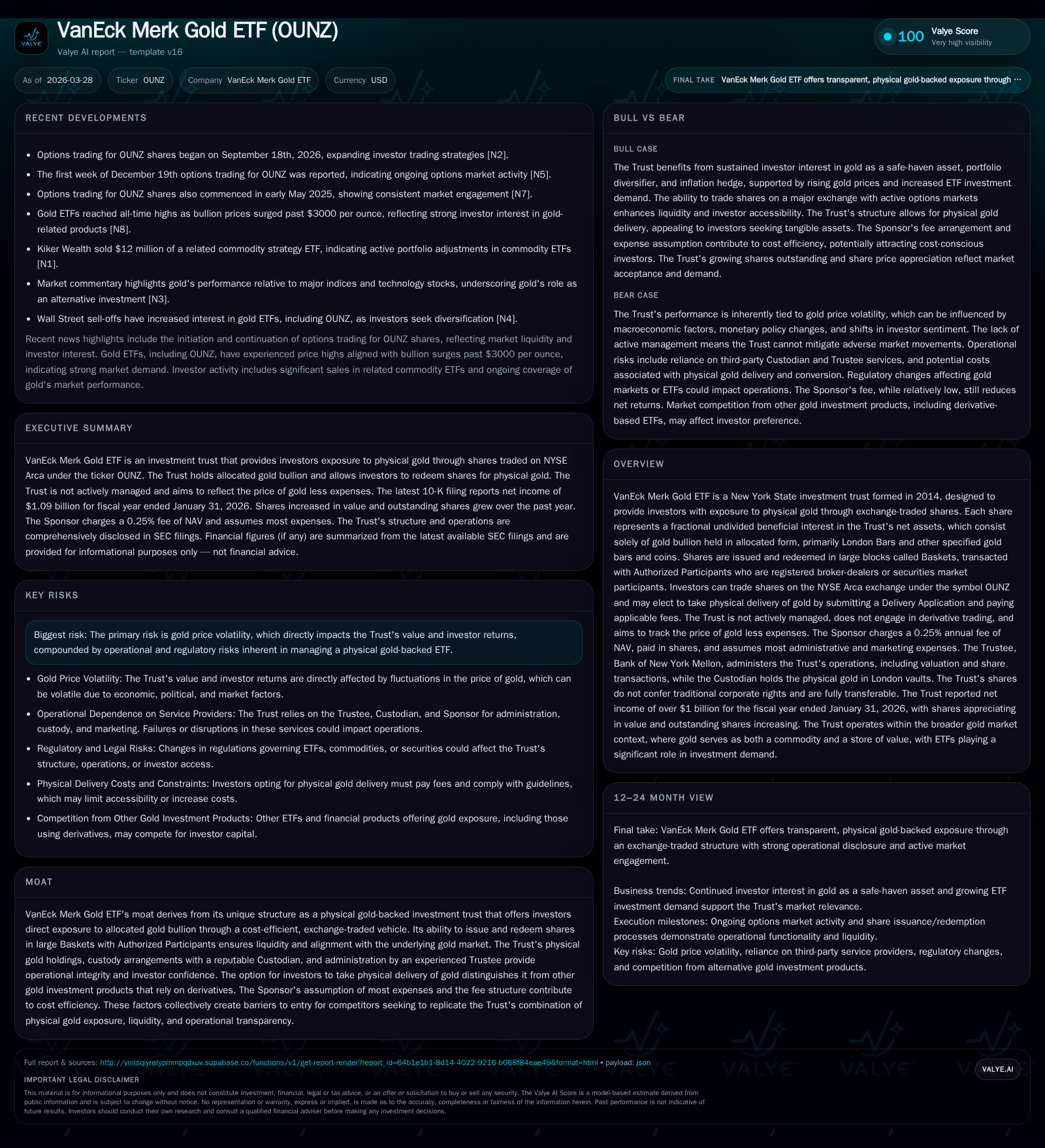
VanEck Merk Gold ETF (OUNZ) has exhibited strong financial progression marked by accelerating net income growth through 2026, driven primarily by increases in gold prices and physical gold demand. The Trust’s distinctive structure—holding allocated physical gold bullion including London Bars—and its redemption feature allowing physical delivery underpin investor confidence and liquidity. Operating within a 0.25% fee framework and without active management, OUNZ aligns closely with gold price movements while managing operational risks related to custody and market volatility.
From Inception: Evolution of VanEck Merk Gold ETF’s Growth Drivers
VanEck Merk Gold ETF (ticker: OUNZ) was formed in May 2014 as a New York State investment trust designed expressly to provide investors with direct exposure to physical gold through exchange-traded shares. Unlike derivative-heavy gold ETFs, OUNZ holds only allocated physical gold bullion — predominantly London Bars meeting LBMA standards — held securely by a reputable Custodian. The Trust issues shares in large blocks known as Baskets (each consisting of 50,000 shares) exclusively through Authorized Participants who are registered broker-dealers or qualified securities market participants [S1].
This basket-based creation/redemption mechanism underpins the Trust's liquidity model whereby Baskets are created or redeemed at net asset value through transfer of the corresponding amount of physical gold to or from the Trust. This ensures that shares precisely track underlying bullion holdings without exposure to derivatives or futures contracts common in other gold ETFs [S1, S6]. The mechanism mitigates tracking errors and supports institutional-scale trading.
Throughout its history since inception, OUNZ has evolved its structure through multiple name changes reflecting branding adjustments but maintaining core operational consistency: from Van Eck Merk Gold Trust initially to VanEck Merk Gold ETF as of August 2024 [S1]. The fundamental mission remains constant: providing a secure, transparent conduit for physical gold ownership within a cost-efficient exchange-traded vehicle.
2025-2026 Financial Surge and Year-over-Year Performance Metrics
Financially, OUNZ's performance notably accelerated over recent years concomitant with rising gold prices and increased share issuance. Tabulated below are key fiscal year data spanning FY2018 through FY2026 derived from available company filings showing net income turning sharply positive after years of losses attributable mainly to expense accruals relative to assets under management:
Historical performance (annual)
| FY | Net ($mm) | Net YoY |
|---|---|---|
| 2026 | 1093 | +249.0% |
| 2025 | 313 | +726.3% |
| 2024 | 38 | |
| 2022 | -17 |
Source: SEC companyfacts cache [F1].
Capital returns and efficiency (annual)
| FY | ROE% |
|---|---|
| 2026 | 37.6 |
| 2025 | 23.8 |
| 2024 | |
| 2022 |
Source: SEC companyfacts cache [F1].
The dramatic increase in net income particularly between FY2025 and FY2026 — a jump of approximately $779 million — reflects appreciation in the underlying gold price coupled with sizable growth in shares outstanding (from ~48.7 million shares to over 62.3 million shares), which expands the Trust's asset base [F1], [S1]. Despite persistently negative operating income caused mainly by ongoing expenses (including Sponsor Fee amortization), the high returns on equity attest to capital efficiency considering the Trust’s unique non-corporate structure.
Calculated ROE for FY2026 stands near 37.6%, indicating robust profitability relative to net asset equity balances foundationally supported by physical bullion appreciation rather than typical business operations [F1].
Physical Gold Custody and Unique Redemption Features Supporting Investor Confidence
Underlying OUNZ’s structural moat is its meticulous approach to physical gold custody. The Trust maintains allocated accounts where London Bars — universally recognized as standard bearer bullion — constitute the majority of holdings. To preserve liquidity flexibility while controlling risk exposure, unallocated gold held by the Custodian is strictly limited to no more than 430 fine ounces at any close of business day; this weight corresponds roughly to one London Bar [S6].
Physical delivery distinguishes OUNZ from many commodity funds: investors can redeem Shares for precise amounts of physical gold through a formal Delivery Application process that mandates approval by the Sponsor followed by transfer instructions executed via broker-dealers affiliated as Authorized Participants [S5]. Processing fees cover preparation and transportation costs linked to delivering bullion bars or coins reflecting the exact fine ounces represented by surrendered Shares.
Should the precise fine ounces delivered differ marginally from Shares tendered due to denomination granularity limitations, excess ounces will be liquidated with proceeds returned as cash credits ensuring minimal residual imbalance for the investor [S5], further enhancing trust in transactional fairness.
Custody controls rely heavily on JPMorgan acting as Custodian under oversight from various banking regulators including Federal Reserve entities and U.K.'s Prudential Regulation Authority; though specific governmental regulation does not extend directly to bullion custody operations themselves, adherence to LBMA good practices serves as an industry benchmark [S15], heightening operational integrity.
Gold Price Volatility: Impact on Fund Valuation and Risk Profile
The value proposition of OUNZ is inseparably tied to price movements of physical gold itself. Gold pricing exhibits significant volatility subject to macroeconomic factors such as supply-demand shifts influenced by mining production levels, central bank activity (notably purchases and sales), geopolitical events impacting global markets, currency fluctuations—particularly USD exchange rate volatility—and monetary policy decisions driving interest rate changes [S1], [S3].
While OUNZ aims to replicate these price dynamics minus operational expenses, this linkage exposes investors directly to sharp price swings without risk mitigation instruments like derivatives or futures that might otherwise dampen fluctuations. Consequently, investors face potential losses if selling occurs during downturns or sustained flat pricing periods despite long holding durations.
Importantly, no assurances exist guaranteeing perpetuation of historically elevated trading prices seen in recent years; adverse economic events or shifts in investor sentiment could depress prices materially impairing NAV values per Share [S1]. This inherent market risk forms the core risk profile communicated candidly in regulatory disclosures.
Capital Allocation Focus: Fees, Dividends, and Liquidity Management
OUNZ operates under a lean expense framework wherein the Sponsor charges an annualized fee of precisely 0.25% of NAV for administering operations including Trustee remuneration, Custodian fees, audit costs, marketing expenses, and legal fees up to defined limits [S7], [S12]. Notably, the Sponsor absorbs most administrative expenses beyond this fee base enhancing overall cost efficiency compared with funds imposing layered expense ratios.
The Trust does not pay dividends or conduct share buybacks reflective of its nature as an investment trust holding physical commodities rather than equity interests generating operating profits distributable via payouts [S4], [S5]. Furthermore, cash flows revolve primarily around payment of fees plus occasional sales of small amounts of gold necessary for extraordinary expenses not covered by Sponsor commitments; such sales are managed judiciously to avoid unnecessary depletion of holdings impacting NAV substantially [S8], [S18].
Given this setup, traditional corporate metrics such as return on assets or conventional ROI require contextual reinterpretation focusing instead on ROE derived from net income relative to equity representing proportional beneficial interests in tangible bullion assets rather than earnings from business activities per se.
Authorized Participants’ Role in Share Creation and Redemption Dynamics
Central to liquidity provision are Authorized Participants—entities qualifying as registered broker-dealers or functional securities market participants required also to maintain Depository Trust Company (DTC) membership enabling book-entry settlement capabilities [S6], [S7]. Their role entails facilitating creation and redemption transactions via exchange of Baskets for corresponding amounts of fine ounces of gold held by the Trust.
The creation/redemption process is governed under contractual frameworks—including Authorized Participant Agreements—that codify procedures encompassing timing requirements (e.g., delivery deadlines within three business days), transaction fees ($500 per operation), lawful order submission protocols and coordination among Trustee, Custodian, DTC infrastructure providers plus precious metals dealers when applicable for bar exchanges requested by Delivery Applicants seeking alternate forms like coins or smaller bars than London Bars currently held by the Trust [S7], [S22].
These intermediaries operate distinctively relative to retail shareholders owning Shares indirectly via brokerage accounts; they execute market-making functions vital for maintaining continuous secondary market liquidity consistent with SEC requirements for ETFs though tailored specifically for this uniquely structured trust vehicle.
Outlook and Forward Indicators to Monitor in OUNZ’s Trajectory
From an analytical perspective absent speculative forecasts, several directional indicators warrant close observation regarding future trajectory:
- Sustained demand trends globally for physical gold including purchases by central banks—as reflected recently with countries augmenting reserves—could continue lifting OUNZ's asset base if mirrored by expanded Basket issuances facilitated through Authorized Participants [S24].
- Inflation expectations alongside interest rate trajectories remain pivotal macroeconomic variables shaping investor appetite for inflation hedges like gold affecting fund valuation stability.
- Any modifications announced by Merk Investments LLC regarding Sponsor fee structures or operational guidelines could influence cost efficiencies embedded within current models.
- Market acceptance trends relating specifically to investors exercising Delivery Applications offering optionality rarely available among competing products could serve both as growth catalysts or constraints depending on practical uptake realization.
- Continued adherence by Custodian entities along with Trustee oversight effectiveness around security control measures against potential system disruptions represent ongoing operational risk considerations critical for maintaining investor confidence.
These factors collectively frame key metrics investors might monitor through periodic reporting submissions alongside external economic environment developments.
Disclaimer: This report does not constitute investment advice or recommendations. All analysis is based solely on information filed with the Securities and Exchange Commission and publicly available disclosures up to March 28, 2026. Past performance is not indicative of future results.
Disclaimer: This is research-only, informational analysis and not investment advice. It may include AI-generated interpretation and general industry context. Always verify important details using primary sources.

Comments