
Cambridge Acquisition Corp.: SPAC Formation and Capital Positioning Ahead of Initial Business Combination
A newly formed SPAC with capital locked in trust targets disruptive sectors but faces execution risk without an identified business combination.
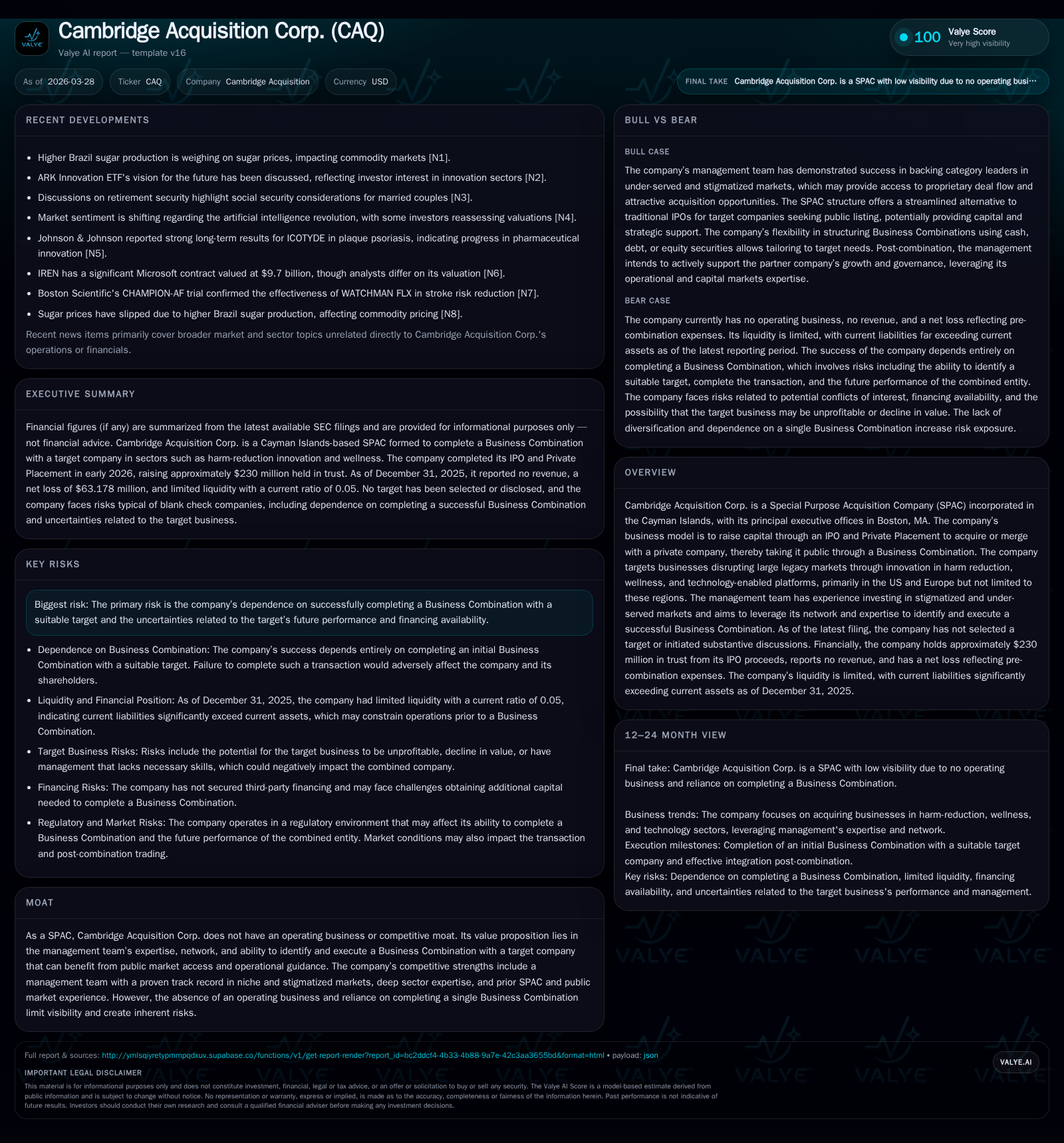
Cambridge Acquisition Corp. launched its IPO in early 2026, raising approximately $230 million to pursue an initial business combination within a 24-month window. Focused on high-growth, under-served markets such as harm reduction and wellness, the company leverages a management team experienced in niche sectors and prior SPAC transactions. Financially, it maintains a strong trust account balance but has yet to select a target or secure third-party financing, creating inherent uncertainties around its future performance and capital allocation.
Company Overview and Historical Context
Incorporated in the Cayman Islands on October 24, 2025, Cambridge Acquisition Corp. (ticker CAQ) is a Special Purpose Acquisition Company (SPAC) formed to merge with or acquire one or more private companies within two years post-IPO to facilitate their transition into publicly listed entities [S1,S3]. The company has no revenue-generating activities to date and functions solely as an acquisition vehicle relying on management's ability to identify promising targets.
The company completed its initial public offering (IPO) on February 9, 2026, issuing 23 million units at $10 each—this includes full exercise of the underwriters’ overallotment option adding 3 million units. Concurrently, the sponsor made a $4.95 million private placement acquisition of approximately half a million units identical in structure to the public units [S1,S13,S21].
Financial Position and Capital Structure
Post-IPO proceeds totaling $230 million were placed into an interest-bearing U.S.-based trust account managed by Continental as trustee. After deducting deferred underwriting fees of approximately $8 million, about $222 million remains reserved exclusively for business combination purposes [S4,S6]. Nasdaq listing rules require that at least 80% of trust assets be deployed toward acquisitions.
Reflective of its startup phase as a blank check company with no operations yet, Cambridge reported net income of negative $63,178 USD for the year ended December 31, 2025 [F1]. Current assets stood at approximately $5,870 against current liabilities exceeding $107,784 resulting in a low current ratio near 0.05—an accounting artifact typical for companies pre-acquisition [F1].
The company’s capital structure includes Class A ordinary shares for public investors and Class B shares held by founders and insiders, along with redeemable warrants allowing holders potential incremental equity participation post-business combination [S3,S1]. Founder shares carry anti-dilution provisions which could dilute public shareholders upon conversion depending on new equity issuance related to the acquisition transaction [S28].
Historical performance (annual)
| FY |
|---|
| 2025 |
Source: SEC companyfacts cache [F1].
Business Model and Investment Strategy
Cambridge Acquisition Corp.’s investment focus is on high-growth companies disrupting large legacy markets through innovations in harm reduction technologies (e.g., nicotine alternatives), hemp-derived consumables, psychedelics regulatory shifts, functional botanicals targeting wellness, as well as emerging sectors like gaming and the "love economy"—platforms focused on intimacy and connection services [S11,S27].
Management comprises individuals with deep experience navigating complex regulatory environments characteristic of stigmatized industries. Their track record includes significant involvement in companies pioneering nicotine harm reduction and psychedelic therapeutics [S11,S27]. This specialized focus provides proprietary deal flow from sector relationships often inaccessible to generalist investors.
Investment criteria emphasize:
- Clear competitive advantages establishing market leadership,
- Strong growth potential supported by unit economics,
- Visionary management teams capable of execution and innovation,
- Attractive valuations relative to peers,
- Benefit from access to public markets for capital raise or deleveraging.
Geographically the focus prioritizes U.S. and European targets aligned with favorable regulatory trends but does not restrict other regions [S11].
Execution Timeline and Outlook
Nasdaq rules mandate completing an initial business combination by February 9, 2028—two years from IPO closing—unless extended by shareholder approval [S21]. Failure triggers liquidation returning funds held in trust less transaction costs.
As of filing date there are no disclosed target candidates or ongoing third-party financing arrangements; management retains flexibility to secure additional capital if needed [S4,S6]. Execution risk remains elevated given absence of announced deal activity alongside market volatility impacting valuation consensus for potential targets.
Key investor considerations include:
- Announcement of qualified acquisition candidates aligned with stated thematic sectors,
- Negotiation details regarding consideration mix (cash/equity/debt) tailored to target needs,
- Potential extensions of Combination Period via shareholder votes,
- Insider transactions affecting liquidity or shareholder composition [S19,S22].
Capital Allocation and Shareholder Returns Considerations
Prior to consummation of an initial business combination:
- Trust account funds generate limited interest income adjusted per prevailing rates,
- No dividends or share repurchases occur due to absence of distributable earnings or operational cash flow generation [F1],[S25,S26],
- Post-merger capital structure decisions will influence leverage profiles and equity valuations affecting investor returns over time,
- Sponsor founder shares typically convert into Class A shares at closing; anti-dilution provisions impact ownership concentration and alignment between insiders and public shareholders [S28].
Risks Summary
Primary risks include:
- Dependence on completing one or more attractive business combinations within prescribed timelines,
- Identification challenges amid evolving regulatory landscapes especially in novel markets like psychedelics,
- Accessing favorable financing if acquisition pricing exceeds available cash resources,
- Potential conflicts arising from directors’ involvement across multiple SPACs targeting overlapping themes,
- Market receptivity post-merger hinging on integrated entity’s ability to execute strategic milestones enhancing shareholder value.
Cambridge Acquisition Corp.’s value proposition rests heavily on management’s network depth and sector insight rather than tangible assets today—a profile requiring thorough due diligence throughout transactional phases.
This report is prepared solely for informational purposes without offering investment advice or recommendations regarding purchase or sale of securities. The analysis synthesizes data from SEC filings up to March 27, 2026 ([S1]–[S29]) together with financial snapshots ([F1]) without speculative extrapolation beyond provided facts.
Disclaimer: This is research-only, informational analysis and not investment advice. It may include AI-generated interpretation and general industry context. Always verify important details using primary sources.

Comments