
Utah Medical Products: Balancing Proven Innovation with Emerging Market Pressures
UTMD leverages a legacy of clinician trust and device differentiation to sustain growth despite intensifying pricing and market access challenges.
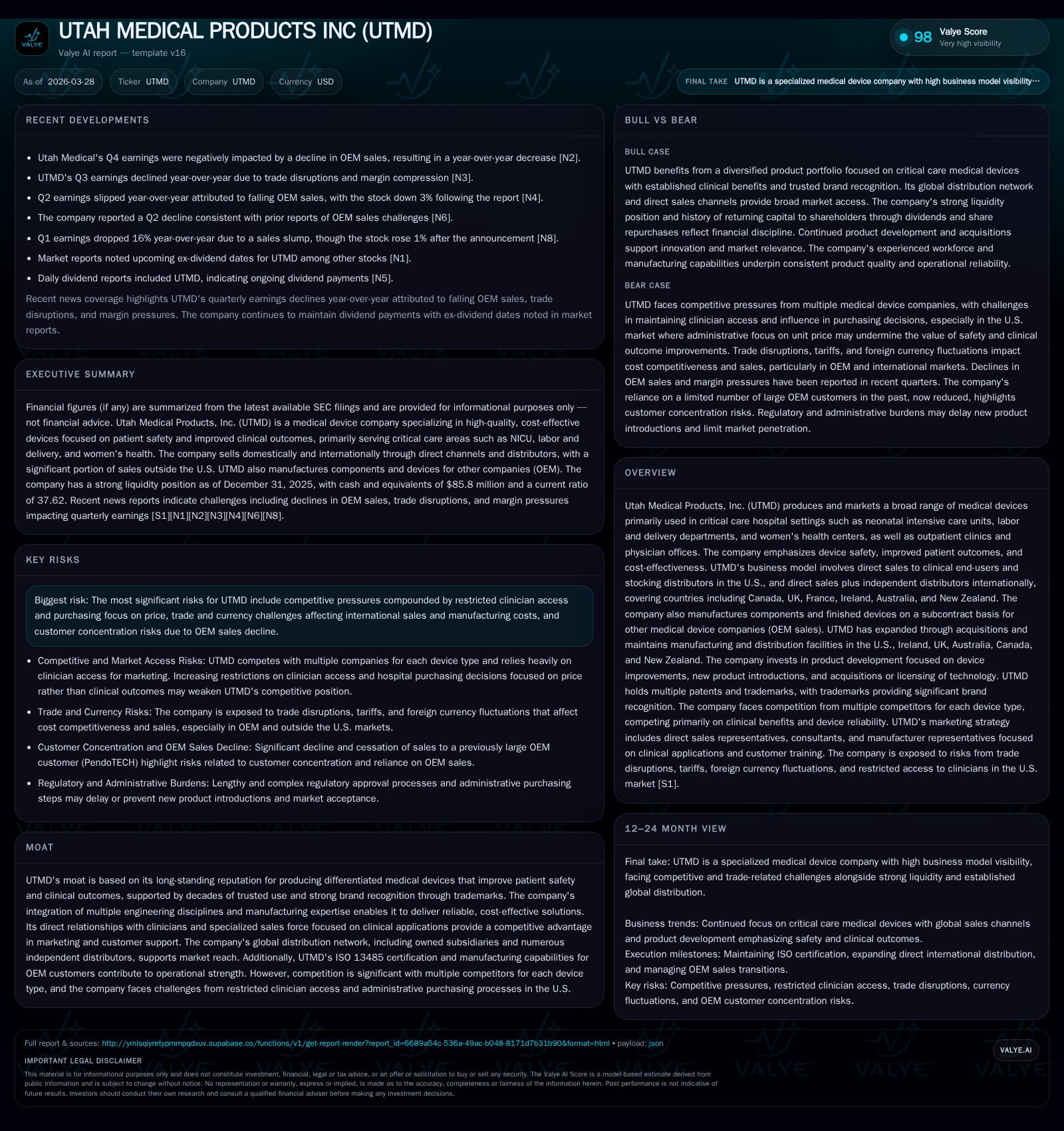
Utah Medical Products (UTMD) has built its reputation on delivering differentiated medical devices emphasizing patient safety and clinical outcomes, especially in neonatal intensive care, labor and delivery, and women's health. Historically, moderate revenue growth has been driven by direct sales to clinical end-users and OEM partnerships, though profitability contracted in 2025 amid reduced OEM sales and competitive pressures. The company faces significant headwinds from restricted clinician purchasing influence, group purchasing organization (GPO) bargaining power, and international trade disruptions affecting foreign revenues. With strong operating cash flow and substantial cash reserves, UTMD continues to invest in incremental product innovation and maintains shareholder returns through dividends and buybacks. Going forward, growth will be contingent upon navigating hospital procurement dynamics, expanding adoption of new products in clinical settings, and mitigating currency and tariff risks internationally.
Legacy of Growth: Historical Performance and Drivers
Utah Medical Products has demonstrated steady albeit modest growth over recent years. Reported revenue increased to approximately $41.4 million in fiscal year 2025, marking a 5.4% year-over-year advance from the prior year [F1]. Despite this top-line progression, operating income suffered a sharp contraction of 16.1%, falling to about $11.4 million [F1], indicative of margin pressure primarily linked to diminished OEM sales volume—a significant contributor that historically bolstered profitability.
Net income followed suit with an 11.6% drop to roughly $2.6 million in FY2025 [F1], showing tighter earnings even as modest sales gains persisted. Operating cash flow held sturdily at nearly $14.7 million [F1], highlighting good cash generation from core operations despite earnings softness.
This performance reflects UTMD's reliance on direct clinical device adoption coupled with subcontract manufacturing for other medical device companies (OEM sales). The decline in OEM revenues notably impacted margins given that OEM is typically a higher-volume business segment [S4], contributing an outsized portion of consolidated profits when healthy.
Historical performance (annual)
| FY | Net ($mm) | CFO ($mm) | OpInc ($mm) | Capex ($) | Net YoY |
|---|---|---|---|---|---|
| 2025 | 3 | 15 | 11 | 371000 | -11.6% |
| 2024 | 3 | 15 | 14 | 230000 | -32.3% |
| 2023 | 4 | 22 | 17 | 639000 | -5.9% |
| 2022 | 5 | 21 | 20 | 809000 |
Source: SEC companyfacts cache [F1].
Capital returns and efficiency (annual)
| FY | Div ($mm) | Buybacks ($mm) | FCF ($mm) |
|---|---|---|---|
| 2025 | 4 | 8 | 14 |
| 2024 | 4 | 20 | 15 |
| 2023 | 4 | 0 | 22 |
| 2022 | 3 | 2 | 20 |
Source: SEC companyfacts cache [F1].
Note: The revenue figure for FY2017 ($41.4M) is the latest explicit value; subsequent years do not report exact annual revenue values.
Clinical Differentiation as a Strategic Moat
UTMD's principal competitive advantage derives from its portfolio of specialty medical devices designed primarily for critical care hospital settings including neonatal intensive care units (NICU), labor and delivery suites, and women's health centers [S7]. Devices are distinguished by their integration of multidisciplinary engineering disciplines encompassing electronics, software, mechanical assembly, plastics processing, and instrumentation.
The company’s well-recognized brands—such as the Filshie Clip System acquired via Femcare—are deeply entrenched due to proven patient safety benefits and clinical outcome improvements documented over decades [S4]. This entrenched use cultivates clinician loyalty that resists commoditization despite the availability of substitute or lower-cost alternatives.
Marketing efforts focus heavily on knowledgeable clinical end-users responsible for outcomes rather than price alone [S4]. However, UTMD faces erosion risks as hospital administrative purchasing increasingly sidelines clinicians’ influence—an important marketing channel traditionally leveraged for these nuanced devices [S4]. The challenge lies in preserving differentiation narratives amidst buyer preference shifts toward upfront unit cost savings rather than long-term total cost-of-care advantages.
Geographic Footprint and Channel Dynamics
The company's geographic spread features substantial U.S.-based direct selling complemented by a broad network overseas encompassing Canada, UK, Ireland, Australia, New Zealand, plus approximately two hundred independent regional distributors worldwide [S5][S6][S7].
In the U.S., UTMD sells mostly direct to clinical end-user facilities or stocking distributors; however, hospital supply is highly shaped by Group Purchasing Organizations (GPOs), whose consolidation limits supplier leverage due to contracts prioritizing price over unique clinical benefits [S6]. This dynamic forces UTMD sometimes to supply via large national distributors servicing hospitals per GPO mandates—a channel accounting for roughly fifteen percent of domestic non-OEM sales [S6].
Internationally, approximately forty-one percent of consolidated revenues stem from outside the U.S., denominated mostly in local currencies that introduce translation risk amidst fluctuating foreign exchange rates [S5]. Reciprocal tariffs implemented in recent years have further complicated cross-border trade economics notably increasing device costs overseas [S16]. To counterbalance such tariff effects, UTMD plans greater reliance on its Ireland manufacturing site for OUS orders previously shipped directly from U.S.-based facilities starting in calendar year 2026 [S14].
OEM sales supply devices or components manufactured under subcontract arrangements primarily to other medical device companies [S7]. While this line expands capacity utilization benefits through economies of scale at UTMD’s plants certified to ISO13485 standards for quality systems, it also exposes the company to intense low-wage competition especially from Mexico, Eastern Europe, India and China [S5]. In FY2025 OEM contribution declined sharply after peaking in FY2022 due to lost volumes with top customers like PendoTECH [S13].
Financial Health: Profitability, Cash Flow, and Returns
Operational profit margins compressed materially over the past three years despite relatively stable revenue growth leading into FY2025’s operating income near $11.4 million—a roughly one-sixth decline versus FY2024 levels [F1]. Net earnings settled around $2.57 million translating into an approximate return on equity near 2.2%, reflective of cautious reinvestment policies amid profitability erosion [F1].
Operating cash flow remained robust at almost $14.7 million owing partly to disciplined working capital management though slightly below prior year figures (-0.9%) [F1]. Capital expenditures stayed restrained at $371 thousand supporting manufacturing maintenance rather than capacity expansion or large-scale innovation projects [F1].
The company’s balance sheet features high liquidity with nearly $85.8 million in cash equivalents versus current liabilities just under $2.6 million producing an exceptionally strong current ratio above thirty-seven—underscoring formidable financial flexibility uncommon among small-cap medtech entities [F1][S10][S18].
UTMD has historically favored consistent shareholder returns combining dividends (~$3.98 million in FY2025) with opportunistic share repurchases ($8.35 million deployed in FY2025), balancing distributions against substantial free cash generation estimated near $14.3 million [F1]. This approach conserves capital for strategic uses including M&A or internal development while sustaining shareholder engagement.
Innovation Pipeline and Product Development Initiatives
Product development lies at the core of UTMD’s market identity emphasizing incremental enhancements responding directly to clinician input plus occasional acquisitions complemented by manufacturing process improvements targeting cost control [S8].
Annual R&D investment approximates two percent of annual revenues focused across several priority areas including augmentation/internal manufacturing enhancements for existing NICU devices; specialized procedural tools addressing cervical/uterine disease assessment; labor & delivery monitoring innovations; biopharmaceutical industry pressure sensors; as well as OEM product developments [S8][S17].
Development operates within tightly controlled project management structures assembling interdisciplinary teams tasked with ensuring new products meet rigorous clinical acceptability, manufacturability certifications including timely regulatory clearances chiefly FDA approvals or equivalent CE marks abroad before marketing launch [S8][S15]. The pipeline’s major bottleneck is often institutional delays evaluating new technologies exposing time-to-market limitations.
Market Challenges: Pricing Pressure, Access Limitations, and Competition
UTMD confronts considerable headwinds stemming from consolidated hospital supply chains managed increasingly through GPOs compressing pricing power despite clinically differentiated offerings valued by end-user practitioners—a channel facing growing bureaucratic hurdles limiting UTMD’s ability to articulate full patient safety benefits during procurement processes [S4][S6][S9][S12].
Competitive landscapes are fragmented yet intense—with each specialty device type having at least two formidable competitors offering substitutes rather than true equivalence due partly to unique design features underpinning UTMD’s differentiation strategy [S4][S9].
OEM manufacturing faces additional margin pressures given low-wage globalization trends favoring manufacturers outside the U.S., particularly Mexico and parts of Asia where cost bases significantly undercut domestic levels despite reciprocal tariffs initiated recently affecting US exports adversely [S5][S16][S26]. Recent declines in OEM customer volumes expose this sensitivity sharply as seen since peak shipments in FY2022 declining through FY2025.[S13]
Legal exposures connected with product liability litigation related to legacy products like the Filshie Clip system pose episodic risk but so far have resulted mainly in dismissals without material financial impact according to ongoing SEC disclosures[S20]. Nonetheless such litigation can distract management attention.
Capital Allocation: Dividends, Buybacks, and Investment Priorities
UTMD displays disciplined capital stewardship marrying steady dividend payments hovering around ~$4 million annually alongside opportunistic buybacks which reached $19.97 million in FY2024 before normalizing near $8.35 million in FY2025 fulfilling shareholder return policies balanced by operational cash flows and retained earnings buildup [F1][S10][S18].
Capital expenditures remain minimal relative to cash flow generated indicating limited reinvestment needs beyond maintenance capex supporting manufacturing plants domestically and internationally including subsidiaries across Ireland, UK, Australia and Canada serving diverse markets directly or through independent distributors[S19].
Although net income contraction tempers return ratios presently (ROE ~2%), large cash positions afford flexibility for strategic initiatives such as acquisitions or product upgrades without external financing dependency.
Outlook: Growth Constraints and Opportunities Ahead
Management signals cautious optimism hinging on several critical factors shaping future growth trajectories: successful new device introductions capturing hospital evaluations stalled by longer approval gate cycles; navigation of complex procurement channels amidst rising administrative barriers limiting clinician influence over purchase decisions; mitigation strategies addressing OEM customer attrition sensitive to international tariffs/currency volatility; plus leveraging brand recognition abroad through expanded direct distribution or partnerships[S14][N1][S21].
Incremental gains may arise from shifting OUS manufacturing footprints toward Ireland aimed at reducing tariff burdens despite reciprocal taxes enacted globally post-2025 affecting device prices adversely impacting demand[S14]. The company’s established history cultivating trusted clinician relationships across core NICU / L&D / women’s health specialties buttresses long-term prospects if purchasing dynamics permit renewal.
Indicators warrant close attention going forward include order backlogs notably among independent distributors which have fluctuated materially; cadence of regulatory approvals enabling launches; evolving hospital GPO contract patterns influencing pricing levers; foreign exchange movements impacting dollar-reported results; plus potential reacceleration or continued erosion within OEM contract volumes following significant recent contractions[S14][S13].
This analysis is based solely on publicly available disclosures by Utah Medical Products Inc., including their SEC filings through March 27, 2026 ([F1],[S1]-[S29]) as well as relevant market news ([N1]). It aims to present an objective overview without investment recommendations or extrapolations beyond documented information.
Disclaimer: This is research-only, informational analysis and not investment advice. It may include AI-generated interpretation and general industry context. Always verify important details using primary sources.

Comments