
WisdomTree Bitcoin Fund's Volatile Path: Assessing Value and Risks in BTC Exposure
An examination of BTCW’s performance since its 2024 launch, focusing on bitcoin volatility, operational frameworks, and regulatory challenges shaping investor access and fund dynamics.
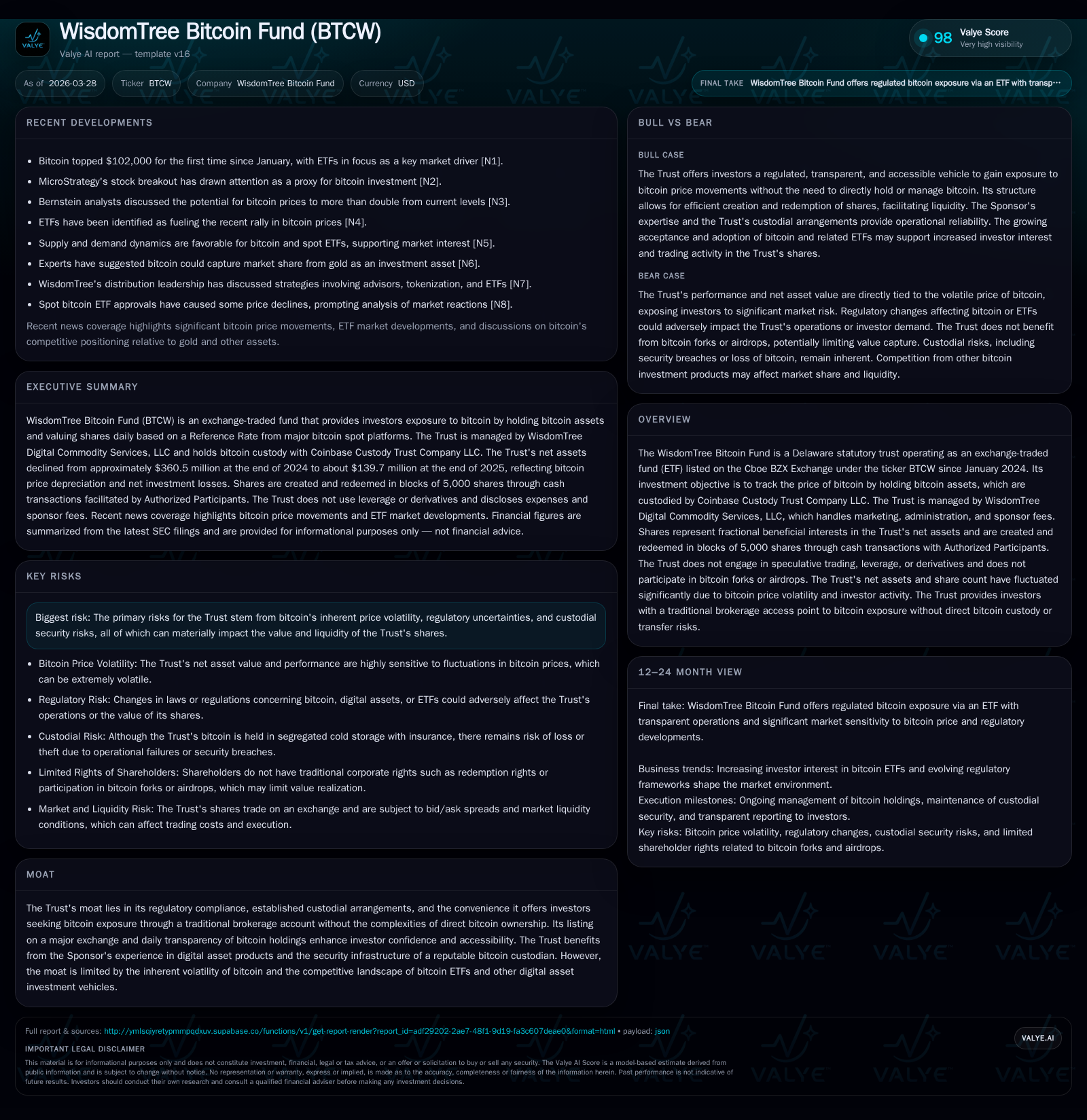
The WisdomTree Bitcoin Fund (BTCW), launched in early 2024 as a Delaware statutory trust, offers investors exposure to bitcoin through an ETF structure that holds bitcoin assets custodied by Coinbase. Despite a challenging market environment marked by bitcoin price volatility and regulatory uncertainties, BTCW has navigated significant swings in its net assets and share counts, driven predominantly by fluctuations in bitcoin prices and investor basket creations/redemptions. The Trust’s financials reveal a stark decline from profitable operating income and net income in 2024 to losses in 2025, offset somewhat by strong positive operating cash flows. Capital allocation centers on sponsor fees paid in bitcoin, while liquidity mechanisms involving Trade Credit facilities introduce operational complexity. The Trust’s moat is anchored in its custodial rigor, regulatory compliance, and accessibility for traditional investors, yet it faces persistent risks tied to bitcoin’s volatility and evolving digital asset regulations.
Historical Growth and NAV Trajectory Since Inception
Launched officially on January 11, 2024, the WisdomTree Bitcoin Fund (BTCW) was positioned as an innovative vehicle allowing investors exposure to bitcoin through a traditional brokerage account without direct custody complexities [S1]. Structurally a Delaware statutory trust formed under the Delaware Statutory Trust Act on March 8, 2021, BTCW issues shares classified as fractional beneficial interests in the Trust's net assets.
The Trust’s net asset value (NAV) per share derives from the total assets (primarily bitcoin valued at the CME CF Bitcoin Reference Rate) less liabilities divided by outstanding shares [S1]. This valuation approach provides a daily transparent indicator for stakeholders. BTCW’s share count has oscillated widely owing to institutional and retail investor activity creating or redeeming baskets—each consisting of 5,000 shares—and fluctuating underlying bitcoin prices.
A meaningful trajectory assessment reveals that at the end of FY2024, BTCW held approximately $360.6 million in fair value bitcoin assets with net assets totaling $360.5 million across 3.64 million shares outstanding [F1]. By year-end FY2025, total assets contracted to roughly $182.0 million with net assets dropping commensurately to $182.0 million over a reduced share base of about 1.51 million shares [F1], reflective of both market depreciation pressures on bitcoin pricing (bitcoin reference rate dropped significantly during this period) and redemption activity.
Financial Summary:
Historical performance (annual)
| FY | Net ($mm) | CFO ($mm) | OpInc ($mm) | Net YoY |
|---|---|---|---|---|
| 2025 | -37 | 184 | -44 | -128.5% |
| 2024 | 128 | -232 | 110 |
Source: SEC companyfacts cache [F1].
As shown above using data from [F1], BTCW experienced a sharp reversal from profitable operating and net income figures in FY2024 to considerable losses the following year. The appreciation realized during early operations gave way to significant markdowns driven predominantly by declining bitcoin valuations. Despite these negative income results on an accounting basis reflecting mark-to-market adjustments and sponsor fee deductions settled partially through asset sales [S7], operating cash flows swung positive as higher investor engagement likely fueled liquidity inflows.
BTCW’s Investment Model and Asset Custody Structure
BTCW operates with an investment objective focused strictly on gaining exposure to the price movements of bitcoin less expenses related to fund operations [S1]. Rather than employing derivatives or leverage—common but riskier tactics among some crypto-focused funds—the Trust exclusively holds physical bitcoin tokens custodied by Coinbase Custody Trust Company LLC [S1]. This arrangement ensures segregation of client assets under institutional custodian standards with security controls including cold storage wallets distributed geographically within the United States and Europe [S28].
Valuation relies on the CME CF Bitcoin Reference Rate—an index aggregating spot prices from multiple regulated exchanges—to establish an accurate daily NAV benchmark [S1]. Should this reference become unavailable or deemed unreliable by the Sponsor (WisdomTree Digital Commodity Services), a fair value methodology is applied as a fallback.
Basket creations/redemptions are transacted predominantly in large blocks of shares corresponding with an equivalent amount of bitcoin at prevailing NAV values [S1]. Authorized Participants must deliver or receive the requisite quantity of bitcoin matching these baskets when transacting with BTCW. A nuanced feature here lies in trade settlement facilitated by Coinbase’s Trade Credit arrangements: short-term borrowing provisions enable timely purchases or sales even if participants do not pre-fund fully upon order initiation [S3,S4]. Such structures are typical among digital-asset ETFs but introduce risk if credit availability tightens amid market stress.
Drivers Behind Recent Financial Performance Turnarounds
The pronounced earnings deterioration between FY2024 and FY2025 originates largely from mark-to-market losses linked closely to substantial declines in underlying bitcoin prices during the latter period [F1,S7]. Operating expenses include sponsor fees remunerated by selling bitcoins held within the fund—a practice naturally eroding aggregate asset holdings over time [S7,S15].
Notably though net income is negative reflecting accounting recognition rules rather than actual outflows assumed by investors or managers directly involved with trades or capital influxes. Operating cash flows illustrate this dynamic: whereas FY2024 recorded negative cash generation at over $232 million reflecting primarily outflows tied possibly to redemptions or prepaid expenses [F1], FY2025 posted a turnaround with positive cash flow exceeding $184 million suggesting resumed inflows from new investments or operational adjustments.
This divergence underscores how reported earnings under GAAP methodologies must be interpreted cautiously for funds like BTCW whose asset base is extremely sensitive to volatile crypto valuations rather than traditional revenue streams.
Determinants of Future Growth and Constraint Factors
Future growth prospects hinge fundamentally on two interrelated factors: increased adoption momentum for regulated bitcoin ETFs within institutional portfolios plus continued interest from retail investors seeking regulated vehicles for digital asset exposure [N/A]. WisdomTree’s experience managing digital commodity services offers some competitive advantage leveraging established custodial relationships such as Coinbase.
However, constraints remain acute given the unpredictable regulatory landscape examined further below plus persistent risks inherent with relying exclusively on physical bitcoin holdings vulnerable to severe price swings [S5,S25]. The competitive field encompassing multiple other ETF providers presenting similar products confines pricing power as well.
Another growth limiting factor is the cost structure driven largely by sponsor fees charged against holdings regardless of fund gains or losses, which can discourage long-term holding during extended bear markets.
Regulatory Environment and Risk Management Policies
BTCW navigates its operational jurisdiction firmly anchored within U.S securities laws applying Delaware statutory trust regulations [S1]. The Sponsor has implemented comprehensive AML/KYC policies ensuring Authorized Participants are vetted brokers compliant under U.S financial regulations consistent with Bank Secrecy Act obligations [S5,S6,S15]. Furthermore, Coinbase Custody operates under New York State Department supervision having obtained required virtual currency licenses termed BitLicenses placing it among regulated entities adhering to capital reserve requirements.
Despite these safeguards coordinated system compliance requirements imply ongoing risk related to changing federal or state level regulations—potentially requiring expensive new licenses or adjustments forcing premature termination/liquidation decisions detrimental for shareholders [S25]. Additionally unknown shifts abroad affect global valuation acceptance affecting U.S.-based funds indirectly.
On insurance fronts,[S21,S27] Coinbase Custody holds crime policies covering up to $320 million pooled across clients protecting against theft/fraud/loss risks although specific coverage limits per client exist capped at $100 million for cold storage addresses introducing residual uninsured risk elements.
Capital Allocation Insights: Fees, Cash Flows, and Returns
There is no dividend distribution or share buyback mechanism employed within BTCW consistent with ETF industry norms focused on passively tracking underlying assets without generating earnings distributions [S12,S18,S26]. Instead capital allocation manifests chiefly via sponsor fees deducted regularly in-kind through conversion of held bitcoins into USD at market prices allowing periodic expense coverage at Trust level without external funding demands [S7,S15].
From an ROE perspective traditional metrics are not directly applicable given absence of conventional corporate equity returns; rather investor returns correlate primarily with fluctuations in net asset values steered by spot bitcoin market movements minus fees incurred.
Noteworthy is that bitcoin sales required for sponsor fees reduce total holdings systematically which may gradually depress NAV beyond market appreciation/depreciation alone especially through sustained bearish cycles impacting long term holder economics negatively absent offsetting inflows.[F1]
Share Creation/Redemption Mechanism Nuances impacting Liquidity
Liquidity functions pivot heavily on Authorized Participants executing basket creations/redemptions settled initially through either bitcoin transfers or cash settlements facilitated via Coinbase Prime Execution Agent agreements enabling efficient execution across connected trading venues [S3,S4,S20,S28]. These processes minimize settlement frictions but involve trade financing (Trade Credit) which carries inherent risk should lender availability contract during crisis periods potentially delaying redemptions or increasing cost burdens impairing secondary market fluidity.
Additionally trade cutoffs impose timing constraints necessitating participants deliver deposits ahead facilitating orderly transactions though deviations between fund execution prices versus Reference Rate based NAV calculations can create momentary premium/discount discrepancies affecting portfolio manager arbitrage opportunities.[S3]
Key Benchmarks and Metrics to Monitor Going Forward
Investors should focus attention on several critical indicators underpinning BTCW’s operational health:
- Daily NAV per Share vs Market Price comparisons revealing premiums or discounts which signal supply-demand imbalances;
- Volume trends for Authorized Participant basket creations/redemptions highlighting shifts in investor appetite;
- Sponsor fee rate modifications potentially altering net asset erosion rates;
- Regulatory announcements impacting licensure requirements or trading restrictions;
- Broader macro factors affecting general cryptocurrency sentiment influencing trust inflows/outflows indirectly.
While no explicit future guidance is provided currently,[N/A] tracking such vectors will illuminate underlying fund performance drivers amid inherent volatility remaining endemic.
Disclaimer: This analysis incorporates publicly available financial data extracted exclusively from WisdomTree Bitcoin Fund’s SEC filings up to fiscal year-end December 31, 2025 ([F1],[S#]) alongside factual operational disclosures; it does not constitute investment advice nor recommendations regarding buying or selling securities related thereto.
Disclaimer: This is research-only, informational analysis and not investment advice. It may include AI-generated interpretation and general industry context. Always verify important details using primary sources.

Comments