
DICK’S Sporting Goods: Adapting to Competitive Pressures and Macroeconomic Headwinds
The company juggles robust revenue gains and margin pressures while leveraging omni-channel growth and Foot Locker integration.
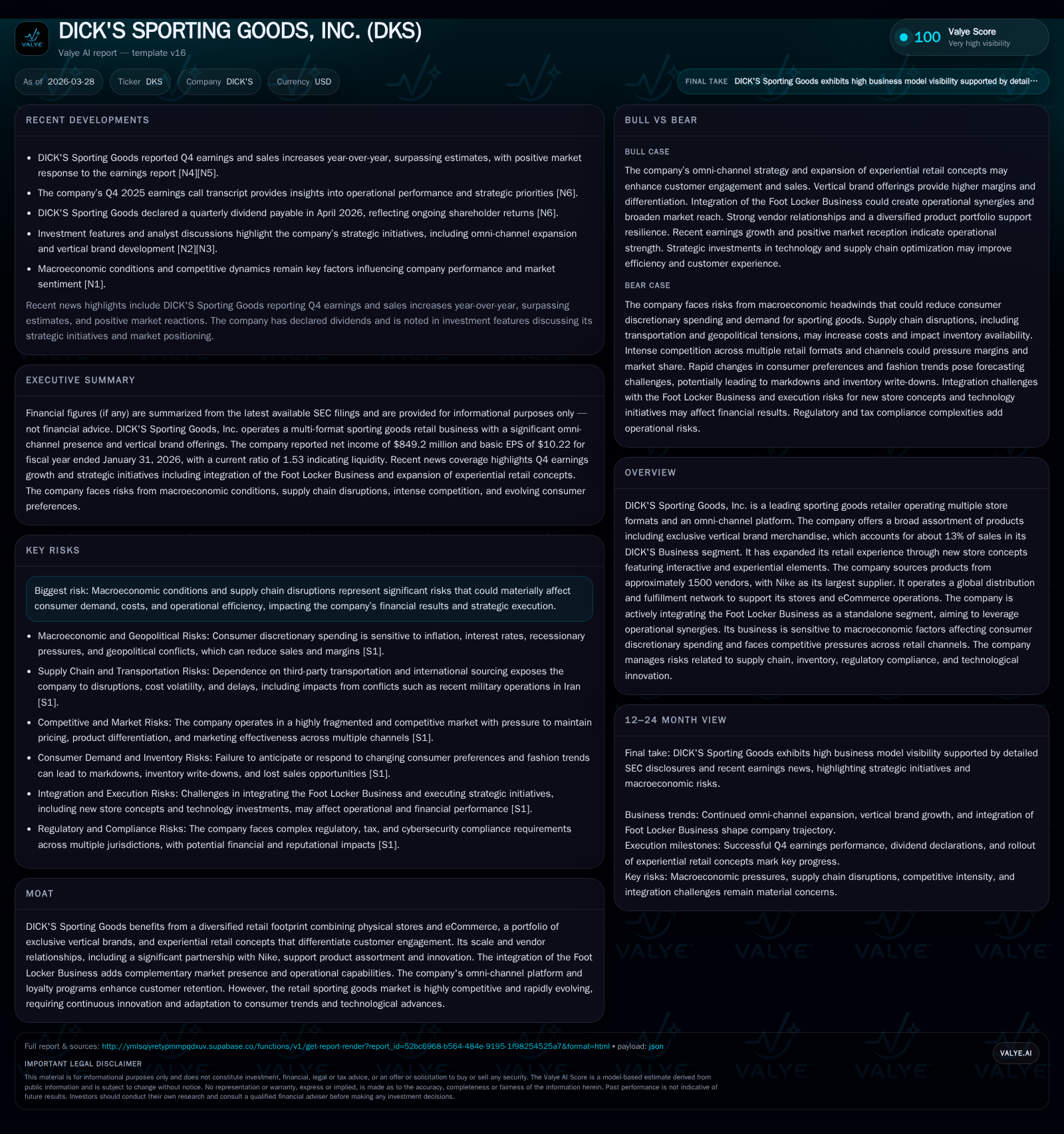
DICK'S Sporting Goods delivered solid top-line expansion with a 7.3% revenue increase in FY2025 but faced a significant 25.6% operating income decline amid rising cost pressures. Net income surged over 360%, reflecting non-operating factors or tax influences. Growth drivers include omni-channel retail expansion, exclusive vertical brands comprising about 13% of sales, and the operational integration of Foot Locker as a stand-alone segment. Macroeconomic headwinds such as inflation and supply chain volatility pose risks, while capital allocation emphasizes dividend growth and moderate share buybacks alongside increased investment in infrastructure.
Revenue and Earnings Trends: Evaluating Recent Growth and Profitability Fluctuations
DICK'S Sporting Goods reported fiscal year 2025 revenue of approximately $2.66 billion, reflecting a healthy year-over-year (YoY) increase of 7.3% [F1]. This growth is notable given the broader retail environment's volatility and aligns with ongoing investments in omni-channel capabilities and store concept innovations. However, despite the top-line expansion, operating income decreased materially by 25.6%, falling to about $1.10 billion [F1]. The divergence between revenue growth and operating profit signals margin pressures likely stemming from heightened promotional activity or elevated operating expenses tied to inflationary forces and supply chain constraints detailed in risk disclosures [S1], [S4]. Interestingly, net income climbed sharply by over 366% to $849 million [F1]. Such an outsized net income gain relative to operating income suggests favorable impacts from non-operating income components or tax benefits, although explicit details are not disclosed.
Operating cash flow (CFO) also improved meaningfully by roughly 17%, reaching $1.54 billion [F1], supporting financial flexibility amid rising capital expenditures (Capex), which surged by about 41.7% to $1.14 billion [F1]. The company's reinvestment focus is mirrored in these heightened asset outlays.
Historical performance (annual)
| FY | CFO ($mm) | OpInc ($mm) | Capex ($mm) |
|---|---|---|---|
| 2025 | 1537 | 1096 | 1137 |
| 2024 | 1312 | 1474 | 803 |
| 2023 | 1527 | 1282 | 587 |
| 2022 | 922 | 1463 | 364 |
Source: SEC companyfacts cache [F1].
Capital returns and efficiency (annual)
| FY | Div ($mm) | Buybacks ($mm) | FCF ($mm) |
|---|---|---|---|
| 2025 | 414 | 347 | 400 |
| 2024 | 362 | 263 | 509 |
| 2023 | 351 | 649 | 940 |
| 2022 | 163 | 458 | 558 |
Source: SEC companyfacts cache [F1].
Note: FY2024 revenue was not explicitly stated; prior period operating income used for YoY comparisons.
Drivers Behind Sales Growth: Omni-Channel Expansion and Foot Locker Integration
Key enablers supporting DICK’S Sporting Goods' recent growth include its expansive global distribution network blending physical stores with eCommerce fulfillment centers [S6], alongside progressive store concepts embedded with experiential features such as climbing walls and batting cages that enhance customer engagement [N9], [S6]. Exclusive vertical brand merchandise accounts for about 13% of the DICK'S Business sales segment [S6], providing differentiated product offerings that command higher margins in an intensely competitive sector.
A strategic catalyst is the integration of Foot Locker as an independent segment — a move designed to capitalize on operational synergies estimated between $100 million to $125 million over the medium term [S26]. The company plans to maintain Foot Locker’s distinct brand presence while applying shared best practices across marketing, logistics, and sourcing channels [N4], contributing additive revenue streams without diluting core brand identities.
Nike remains DICK'S largest vendor, constituting nearly one-third (31%) of merchandise spend [S9]. This close supplier relationship is critical to sourcing innovative products but introduces vendor concentration risk.
Challenges from Macroeconomic and Supply Chain Dynamics
Consumer discretionary spending volatility places DICK'S Sporting Goods at risk amid prolonged inflationary pressures, interest rate hikes, and weakening consumer confidence noted in risk disclosures [S1], [S4]. Inflation has driven up input costs for raw materials and transportation—especially fuel prices impacted by geopolitical tensions such as military actions in Iran affecting trade routes like the Strait of Hormuz [S6]. These dynamics have pressured gross margins through increased freight costs and necessitated promotional cadence adjustments aimed at inventory movement without eroding pricing integrity.
Supply chain fragility persists due to global trade uncertainties including tariffs on imports from China, Mexico, Canada, plus potential labor disputes within transport logistics providers [S6]. Interruptions could delay replenishment cycles or elevate carrying costs for inventory–a sensitive balance in trend-driven athletic apparel retailing.
Innovations in Exclusive Brands and Experiential Retailing
DICK’S leverages its exclusive private label brands to drive customer loyalty and profitable differentiation within a crowded market landscape [S15]. About thirteen percent of sales emanate from vertically developed brands that offer innovation agility unavailable from third-party suppliers [S6], representing an important margin lever.
Simultaneously, immersive experiential retail initiatives across flagship formats such as House of Sport aim to heighten omni-channel conversion rates by fusing physical retail with interactive customer experiences like indoor batting cages or fitness classes [N9], [S18]. While these strategies demand elevated operational spend and carry liability risks (bodily injury, property damage), they reinforce brand exclusivity that aids retention amid online commoditization trends.
Future Growth Outlook and Market Positioning
While explicit management guidance is not detailed in filings or news releases beyond growth optimism [N2], key performance indicators remain centered on effective Foot Locker segment consolidation into standalone reporting; scaling eCommerce capabilities; expanding loyalty programs; and evolving assortment strategies to anticipate shifting consumer tastes across diverse demographics including urban markets targeted by Foot Locker [N14], [S14].
Persistent headwinds from competitive intrusions by mass merchants, direct-to-consumer entrants using AI-powered personalization technology, coupled with macroeconomic uncertainties will cap upside unless matched by nimble inventory forecasting enhancements underpinned by expanded data science deployments noted internally [S11].
Capital Allocation: Dividends, Buybacks, and Investment Priorities
Reflecting confidence in cash flow generation despite near-term profit pressure, DICK'S upped its dividend payout by a modest three percent per latest declaration [N14] totaling over $413 million for FY2025 versus prior year disbursements of approximately $362 million [F1]. Share repurchase activity moderated to $347 million following historically larger buybacks (~$648 million in FY2023), signaling calibrated capital discipline amid higher reinvestment needs.
Capex intensification (+41.7%) underscores priorities toward fulfillment infrastructure enhancement supporting omni-channel synergy objectives rather than purely shareholder return maximization—a pragmatic balance amid industry transition.
Financial Health Analysis: Liquidity, Debt Structure, and Return on Equity
With a current ratio standing around 1.53 as of January-end fiscal year close [F1], liquidity is sufficiently robust to cover short-term obligations comfortably relative to current liabilities surpassing $4.64 billion against assets over $7.10 billion [F1]. DICK’S holds senior notes due in staggered tranches through years 2029, 2032, and notably to 2052 at coupon rates ranging from approximately 3.15% to just above four percent reflecting manageable interest expense levels compared with operating cash flow coverage metrics discussed but not numerically specified here [S5], [S10].
Return on equity computed approximates a solid mid-teens level near ~15.3%, indicative of efficient capital deployment sustaining shareholder value despite elevated capital expenditures absorbing free cash flow generation which remains positive at over $400 million for FY2025 after Capex offsetting CFO figures [F1].
Competitive Environment and Vendor Relationships Influencing Operations
Competition pressures emanate from diversified retail formats including large- and specialty-format retailers alongside digital native brands deploying direct-to-consumer models exploiting technology-driven efficiencies highlighting SKU rationalization imperatives within DICK’S assortments to sharpen focus and improve inventory turns efficiently across approximately 1500 vendors networked globally including Nike as dominant supplier accounting for nearly one-third of purchases poses dependency risks requiring careful negotiation of supply allocation agreements under evolving demand conditions affecting vendor managed inventories strategies widely applied in athletic footwear segments [S9], [N8].
Risks Spotlight: Regulatory, Litigation, and Geopolitical Factors
Persisting regulatory complexities envelop labor law reforms increasing wage obligations exposing cost structure vulnerability; potential litigation stemming from legacy firearm business claims notwithstanding discontinuation; product safety compliance enforcement risks with potential reputational damage; plus cybersecurity regulatory burdens intensified by multi-jurisdictional data privacy standards notably GDPR regimes present continuous compliance costs juxtaposed against reputational protection imperatives discussed extensively in filings underscoring need for agile risk mitigation frameworks maintaining operational resilience amid escalating geopolitical tensions impacting international supply chains forming part of the broader strategic risk continuum monitored closely by management teams across compliance programs globally [S4], [S8], [S15], [S18], [S23].
This analysis synthesizes information exclusively derived from verified corporate filings ([F1], [S#]) and credible news sources ([N#]) as of March 2026 without speculative projections or investment guidance. Its purpose is informational reflecting DICK’S Sporting Goods’ strategic positioning amidst evolving market forces.
Disclaimer: This is research-only, informational analysis and not investment advice. It may include AI-generated interpretation and general industry context. Always verify important details using primary sources.

Comments