
Fusemachines Inc. Advances Enterprise AI Amid Financial and Market Challenges
Fusemachines integrates AI product innovation with a mission-driven talent model while confronting capital constraints and competitive headwinds.
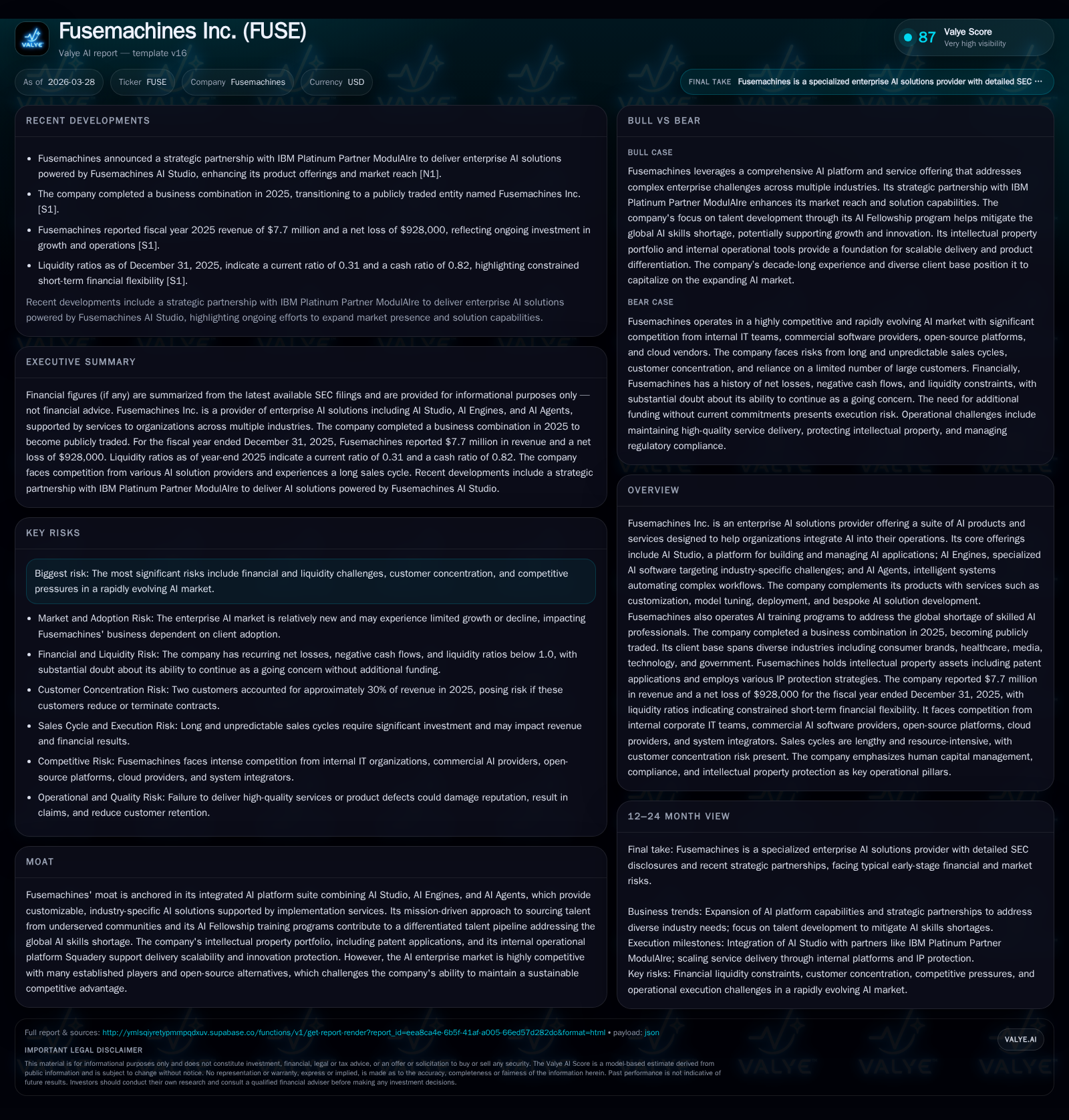
Fusemachines Inc. offers a comprehensive AI platform suite that addresses complex enterprise needs through AI Studio, AI Engines, and AI Agents. Despite moderate revenue growth driven by diversified industry adoption, the company faces financial challenges marked by negative operating income and liquidity pressures. Its differentiated talent pipeline supports innovation and scalability but must contend with intense competition and execution risks in a nascent market. Going forward, growth depends on expanding client engagements, product enhancement, and resolving financial constraints that currently limit operational flexibility.
Historical Performance and Growth Drivers
Fusemachines Inc., publicly traded since late 2025 following a business combination, reported $7.7 million in revenue for fiscal year 2025 [F1]. While this reflects moderate growth supported by enterprise adoption across industries such as healthcare and consumer brands, the company incurred an operating loss of $5.95 million and a net loss of $0.93 million during the same period [F1]. These results highlight ongoing investments in product development and market expansion as Fusemachines integrates its core offerings—AI Studio, AI Engines, and AI Agents—with implementation services tailored to diverse operational contexts [S6]. The revenue benefits from long-term client relationships leveraging Fusemachines’ platforms to improve business processes including sales forecasting accuracy and fraud detection.
Historical performance (annual)
| FY |
|---|
| 2025 |
Source: SEC companyfacts cache [F1].
Note: Free cash flow derived from cash flow from operations minus capital expenditures as reported [F1].
Integrated AI Products Fueling Competitive Differentiation
Fusemachines’ AI portfolio is structured into three main components: AI Studio serves as the foundational platform enabling enterprises to build, deploy, and manage lifecycle stages of AI applications within a unified environment that accommodates data scientists through business teams; AI Engines deliver industry- and problem-specific capabilities such as fraud detection leveraging large language models (LLMs) and computer vision; while AI Agents automate workflows like candidate interviewing by integrating reasoning engines with real-time data retrievals [S6][S12][S19].
The platform architecture includes the Business Layer for deploying AI-powered workflows; the AI Hub managing model development and integration; the Data Layer handling multi-format data ingestion; and a Governance Layer ensuring compliance and lifecycle management across environments [S12]. This structure supports client customization including model tuning within enterprise data ecosystems coupled with consultancy-led deployment via Forward Deployed Engineers (FDEs). This approach enhances customer retention by delivering measurable automation ROI addressing critical challenges.
Navigating Financial Constraints and Liquidity Risks
Financially, Fusemachines faces liquidity pressures. As of December 31, 2025, cash reserves stood at approximately $4.2 million with total current assets around $6.3 million against significantly higher current liabilities near $20 million—resulting in a constrained current ratio of about 0.31 [F1]. Negative free cash flow nearing $5.58 million underscores cash burn driven primarily by operating losses related to ongoing R&D investments and sales expansion initiatives [F1][S16].
The company acknowledges dependence on securing additional capital to sustain operations without delaying or scaling back development efforts [S16]. Operating leverage is also affected by lengthy sales cycles averaging six to eight months or longer which introduce volatility in cash inflows [S17]. Consequently, delays or difficulties in financing rounds could impede strategic investments necessary to maintain competitive momentum.
Market Position Within an Evolving Enterprise AI Landscape
Fusemachines competes in a fragmented enterprise AI market characterized by diverse players including corporate IT organizations developing internal solutions; specialized commercial vendors offering point products; open-source platforms favored for flexibility but lacking turnkey support; major public cloud providers offering microsolutions; and system integrators delivering custom end-to-end implementations [S13][S1].
These dynamics create freemium threats from open-source tools lowering switching costs while raising vendor lock-in challenges that Fusemachines must overcome through demonstrable value delivery and seamless integration. The company’s intellectual property portfolio comprises eight patent applications covering technologies central to its offerings—a key differentiation element—though enforcement costs remain significant against better-resourced competitors [S13].
Talent Pipeline as a Strategic Moat
A distinctive strength is Fusemachines’ commitment to sourcing talent predominantly from underserved communities complemented by its proprietary AI Fellowship training program certifying hundreds of professionals across locations such as the U.S., Nepal, and the Dominican Republic [S6][S12]. This initiative provides hands-on experience on live deployments addressing acute global shortages where many businesses cite gaps in machine learning expertise.
This workforce ecosystem facilitates scalable service delivery while fostering innovation via close technical collaboration between Forward Deployed Engineers embedded at customer sites executing customization, model fine-tuning, deployment through Squadery—an internal platform consolidating CRM and HR data streamlining project management across clients [S19].
Future Growth Opportunities and Strategic Challenges
Growth prospects include expanding vertical market penetration beyond core sectors like healthcare; advancing product roadmaps incorporating enhanced capabilities such as Retrieval Augmented Generation (RAG) for document understanding; sustaining contract renewals where two customers accounted for about 30% of revenues in 2025 reflecting concentration risk [F1][S9]; improving sales cycle efficiency; plus leveraging training programs to mitigate talent bottlenecks constraining scale-up capacity.
Risks include macroeconomic uncertainties impacting purchasing budgets; intensified competition affecting pricing power; evolving regulatory requirements increasing compliance costs; potential intellectual property litigation disrupting operations; cybersecurity threats posing operational risks affecting customer confidence; dependence on key executives including the CEO whose departure could impact strategic execution; along with concentrated customer revenue bases vulnerable to contract term changes or non-renewals amid volatile macro conditions influencing demand visibility post initial wins [S8].
Capital Allocation, Profitability, and Return Metrics
Capital deployment focuses on innovation over immediate profitability with an approximate return on equity of 6.4% despite net losses reflecting reinvestment priorities typical for early-stage technology firms transitioning toward market expansion [F1]. No dividends or share repurchases have been declared or executed indicating capital preservation amid liquidity constraints.
Capital expenditures align largely with R&D directed at enhancing platform scalability alongside service delivery automation improvements supported by engineering teams embedded within pre-sales workflows highlighting operating leverage tied to scaling direct sales forces technically supported upstream [F1][S17].
Investor Considerations: Key Risks and Milestones to Monitor
Investors should monitor key risk vectors including reliance on additional capital which if delayed could jeopardize operations; exposure to intellectual property disputes requiring costly defenses potentially impairing technology use; cybersecurity risks necessitating ongoing investment in controls to safeguard reputation; dependency on key executives notably CEO Sameer Maskey whose departure might affect execution; regulatory-compliance complexity diverting management focus; concentrated customer revenue increasing vulnerability if renewals falter or contract terms shift unfavorably—all amid macroeconomic volatility influencing purchase decisions affecting pipeline visibility after initial deployments .[F1]
Key milestones include renewal rates among top customers representing nearly one-third of revenues indicating success in deepening integration footprints; financing round outcomes providing runway clarity for growth investments; progress on shortening deployment cycles or entering new verticals reflecting sales maturity; R&D advances enhancing governance features vital for client trust adherence; plus expansion within training programs ensuring workforce supply alignment sustaining scalable execution capabilities.
Disclaimer: This analysis is based solely on information publicly disclosed by Fusemachines Inc., including SEC filings as of March 28, 2026. It is not investment advice nor an endorsement or recommendation regarding ownership interests. Investors should perform their own due diligence considering their unique circumstances.

Comments