
Autolus Therapeutics Advances Commercialization of AUCATZYL Amid Intensifying Losses
Autolus launches its first commercial CAR T therapy with strong initial revenue growth while facing substantial operating losses and capital requirements.
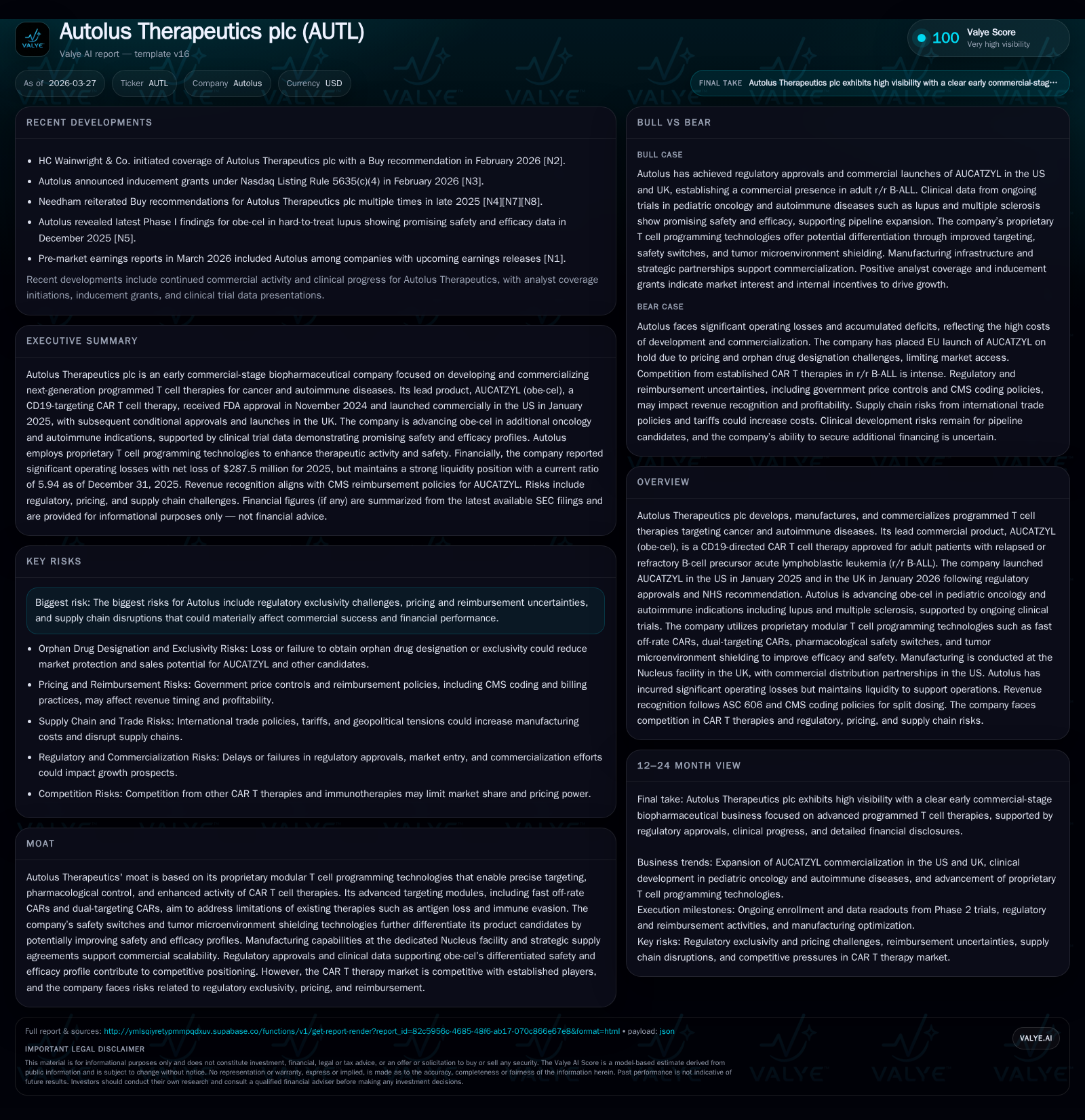
Autolus Therapeutics entered the commercial stage with AUCATZYL’s launches in the US and UK during 2025-2026, leveraging proprietary modular T cell technologies to address aggressive r/r B-ALL cancer. Despite notable revenue growth from initial sales reaching $74.3 million in 2025, operating losses deepened amid investments in manufacturing scale-up, R&D pipeline expansion, and commercialization infrastructure. The company’s cash runway extends through at least twelve months post-2025, supported by a strong current ratio, but negative free cash flow exceeding $300 million highlights ongoing financing needs. Regulatory exclusivity challenges following orphan drug status withdrawal in Europe and pricing pressures limiting EU market entry could constrain international expansion.
Commercial Launch and Initial Revenue Performance of AUCATZYL
Autolus achieved key commercialization milestones launching AUCATZYL (obe-cel), a CD19-directed CAR T therapy for adult relapsed/refractory B-cell precursor acute lymphoblastic leukemia (r/r B-ALL). Following FDA approval in November 2024, the company commenced US commercial sales in January 2025,[S1] generating net product revenue of $74.3 million for the year ended December 31, 2025,[S1][F1] driven predominantly by US sales. The United Kingdom's National Institute for Health and Care Excellence (NICE) recommended AUCATZYL treatment under NHS commissioning protocols in November 2025,[S1] enabling a UK launch in January 2026 supported by conditional MHRA authorization earlier that year.[S1]
Real-world data from the ROCCA Consortium database demonstrate improved safety and efficacy profiles relative to pivotal clinical trials underpinning regulatory approval.[S1] This registry covers approximately 60% of U.S. commercial patients as of early 2026,[S1] underscoring clinical adoption critical for further payer acceptance.
The company's launch strategy prioritized the US market where reimbursement frameworks are more established for novel CAR T therapies. The subsequent UK NHS commissioning represents advancement toward European access despite ongoing holds on broader EU launches due to pricing and reimbursement challenges.[S1][N1]
Proprietary Modular CAR T Programming Technologies
Autolus employs proprietary modular T cell programming technologies designed to produce next-generation CAR T therapies with enhanced control and targeted efficacy.[S1] Key features include fast off-rate CAR constructs aimed at minimizing excessive T cell activation linked to toxicity, dual-targeting CARs addressing tumor antigen heterogeneity and immune escape, pharmacological safety switches allowing therapeutic modulation, and tumor microenvironment shielding technologies enhancing persistence.[S1]
These innovations target significant challenges such as treatment resistance and cytokine release syndrome severity prevalent in cell therapy. Manufacturing scalability is supported by the dedicated Nucleus facility in Stevenage, UK,[S1] enabling global supply tailored for complex autologous cell production.
Strategic partnerships, including Cardinal Health for US distribution logistics,[S1] complement Autolus’ technology and manufacturing capabilities.
Financial Performance: Revenue Growth during Expanding Operating Losses
Autolus reported substantial revenue growth alongside widening operating losses aligned with commercialization scaling during 2025.[F1][S1][S2] Revenue increased approximately 248% from $10.12 million in FY2024 to product revenues of $74.3 million driven largely by AUCATZYL sales,[F1][S1] though detailed quarterly splits are not publicly disclosed.
Operating income deteriorated further with a loss of $270.5 million in FY2025 compared to a $241.4 million loss the prior year—a deepening loss ratio of approximately -12%. Net loss widened over 30% year-over-year to -$287.5 million.[F1]
Operating cash flow contracted by nearly 37.5%, totaling -$283.6 million for FY2025,[F1] reflecting cash burn from establishing commercial infrastructure, ongoing clinical development programs, and manufacturing scale-up costs partially offset by initial product receipts.
Capital expenditures moderated by roughly -13.7% to $19 million,[F1] indicating phased investment following earlier heavy spending on facilities including Nucleus enhancements.[S11]
Historical performance (annual)
| FY | Net ($mm) | CFO ($mm) | OpInc ($mm) | Capex ($mm) | Net YoY |
|---|---|---|---|---|---|
| 2025 | -288 | -284 | -271 | 19 | -30.3% |
| 2024 | -221 | -206 | -241 | 22 | -5.9% |
| 2023 | -208 | -146 | -180 | 11 | -40.0% |
| 2022 | -149 | -112 | -168 | 11 |
Source: SEC companyfacts cache [F1].
Capital returns and efficiency (annual)
| FY | FCF ($mm) | ROE% |
|---|---|---|
| 2025 | -303 | -161.4 |
| 2024 | -228 | -51.6 |
| 2023 | -157 | -186.9 |
| 2022 | -123 | -49.8 |
Source: SEC companyfacts cache [F1].
The increasing losses reflect typical biopharmaceutical dynamics transitioning through product launch phases but indicate high capital intensity that requires monitoring.
Pipeline Expansion: Pediatric Oncology and Autoimmune Indications
Beyond adult r/r B-ALL targeted by AUCATZYL approval, Autolus is advancing obe-cel into pediatric populations and additional oncology indications including B-cell non-Hodgkin lymphoma (B-NHL).[S1][N1] Phase 1b data from the CATULUS trial show promising efficacy in pediatric r/r B-ALL patients with an overall response rate near 95.5%, coupled with low rates of severe cytokine release syndrome.[S1]
The company is also exploring autoimmune diseases such as lupus erythematosus and multiple sclerosis leveraging its precision T cell programming technologies.[S1]
These expansions represent important avenues for future growth but remain subject to inherent clinical development risks including regulatory timelines and trial variability.
Regulatory Environment and Market Access Challenges
AUCATZYL holds FDA approval alongside UK conditional marketing authorization reinforced by NICE NHS coverage recommendation—critical milestones for reimbursement stability.[S1][N2]
However, European Commission marketing authorization granted mid-2025 remains unexploited due to withdrawn orphan drug designation exclusivity concerns,[S7] compounded by difficulties achieving commercially viable pricing across EU markets resulting in deferred launches.[S1][N2]
Pricing pressures increasingly shape cell therapy market access where payors demand real-world effectiveness or outcomes-based contracts justification.[S7] Autolus must navigate evolving reimbursement environments amid legislative reforms targeting pharmaceutical price containment especially within Medicare frameworks.[S7]
These factors introduce uncertainty around geographic expansion beyond established US/UK markets.
Capital Allocation: Funding R&D, Manufacturing Scale-Up, and Commercial Build-Out
Recent fiscal periods show heavy capital deployment toward research & development programs, manufacturing capacity at Nucleus,[F1][S11][S28][S29] and commercial infrastructure build-out.
R&D expenses are rising alongside expanded clinical trials particularly for pediatric oncology and autoimmune indications while manufacturing process improvements remain critical given autologous therapy complexities.[S15]
Financial arrangements include strategic collaborations such as a Blackstone partnership providing milestone-driven payments up to $150 million supplementing internal funding needs.[S22]
This capital allocation pattern reflects typical 'operating leverage' where upfront costs precede anticipated revenue inflection points tied to approvals or volume growth.
Financial Position: Liquidity, Working Capital, and Return Metrics
As of December 31, 2025, Autolus held approximately $104 million cash plus $197 million marketable securities,[F1] totaling near $300 million liquidity supporting operational runway extending beyond twelve months per management disclosures.[S1]
Current assets stood at approximately $436 million against current liabilities near $73 million yielding a robust current ratio around 5.9x,[F1] indicating working capital adequacy despite high cash burn.
Shareholders’ equity declined materially from $427 million at end-2024 down to $178 million at end-2025,[F1] reflecting accumulated deficit growth due to widening net losses.
Return on equity remains negative at approximately -161%,[F1] characteristic of early-stage commercialization investments exceeding immediate profitability.
Maintaining sufficient liquidity while advancing pipeline breadth will be critical given potential dilution or need for additional partnerships.
Risks: Exclusivity Losses, Pricing Pressure, and Supply Chain Complexity
Principal risks include loss of orphan drug exclusivity in Europe following voluntary withdrawal impacting market protection duration,[S7][N2] which may invite competitive pressures reducing potential revenue streams.
Pricing negotiations pose challenges particularly across fragmented EU reimbursement landscapes where health technology assessments may not support premium valuations necessary for sustainable launches.[S7][N2]
Supply chain complexities inherent to autologous therapies—including raw material sourcing constraints,[S10][S14] manufacturing yield variability, and logistical coordination—present operational risks potentially delaying patient access or increasing costs adversely affecting margins.[N2]
These factors require calibrated commercialization strategies balancing rollout speed against economic sustainability.
Outlook: Monitoring Clinical Readouts and Market Expansion Catalysts
Upcoming milestones include further data readouts from pediatric r/r B-ALL trials assessing obe-cel safety/efficacy beyond adult populations,[N1] which could significantly expand label indications boosting addressable markets.
Autoimmune disease programs remain early-stage but represent innovative opportunities leveraging precise immune modulation capabilities.[N2]
Resolution on pricing strategies governing EU launches is a key catalyst shaping regional footprint expansion timelines.[S1]
Absent explicit numeric guidance beyond current disclosures,[N1][S1] qualitative signals such as payer contract progress or new strategic alliances will be key indicators of execution success amid financial pressures.
Robust real-world evidence demonstrating differentiated clinical benefits versus incumbent therapies could accelerate payor acceptance offsetting reimbursement challenges common across advanced cell therapy sectors.
This analysis is based exclusively on publicly available SEC filings [F1/S#], verified news sources [N#], and recognized sector knowledge up to March 27, 2026 without speculative projections or investment advice.
Disclaimer: This is research-only, informational analysis and not investment advice. It may include AI-generated interpretation and general industry context. Always verify important details using primary sources.

Comments