
How Avidia Bancorp Balances Local Focus with Payments Processing Growth
Avidia Bancorp combines regional banking with payments sponsorship to drive diverse revenue streams amid financial pressures.
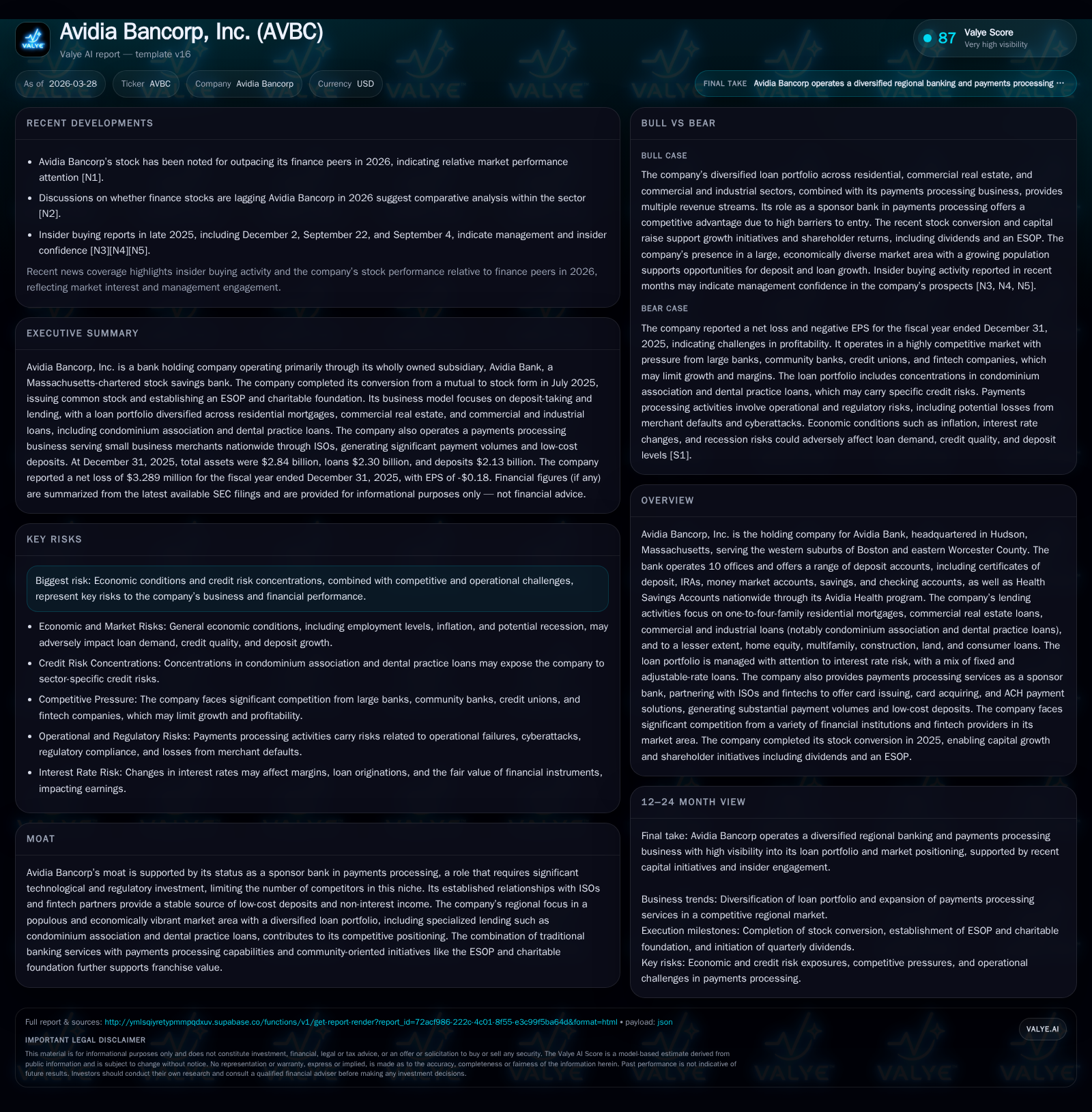
Avidia Bancorp operates a hybrid business model blending traditional community banking in the Boston suburbs with niche payments processing sponsorship. Despite a modest net loss and negative returns on equity reported for 2025, its diversified loan portfolio, including specialized commercial lending, and its role as a sponsor bank underpin stable deposit growth and non-interest income. The company’s capital allocation emphasizes consistent dividend payments supported by strong free cash flow generation, while careful credit risk management addresses local economic sensitivities. Future growth hinges on leveraging technology investments in payments and managing interest rate risk across mixed fixed- and adjustable-rate loans.
Evolution of Avidia Bancorp’s Growth Trajectory and Financial Performance
Avidia Bancorp’s trajectory has reflected steady expansion fueled primarily by its lending activities within the western Boston suburbs and eastern Worcester County region. Historically, revenue generation centered on one-to-four-family residential mortgages complemented by commercial real estate loans alongside commercial and industrial (C&I) loans targeting niche sectors like condominium associations and dental practices [S1]. This specialization helped build a diversified asset base.
Financially, the fiscal year ending December 31, 2025, saw challenges emerge. The company recorded a net loss of approximately $3.3 million incorporating pressures from margin compression and credit-related costs [F1], which translated into a negative ROE near -0.9%. This downturn contrasts prior years where profitability remained positive (see table below). Operating cash flows remained robust at over $24 million free cash flow, suggesting underlying operational resilience despite profitability headwinds [F1].
Historical performance (annual)
| FY |
|---|
| 2025 |
Source: SEC companyfacts cache [F1].
This shift reflects tightening margins common in smaller regional banks facing rising interest rates alongside competitive dynamics affecting loan yields [S3]. Nonetheless, legacy strengths such as specialized lending niches continue to contribute to revenue stability.
Analyzing Loan Portfolio Composition and Interest Rate Risk Management
Avidia’s loan book displays deliberate diversification designed to balance risk-return tradeoffs inherent in community banking. Fixed-rate residential mortgages represent a substantial portion; however, management sustains attention on adjustable-rate exposures to manage sensitivity to rising rates [S2]. Adjusting repricing schedules provides some insulation against margin erosion but also introduces volatility depending on interest rate cycles.
Commercial real estate loans total over $534 million at year-end 2025, subdivided into owner-occupied versus non-owner-occupied properties spanning sectors such as mixed-use, retail, industrial, office spaces, medical facilities, hospitality, and others [S24]. Multifamily CRE loans amounting to $104.7 million further diversify the portfolio within the residential spectrum.
The C&I lending segment includes loans secured by business assets like machinery, inventory, and accounts receivable; dental practice loans exemplify focused underwriting that examines detailed business financials alongside collateral value [S8]. Collateral-dependent loans are regularly monitored, with workout strategies implemented when borrowers show financial distress [S11]. Comprehensive allowance for credit losses is maintained reflecting ongoing assessment of delinquencies and impairments [S2].
Interest rate risk governance employs both fixed and adjustable products alongside judicious underwriting standards including debt service coverage ratios commonly set at minimum thresholds (~1.20x), loan-to-value limits, and annual appraisals from approved external valuers [S24]. This multi-layered defense aids in containing credit losses amid uncertain local economic conditions.
The Strategic Role of Payments Processing Sponsorship in Revenue Diversification
Significantly differentiating Avidia Bancorp from many regional peers is its role as a sponsor bank within the payments processing ecosystem [S15]. This function entails considerable technological investment and navigating complex regulatory frameworks unique to participant banks supporting Independent Sales Organizations (ISOs) and fintech partnerships.
As a sponsor bank for these partners, Avidia accesses low-cost deposits generated through payment flows alongside fee-based revenues not directly tied to interest income. At December 31, 2025, deposits related to payments processing amounted to approximately $352.8 million—representing roughly 16.6% of total deposits—and Health Savings Accounts contributed another $248.2 million or about 11.7% [S15].
This dual deposit base not only supports funding cost advantages but also secures franchise value difficult to replicate due to entry barriers involving compliance complexity and technology scale requirements within payment networks.
Complementary community-focused initiatives such as an Employee Stock Ownership Plan (ESOP) strengthen stakeholder alignment while charitable foundations enhance local goodwill—both bolstering Avidia's branding amidst regional competition [S1].
Capital Allocation Approach: Dividends, Cash Flows, and Shareholder Returns
Despite recording a net loss in 2025 leading to negative ROE figures [F1], Avidia continued paying dividends ($0.05 per share declared early 2026) indicative of maintenance of shareholder returns policy even amid profitability pressures [S3].
The company produces strong operational cash flow enabling free cash flow of approximately $24 million annually—the excess after capital expenditures—which underpins dividend coverage without reliance on external funding sources or capital raises [F1]. This approach reflects disciplined capital allocation prioritizing consistent income distribution.
There is no recent sign of share repurchase programs or special dividends highlighting measured deployment of capital awaiting clearer profit recovery trajectories or strategic opportunities [S3]. This prudent stance aligns with smaller reporting company dynamics emphasizing stability.
Assessing Credit Quality and Economic Environment Risks
Credit quality metrics signal conservative underwriting tempered by active monitoring processes [S2]. Delinquency rates remain within manageable parameters though recent reports note observed upticks linked partially to inflation-driven borrower stress and evolving local labor market conditions impacting debt service capacity.
Provisions for credit losses have been adjusted periodically as warranted by portfolio seasoning changes—reflecting allowances calibrated for expected losses especially in commercial real estate segments exposed to cyclical valuation shifts [S1]. Management undertakes modifications involving principal or interest term concessions only when financially justifiable workout plans exist aimed at maximizing recovery prospects [S11].
Economic risks cited encompass employment fluctuations potentially dampening loan demand or increasing default likelihoods alongside interest rate environment effects that could constrict margins while impacting mortgage origination volumes among other factors [S1]. The geographically concentrated footprint accentuates sensitivity to Massachusetts-area economic cycles.
Insights into Forward-Looking Strategy and Investor Signals
Recent analyst commentary underscores management's balanced viewpoint: optimistic regarding growth opportunities afforded by payments sponsorship expansion yet cautious about headwinds from tightening regulatory standards and technology integration costs [N1][N2][S1].
Growth initiatives appear routed toward scaling low-cost deposit acquisition via HSA programs and expanding partner relationships among ISOs fostering stable fee income diversification pathways beyond traditional net interest income reliance.
Operational challenges include ongoing investments required to maintain compliance rigor amid evolving payments industry rules while managing credit risk proactively given localized commercial real estate market movements.
Key milestones investors should monitor comprise upcoming quarterly earnings results focusing on shifts in loan growth patterns (especially specialized lending), net interest margin fluctuations tied closely to interest rate dynamics, progression in allowance adequacy reflecting credit environment developments, and traction on deposit base expansion especially in payments-related segments.
This analysis compiles data strictly supported by publicly available SEC filings ([S#]) and validated financial figures ([F1]) without speculative forecasts or investment recommendations.
Disclaimer: This is research-only, informational analysis and not investment advice. It may include AI-generated interpretation and general industry context. Always verify important details using primary sources.

Comments