
AIM ImmunoTech’s Ampligen Development Confronts Financial Strains and Regulatory Hurdles
The company’s proprietary immunotherapy advances clinical trials amid persistent losses and NYSE American listing compliance challenges.
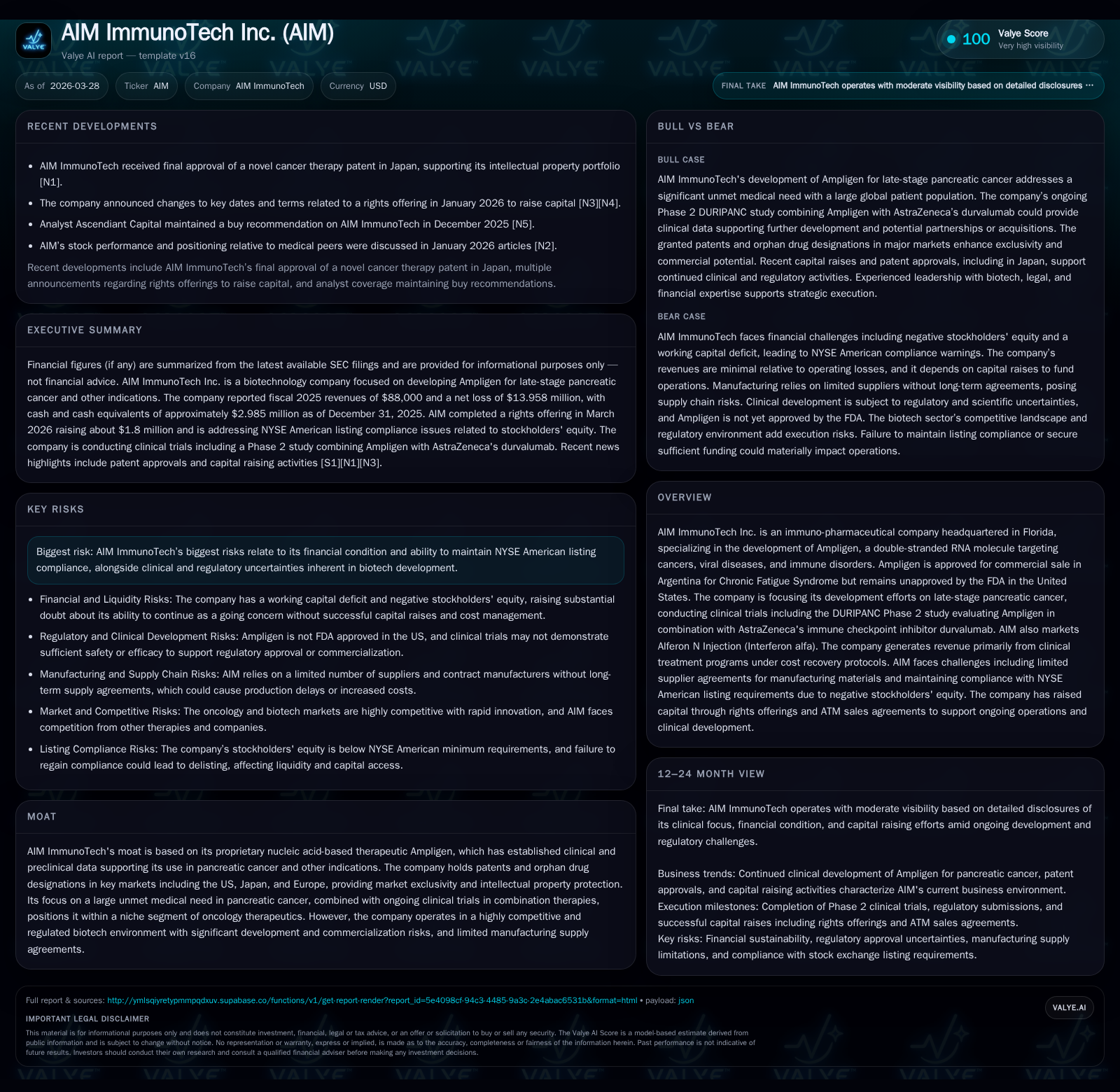
AIM ImmunoTech Inc. is progressing with its lead product Ampligen, focusing on pancreatic cancer trials and leveraging patent protection, yet operates under severe financial constraints and regulatory challenges. Revenue declined sharply in 2025 due to limited commercial approvals, while operating losses narrowed. The company faces a critical juncture to restore NYSE American listing compliance by mid-2026 amid a fragile liquidity position and ongoing litigation matters. Capital raises and strategic partnerships will be essential to sustain its clinical programs and potential market entry.
Historical Performance
AIM ImmunoTech’s financial results through FY2025 reflect a biotech firm facing commercialization constraints but showing modest operational improvement. Annual revenue declined from $170K in 2024 to $88K in 2025, reflecting the limited market reach of products like Ampligen which is FDA-unapproved in the US and only commercially available for Chronic Fatigue Syndrome in Argentina [F1]. Operating losses improved from $19.8M to $11.7M during the same period, mainly driven by expense control amidst continued clinical development [F1]. Net losses narrowed by approximately 20% year-over-year.
Cash flow from operations remained negative at about -$10.96M in 2025, consistent with prior years as AIM invests heavily into clinical trials and development costs [F1]. Capital expenditures were minimal at $18K, indicating a focus on research rather than fixed asset expansion.
The balance sheet showed deterioration with stockholders’ equity turning negative by nearly $9.8M at year-end 2025 compared to a deficit of around $1.3M the previous year [F1]. This decline has resulted in noncompliance with NYSE American’s minimum equity requirement of $6 million, requiring AIM to submit a remediation plan targeting compliance restoration by June 11, 2026 [S1].
Historical performance (annual)
| FY | Rev ($) | Net ($mm) | CFO ($mm) | OpInc ($mm) | Rev YoY | Net YoY |
|---|---|---|---|---|---|---|
| 2025 | 88000 | -14 | -11 | -12 | -48.2% | +19.4% |
| 2024 | 170000 | -17 | -15 | -20 | -15.8% | +40.2% |
| 2023 | 202000 | -29 | -21 | -32 | -48.9% | |
| 2022 | -19 | -16 | -20 |
Source: SEC companyfacts cache [F1].
Capital returns and efficiency (annual)
| FY | FCF ($mm) | ROE% |
|---|---|---|
| 2025 | -11 | 142.7 |
| 2024 | -15 | 1310.1 |
| 2023 | -21 | -283.0 |
| 2022 | -16 | -50.5 |
Source: SEC companyfacts cache [F1].
Table: Selected annual financial performance showing sustained losses alongside declining revenue and eroding equity [F1]
Business Overview
AIM ImmunoTech focuses on Ampligen (poly I:poly C12U), an experimental double-stranded RNA molecule designed to modulate immune responses against cancers—including pancreatic cancer—viral diseases and immune disorders [S1]. Ampligen acts as an immune stimulant engaging Toll-like receptor pathways.
The company also markets Alferon N Injection (Interferon alfa), though manufacturing is currently paused due to FDA approval challenges related to new inventory or contract manufacturing arrangements [S25].
Ampligen benefits from orphan drug status across key territories such as the US and Europe. In March 2026 it secured patent approval for its novel cancer therapy in Japan enhancing exclusivity protections [N1], which supports its intellectual property moat within a competitive immuno-oncology landscape.
However, AIM remains small and resource-constrained compared to larger peers pursuing multi-indication clinical pipelines. Manufacturing relies on limited suppliers—Jubilant HollisterStier LLC and Pharmaceutics International Inc.—without long-term binding contracts ensuring supply continuity or redundancy [S13]. This dependency poses risks to production schedules if vendor issues arise.
Clinical Development and Outlook
The company’s strategic focus is on Ampligen’s Phase 2 pancreatic cancer trial DURIPANC evaluating combination therapy with AstraZeneca’s durvalumab checkpoint inhibitor [S1]. Pancreatic cancer presents substantial unmet medical needs given poor prognosis and limited treatments; success here could unlock significant commercial value.
Ampligen is only approved for commercial sale in Argentina for Chronic Fatigue Syndrome; broader regulatory approvals remain pending globally [S1]. The company faces complex regulatory hurdles before expanding marketing rights or achieving FDA approval nationally.
Future growth may also derive from indications involving viral infections or other cancers where immune modulation offers therapeutic benefit. However:
- Regulatory risks remain high with potential additional FDA requirements on trial design or manufacturing processes [S11].
- Market adoption depends on demonstrating clinical efficacy in combination regimens against established therapies.
- Manufacturing scale-up challenges persist without secured long-term supply agreements [S13], complicating commercialization readiness.
Capital Allocation and Financing
AIM has not issued formal forward guidance but identified key near-term objectives including restoring NYSE American listing compliance through capital raises by June 11, 2026 [S1]. Maintaining exchange listing is critical for liquidity access and investor confidence.
Recent capital raising activities include:
- A rights offering closed March 6, 2026 generating approximately $1.8 million gross proceeds primarily from existing shareholders [S1].
- At-the-market common stock sales exceeding $2 million post-year-end [S1].
These financings provide short-term runway but highlight ongoing capital needs given persistent operating losses exceeding $10 million annually.
No dividends have been paid nor share repurchases conducted recently; capital deployment prioritizes sustaining R&D programs and operational continuity amid financial constraints [S10][S12][S15].
Long-term debt consists of unsecured promissory notes totaling around $5.3 million principal before discounts with maturities extending through late 2027 [S7][S17][S24]. Some debt settlements have occurred via issuance of common stock reflecting liquidity pressures.
ROE calculations are distorted due to negative equity; the ratio of net loss relative to negative equity exceeds nominal percentages but reflects accounting deficits rather than profitability [F1]. Operating cash flows remain deeply negative consistent with heavy investment phase.
Risks Summary
Key risks include:
- Continued noncompliance with NYSE American listing standards due to low shareholder equity threatens delisting risk affecting liquidity and capital access [S1][S20].
- Persistent substantial net losses raise sustainability concerns absent successful commercialization or partnership deals.
- Clinical trial outcomes are uncertain; failure would materially impair prospects.
- Manufacturing depends on few suppliers without long-term contracts creating supply chain vulnerabilities [S13][S19][S25].
- Litigation related to activist investors has consumed management time though recent rulings favor AIM; residual legal costs remain relevant [S4][S6][S26][S22].
- Limited product liability insurance coverage exists despite low historical claims exposure; future claims could be financially impactful [S11].
- Regulatory complexities include approval timing uncertainties and reimbursement challenges especially outside Argentina where approvals are lacking [S11][S21].
Conclusion: Strategic Imperatives Ahead
AIM ImmunoTech stands at a critical juncture where operational viability hinges on successful capital raises while advancing pivotal phase trials of Ampligen amid challenging regulatory landscapes and manufacturing constraints. The recent Japanese patent approval strengthens its IP position internationally but does not resolve immediate funding or regulatory hurdles domestically.
Restoring NYSE American listing compliance by mid-2026 remains essential not only for procedural reasons but as a gateway for investor support necessary to sustain clinical momentum. Monitoring upcoming DURIPANC data readouts alongside strategic collaborations will provide clearer signals regarding Ampligen’s commercial potential.
With revenues constrained to niche indications pending expanded approvals—and expenses outpacing inflows—AIM exemplifies biotech tradeoffs: promising science shadowed by financial fragility until meaningful commercialization milestones materialize.
Disclaimer: This report compiles publicly available information up through March 28, 2026. It does not constitute investment advice or endorsement of AIM ImmunoTech Inc.'s securities.
Disclaimer: This is research-only, informational analysis and not investment advice. It may include AI-generated interpretation and general industry context. Always verify important details using primary sources.

Comments