
Holistic Asset Finance Group Co.: Strategic Shift to Digital Marketing Amid Financial Challenges
HAFG has transitioned from wellness product sales to digital marketing and video production, achieving significant revenue growth while facing ongoing liquidity and profitability issues.
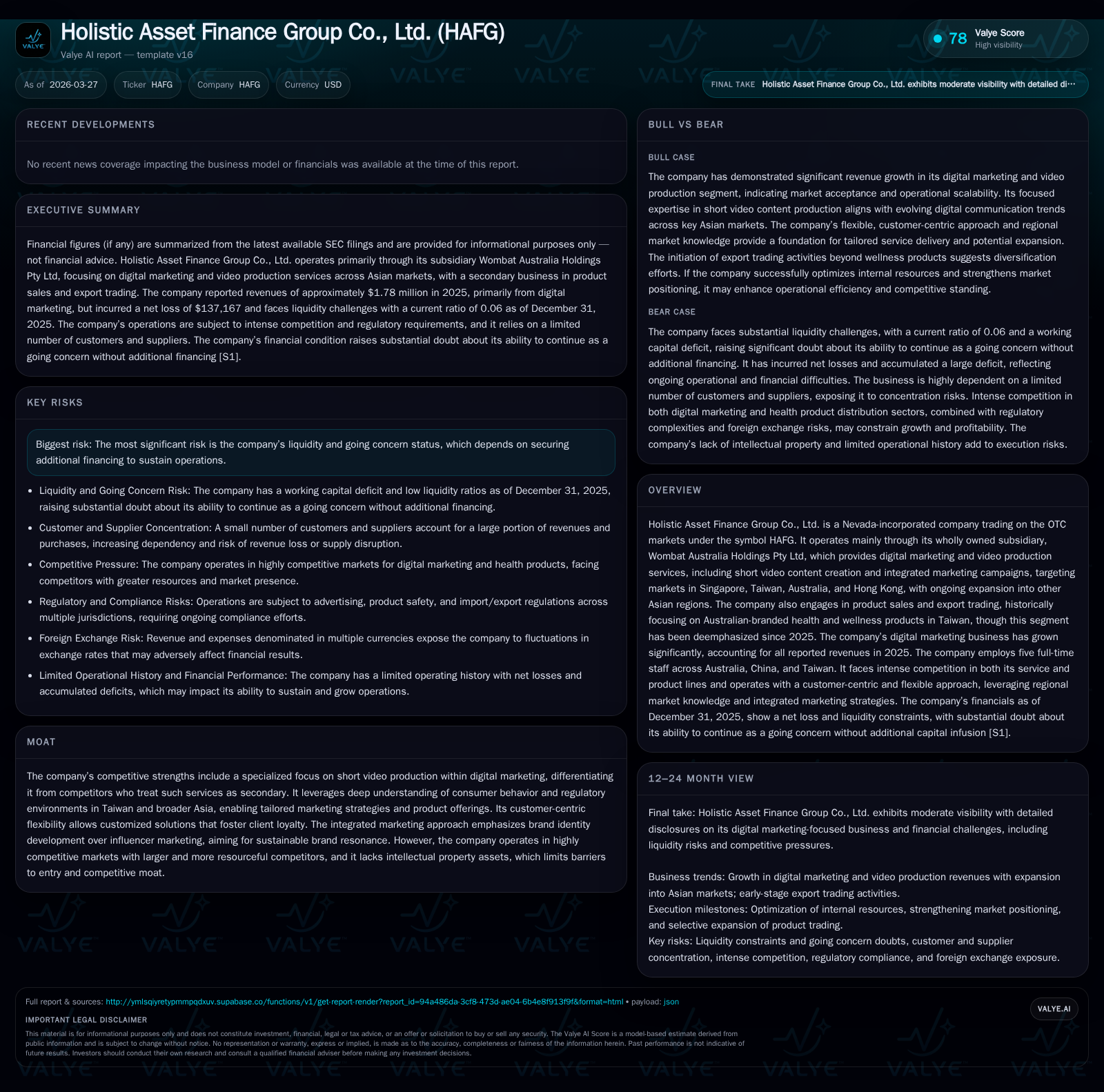
Holistic Asset Finance Group shifted focus from Australian health product distribution to digital marketing and short-form video production across Asia-Pacific. Revenue grew from $103K in 2024 to $1.78M in 2025, driven entirely by digital marketing services. Despite this growth, the company remains unprofitable with operating losses near $130K and net losses of $137K in 2025. Liquidity is constrained with cash at $15K and a current ratio of 0.06, raising going concern risks. Customer concentration is high with three clients representing about 70% of revenues. Early-stage export trading activities commenced but had no recognized revenue by end-2025. Capital structure relies heavily on interest-free related party loans totaling over $300K, with no dividends or share repurchases planned. Future performance depends on expanding the customer base, improving liquidity, and successful development of export trading.
Strategic Transformation Driving Revenue Growth
Holistic Asset Finance Group Co., Ltd. (HAFG) has significantly reoriented its business model over recent years. Historically focused on distributing Australian-branded health and wellness products primarily in Taiwan via offline group-buying channels, this segment generated approximately $103K in revenue in 2024[F1][S7]. In contrast, during 2025 the company pivoted decisively towards digital marketing and short-form video production through its subsidiary Wombat Australia Holdings Pty Ltd[S1][S7].
This segment delivers tailored short videos for platforms such as TikTok, Instagram Reels, and YouTube Shorts alongside integrated online and offline marketing campaigns targeting markets including Singapore, Taiwan, Hong Kong, and Australia[S7][S9]. By the end of 2025, digital marketing accounted for all recognized revenues totaling $1.78 million as wellness product sales declined to zero following strategic deprioritization[F1][S4]. Concurrently, export trading activities involving non-wellness products commenced but had not yet resulted in recognized revenue at fiscal year-end due to incomplete transactions[S4].
Financial Performance Overview
The transition yielded a dramatic revenue increase exceeding 17-fold from FY2024 to FY2025[F1]. Yet profitability challenges persist; operating losses stood at approximately $130K with net losses near $137K for FY2025[F1]. Liquidity remains strained — cash and equivalents were only $15,413 at year-end against current liabilities exceeding $400K, resulting in a very low current ratio around 0.06[F1]. This working capital deficit underscores substantial going concern risks.
Historical performance (annual)
| FY |
|---|
| 2025 |
Source: SEC companyfacts cache [F1].
Note: Revenue growth reflects discontinuation of wellness sales combined with rapid expansion of digital marketing.
Customer Concentration and Geographic Reach
In FY2025, three third-party customers accounted for approximately 36%, 20%, and 14% of revenues respectively — collectively about 70% concentration risk[S4][S13]. This exposes HAFG to revenue volatility should any major client reduce engagement.
Geographically, the company operates mainly across Singapore—known for stringent advertising regulations—Taiwan with diverse consumer preferences, Australia requiring multi-jurisdictional compliance, and Hong Kong[S4][S9]. This regional diversification offers growth potential but increases operational complexity.
Competitive Positioning: Focused Short-Form Video Expertise
HAFG differentiates itself by specializing exclusively in short-form video production within digital marketing — a service often treated as secondary by competitors[S3][S12]. The company integrates creative content production with data-driven campaign execution emphasizing brand identity over influencer dependency[S10][S27]. This customer-centric approach allows tailoring strategies aligned with local cultural trends across Asia-Pacific markets.[S10]
However, the absence of proprietary intellectual property limits competitive barriers against larger firms with deeper resources capable of scaling creative offerings.[S3]
Risks: Liquidity Constraints and Regulatory Complexity
The most critical risk is liquidity stress evidenced by working capital deficits exceeding $375K at end-2025 alongside cumulative accumulated deficits over $71 million[S8][F1]. The company relies heavily on unsecured interest-free loans from related parties amounting to approximately $319K as of December 31, 2025[S8][S16], highlighting dependence on insider financing.
Regulatory challenges include navigating diverse advertising standards such as Singapore’s ASAS and IMDA disclosure requirements for sponsored content[S6][S10], alongside compliance demands for export-traded products under health and safety laws[S5][S6]. Non-compliance could result in fines or reputational harm detrimental to a firm with limited financial buffers.
Supply chain disruptions remain relevant despite reduced wellness product focus; emerging export trading ventures face uncertainties without long-term supplier contracts or stable demand forecasts.[S4][S6][S11]
Export Trading Ventures: Early Development Stage
Following de-emphasis on wellness sales post-2024, HAFG initiated export trading involving non-wellness goods procured on a purchase order basis without secured long-term agreements[S4]. No revenue was recognized through the end of 2025 due to ongoing transaction completion processes[S4].
This nascent business line offers diversification potential if scaled successfully but entails operational challenges amid fragmented Asia-Pacific trade networks requiring logistical optimization.
Capital Allocation: Financing Reliance and Return Metrics
Operating cash flows remain negative reflecting investment phase costs associated with building digital marketing capabilities at modest scale[F1]. No dividends or share buybacks are planned as losses continue and resources remain constrained[S14][S15].
Related party financing increased from approximately $187K at end-2024 to over $319K at end-2025 through unsecured interest-free loans indicative of growing reliance on internal funding sources[S8][S16].
An approximate return on equity calculation based on net income relative to equity suggests about +37.9% ROE; however this figure likely reflects accounting equity fluctuations rather than sustainable profitability given ongoing net losses[F1], warranting cautious interpretation.
Outlook: Key Milestones to Monitor
Absent explicit forward guidance, analysts should watch for:
- Expansion beyond top three customers reducing concentration risk,
- Revenue recognition acceleration from export trading,
- Improved operating leverage signaling scalability,
- External financing or equity raises relieving liquidity constraints,
- Compliance achievements addressing multi-jurisdictional advertising regulations,
- Competitive dynamics impacting pricing or market share.
Management’s success in converting digital marketing expertise into consistent cash flow while evolving toward scalable operations will be pivotal.
Disclaimer
This analysis is based solely on publicly filed SEC documents without speculation or investment advice. Financial results reflect periods ending December 31, 2025 per SEC filings [F1], [S#]. Market conditions may change materially post-reporting period.
Disclaimer: This is research-only, informational analysis and not investment advice. It may include AI-generated interpretation and general industry context. Always verify important details using primary sources.

Comments