
Capital Discipline and Growth Dynamics at BV Financial in Maryland's Banking Sector
BV Financial’s conservative loan focus and capital allocation reflect a balance between steady growth and local economic risks tied to commercial real estate concentration.
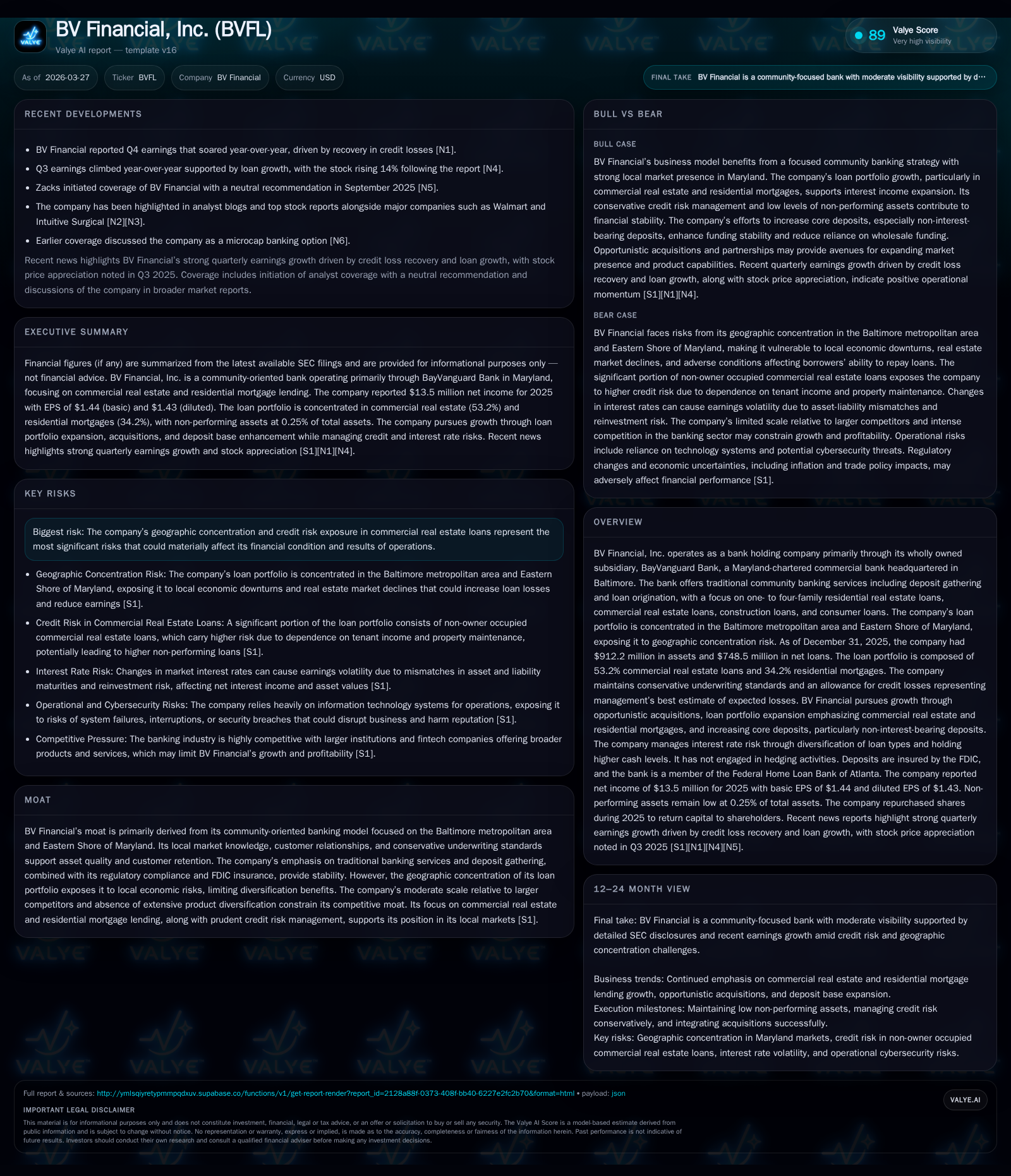
BV Financial, Inc., operating through BayVanguard Bank, has maintained a steady asset base around $912 million with a disciplined underwriting approach focused on commercial and residential real estate loans concentrated in the Baltimore metro area. Over the past three years, net income showed moderate volatility but grew by 15.1% in 2025, supported by improved interest income and credit loss recoveries. The company’s capital allocation balances stock repurchases exceeding $30 million alongside continued investments in core deposits amid competitive pressures. However, its concentrated exposure to non-owner occupied commercial real estate loans poses amplified credit risk sensitive to local market conditions.
Track Record of Measured Growth and Lending Focus
BV Financial operates primarily through BayVanguard Bank, a Maryland-chartered community bank centering its lending activities within the Baltimore metropolitan area and Eastern Shore of Maryland [S1]. The company reported total assets of $912.2 million as of December 31, 2025 [S11], with net loans increasing modestly by $19.2 million year-over-year to $748.5 million [S11]. This loan growth underpins the bank’s traditional community banking model emphasizing one- to four-family residential real estate loans (34.2% of loan portfolio) alongside a heavier stake in commercial real estate loans (53.2%) [S1].
Financially, BV Financial realized net income of $13.5 million for FY2025—a robust 15.1% improvement over the prior year’s $11.7 million [F1]. This uptick was driven primarily by an increase of $3.0 million in interest income coupled with a material recovery reflected in provision for credit losses (+$2.2 million) [S11]. Operating cash flow also strengthened sharply, rising 18.4% to $19.0 million compared to FY2024 levels [F1]. Capital expenditures remain restrained—only $237,000 spent during FY2025—signaling disciplined spending congruent with its community-centric business focus [F1].
Underwriting standards are conservative across commercial and residential segments, reinforced by geographic concentration which informs credit risk vigilance given exposure solely within Maryland markets [S1]. This measured growth reflects management’s prioritization of stable portfolio quality over aggressive expansion.
Exposure and Risks in Commercial Real Estate Lending
BV Financial’s loan composition skews heavily toward commercial real estate, totaling approximately $401.4 million or 53.2% of overall loans as of end-2025 [S1]. These loans encompass multifamily, office, retail properties—mainly non-owner occupied—with inherent complexities linked to operational management and collateral valuation variability within the local economy [S1]. This creates outsized sensitivity to adverse developments within Baltimore’s real estate market or broader economic cycles affecting the region.
The company acknowledges that non-owner occupied commercial properties tend to have less stringent maintenance standards than owner-occupied counterparts, escalating potential depreciation risks affecting collateral values [S1]. Moreover, borrowers holding multiple commercial real estate credits introduce credit risk concentrations where deterioration on one relationship can produce disproportional losses compared to diversified residential exposures [S1]. The typical extended holding periods for foreclosed commercial properties present liquidity challenges too.
These factors substantially heighten potential downside; any downturn reducing property revenues or valuations without adequate credit loss reserves could pressure earnings and capital.
Strategic Outlook: Growth Potential and Market Constraints
While BV Financial demonstrates steady volume gains in deposits (+3.8% YoY) boosting funding from core deposit sources ($676 million as of FY2025) [S7], competitive pressures within its regional market restrict room for rapid deposit expansion or repricing flexibility without incurring higher costs [S7]. To mitigate this, the bank supplements funding via wholesale mechanisms including Federal Home Loan Bank (FHLB) borrowings ($35 million outstanding end-2025) and brokered deposits ($50.3 million) despite their cost implications [S7][S14].
Regulatory capital constraints curtail excessive distributions; the company remains categorized as well-capitalized yet must adhere to capital conservation buffers limiting dividends or buybacks should ratios decline below prescribed thresholds [S8]. Forward-looking strategy includes opportunistic acquisitions intended to enhance product capabilities or geographic footprint while maintaining risk discipline—but such moves carry integration risks [S21].
Overall growth faces natural limits imposed by geographic concentration risk as well as regulatory frameworks emphasizing capital adequacy.
Key Financial Milestones and Performance Indicators
BV Financial’s key financial metrics over a recent three-year window illustrate stable profitability with fluctuations responding to economic dynamics:
Historical performance (annual)
| FY | Net ($mm) | CFO ($mm) | Capex ($) | Net YoY |
|---|---|---|---|---|
| 2025 | 13 | 19 | 237000 | +15.1% |
| 2024 | 12 | 16 | 611000 | -14.5% |
| 2023 | 14 | 15 | 155000 |
Source: SEC companyfacts cache [F1].
Capital returns and efficiency (annual)
| FY | Buybacks ($mm) | FCF ($mm) | ROE% |
|---|---|---|---|
| 2025 | 30 | 19 | 7.3 |
| 2024 | 18 | 15 | 6.0 |
| 2023 | 15 | 6.9 |
Source: SEC companyfacts cache [F1].
The return on equity measured approximately 7.3% in FY2025 (net income divided by equity level) indicating modest profitability relative to capital employed [F1]. Operating cash flow trends illustrate improving cash generation capacity while capex remains low relative to typical banking institution scales highlighting efficiency in managing tangible asset investments.
Equity contracted by about $11.7 million year-over-year due primarily to sizable share repurchases totaling nearly $30 million offsetting net income generated during the period [F1][S11].
Capital Allocation Philosophy: Balancing Shareholder Returns and Regulatory Capital
BV Financial actively employs stock repurchases as part of its capital return strategy; repurchases totaled roughly double between FY2024 ($17.7M) and FY2025 ($30M), reflecting management's commitment to enhance per-share metrics amid lack of dividend payouts historically [F1][S23]. Dividends have not been declared due mainly to regulatory limitations tied to capital conservation buffer requirements constraining discretionary distributions [S8][S23].
Maintaining compliance with stringent regulatory minima for Tier 1 common equity and total capital ratios remains a priority underpinning cautious allocation decisions that reconcile shareholder returns against the imperative for resilient capital buffers given loan portfolio concentration risks [S8][S23]. Rebalancing between buybacks versus preserving excess capital is a nuanced decision influenced by evolving economic outlooks impacting commercial real estate values.
Liquidity Management and Funding Composition Insights
Liquidity is anchored predominantly by core retail deposits which reached $676.1 million at December 31, 2025 after increasing approximately $24.6 million or +3.8% from prior year-end levels [S7][S12][S14]. Within these deposits, certificates of deposit grew by approximately $14 million while noninterest-bearing accounts contributed nearly $8.6 million incremental inflows signaling durable funding sources albeit amid intense deposit competition requiring elevated pricing strategies occasionally [S7][S12].
The bank supplements these deposits with wholesale funds comprising Federal Home Loan Bank advances totaling $35 million at December 31, 2025—up from $15 million a year earlier—to replace subordinated debt retired during the year [S14][S15]. An unfunded letter of credit facility backs municipal deposits which evidences layered liquidity contingencies alongside a correspondent bank line-of-credit facility remaining unused at year-end [S14][S6].
Interest expense rose moderately due primarily to increased FHLB borrowing costs but was partially offset by declined subordinated debt expenses following pay-offs completed during FY2025 [S15]. Net interest margin expanded slightly from 4.27% in FY2024 to approximately 4.35% in FY2025 illustrating effective cost management despite structural funding mix changes [S15].
Market Positioning Within the Baltimore Metropolitan Banking Scene
BV Financial’s moat is closely tied to its community-banking roots evidenced by deep local market knowledge within Maryland’s Baltimore region complemented by strong customer relationships among retail and small business clients [S1]. This proximity supports prudent credit selection practices along with resilience stemming from regulatory compliance oversight including FDIC insurance coverage on deposits fostering customer confidence.
However, limited geographic diversity concentrates exposure risks during localized economic stress particularly given heavy weighting toward commercial real estate lending—a segment inherently more cyclically volatile than residential mortgage products stabilized through owner occupancy safeguards [S1][S25]. Additionally, absence of extensive product diversification relative to larger regional competitors capabilities constrains scale advantages potentially limiting rapid growth beyond established markets.
Mechanisms such as conservative reserving techniques combined with evolving CECL model enhancements that incorporate unemployment rates underscore management’s commitment toward vigilant risk control adapted for their specific regional profile [S16][S24].
This analysis synthesizes information directly from publicly available SEC filings and company data as of March 27, 2026, with no speculative forecasts or investment recommendations provided herein.
Disclaimer: This is research-only, informational analysis and not investment advice. It may include AI-generated interpretation and general industry context. Always verify important details using primary sources.

Comments