
KBS Real Estate Investment Trust III Faces Debt Maturities Amid Challenging Office Market
High leverage and debt maturity pressures strain KBSR's core U.S. office portfolio during persistent sector headwinds.
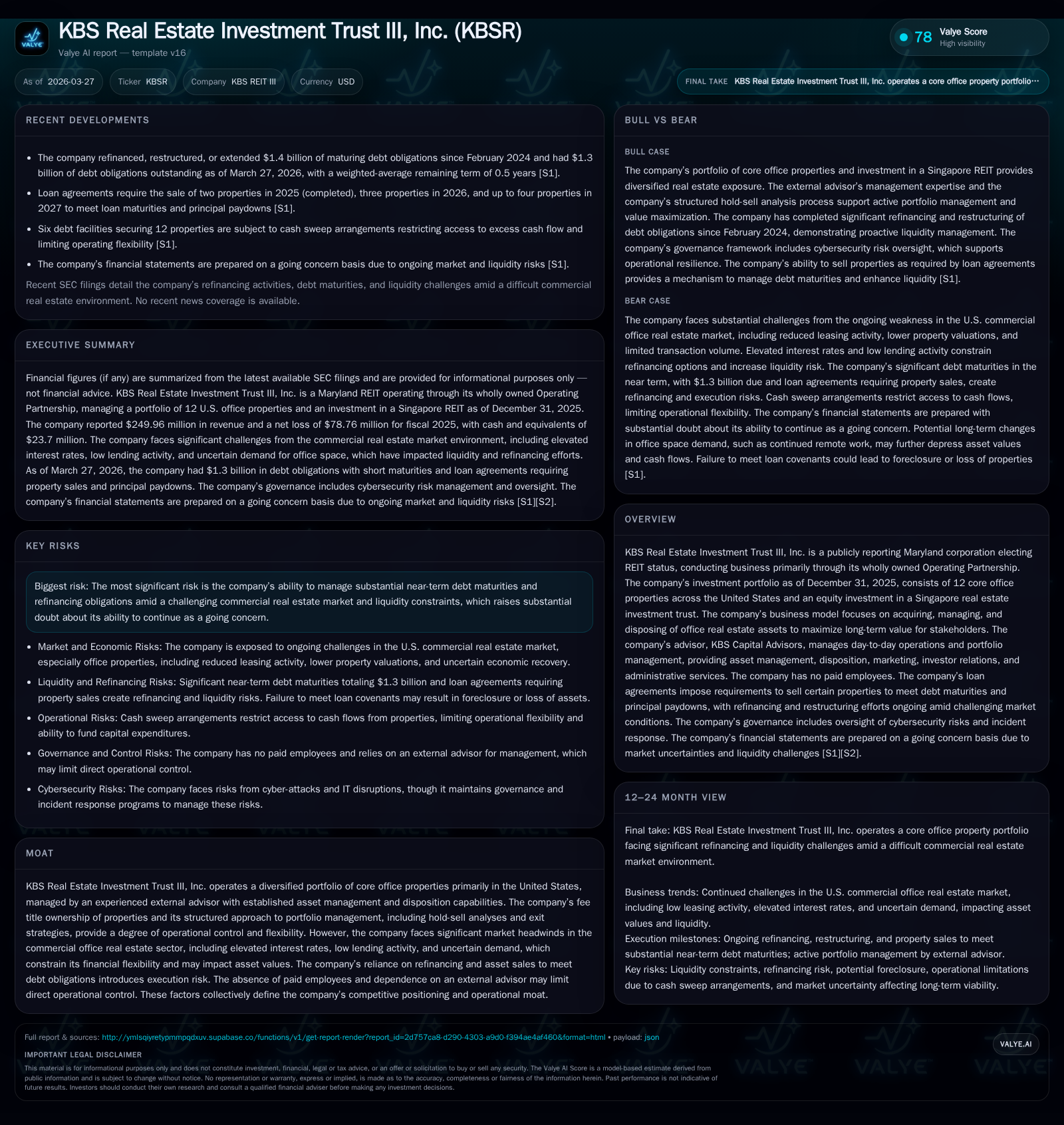
KBS Real Estate Investment Trust III, Inc. operates a portfolio of 12 core U.S. office properties and holds an equity stake in a Singapore REIT. The company faces significant financial stress due to $1.3 billion in near-term debt maturities, with loan agreements requiring property sales and principal paydowns amid a weak commercial office market and constrained lending environment. Despite managing operations through an experienced external advisor, KBSR’s capital structure risks and operational challenges cast doubt on its going concern status. Historical revenue has declined over recent years, net losses deepened in 2025, and cash flow has turned negative, while no dividends or share repurchases were made recently as the company prioritizes debt management and asset disposition.
Company Profile and Business Model
KBS Real Estate Investment Trust III, Inc. (KBSR) is a Maryland corporation electing REIT tax status, conducting business predominantly through its wholly owned Delaware limited partnership operating structure. Its portfolio focuses primarily on core office real estate holdings across the United States supplemented by an equity stake in a Singapore real estate investment trust (SREIT). The company does not employ direct staff but relies on its external advisor, KBS Capital Advisors, for comprehensive management functions ranging from asset management to investor relations and marketing [S1,S8].
Key to its operational approach is owning fee simple title to office properties while actively evaluating exit strategies including hold-versus-sell analyses aimed at optimizing long-term stakeholder value within prevailing market conditions [S14].
Historical Financial Performance
The company’s revenue declined steadily from $308 million in fiscal year (FY) 2022 to roughly $250 million by FY 2025, reflecting broad sector pressures impacting tenant demand and leasing activity across its office portfolio [F1]. This roughly 19% cumulative decrease encapsulates ongoing headwinds from elevated interest rates and subdued office space utilization post-pandemic.
Net income figures mirror these stresses with a growing loss trajectory worsening significantly in FY 2025 to -$78.8 million—an over sevenfold increase versus the -$10.9 million loss incurred in FY 2024 [F1]. Operational profitability metrics are similarly compressed.
Operating cash flows have been volatile: while positive cash flow of $76 million was generated in FY 2022 easing concerns at that time, the figure collapsed into negative territory (-$6.1 million) by FY 2025. Concurrently, capital expenditures have been curtailed sharply from $19.3 million down to slightly above $3 million across the same period, signaling restrained reinvestment [F1].
Capital allocation has shifted away from shareholder returns; no dividends were paid following the termination of dividend reinvestment and redemption programs as of March 2024. Previously notable buybacks and dividends distributed through FY 2023 ceased entirely by FY 2024 continuing into FY 2025 [F1,S12].
Historical performance (annual)
| FY | Rev ($mm) | Net ($mm) | CFO ($mm) | Capex ($mm) | Rev YoY | Net YoY |
|---|---|---|---|---|---|---|
| 2025 | 250 | -79 | -6 | 3 | -10.0% | -625.8% |
| 2024 | 278 | -11 | 8 | 7 | -7.7% | +93.1% |
| 2023 | 301 | -158 | 42 | 14 | -2.4% | |
| 2022 | 308 | 76 | 19 |
Source: SEC companyfacts cache [F1].
Capital returns and efficiency (annual)
| FY | Div ($mm) | Buybacks ($mm) | FCF ($mm) |
|---|---|---|---|
| 2025 | 0 | 0 | -9 |
| 2024 | 0 | 0 | 1 |
| 2023 | 25 | 12 | 27 |
| 2022 | 56 | 89 | 57 |
Source: SEC companyfacts cache [F1].
Revenue and earnings are reported in thousands; YoY figures compare to prior year.
Liquidity Position and Debt Maturities
Liquidity emerges as the critical constraint for KBSR given its substantial leverage profile. The company held approximately $23.7 million in cash and equivalents at year-end 2025 — insufficient relative to looming debt maturities totaling about $1.3 billion with an average maturity window of just six months from March 2026 onward [F1,S4,S16].
Loan covenants necessitate ongoing deleveraging through scheduled principal repayments coupled with mandatory property dispositions: two properties mandated for sale were divested successfully during calendar year (CY) 2025; three additional sales are targeted for CY 2026 with potential for up to four disposals needed by CY 2027 [S4,S11,S19]. This forced asset liquidation occurs within a notably illiquid U.S. office market characterized by depressed transaction volumes and pricing uncertainties.
Further complicating access to funds are existing loan facility provisions requiring monthly cash sweeps — excess property-level operating cash flows are redirected into collateral accounts benefiting lenders rather than freely available for corporate needs or reinvestment [S5,S17]. These restrictions amplify operational inflexibility amid tight credit markets.
To manage maturities, KBSR has engaged frequently in refinancing and loan amendments since early February 2024 covering over $1.4 billion of obligations; however, these restructurings often involve tradeoffs such as reduced loan commitments or stipulations demanding asset sales and prepayments under conditions outside company control — heightening execution risk substantially [S4,S15,S27].
Market Environment Impacting Portfolio Valuation
KBSR’s office portfolio faces pronounced headwinds due to evolving tenant behaviors including sustained remote work trends affecting demand intensity particularly in key markets like the San Francisco Bay Area where several properties reside [S8,S27]. Appraisers have marked down property valuations reflecting cap rate expansions induced by persistent inflation fears and elevated interest rates.
The combination of weaker leasing activity, declining rental rates in select locales, and valuation impairments erodes collateral values backing loans — contributing directly to restricted capital availability through lender-imposed constraints like cross-default clauses that can accelerate multiple debt facilities upon one default event [S6,S17,S28].
Management’s strategic focus remains on balancing near-term liquidity requirements against preserving long-term portfolio value through disciplined hold-sell decisions intended to maximize net proceeds from asset sales while optimizing timing amidst unpredictable market recovery dynamics [S14,S8].
Governance and Management Structure
The absence of salaried employees places operational responsibility squarely on KBS Capital Advisors who execute day-to-day management under agreed service contracts covering asset management, dispositions, marketing initiatives, investor relations, and administrative tasks [S1,S8]. This externalized management model streamlines cost but may limit direct responsiveness or agility particularly under distress scenarios requiring rapid strategic actions.
Board oversight emphasizes cybersecurity as a significant risk area with established governance committees monitoring policies proactively — indicative of holistic risk management beyond traditional real estate concerns [S1].
Future Outlook: Risks and Observables
No explicit formal guidance or milestones have been published beyond routine annual estimated share valuations conducted with assistance from independent appraisers such as Kroll LLC confirming significant declines in estimated NAV per share—from $3.89 (Dec-24) down to approximately $2.70 as of late-2025 reflecting ongoing asset value erosion combined with liabilities adjustments [S22,S29]. Watchpoints include ability to refinance or restructure debt facilities expiring mid-2026 onward, successful execution of planned property sales without steep discounts relative to appraised values, changes in lease expirations or tenant retention rates influencing NOI stability, and broader market liquidity conditions for commercial real estate transactions.
Risks remain material:
- Failure to meet debt covenant conditions could trigger lender enforcement rights including foreclosure on collateral properties or forced equity pledges gaining lender control over subsidiaries.
- Cross default provisions entail that an issue with one loan could cascade accelerating others increasing restructuring complexity.
- Prolonged low demand for office space driven by structural shifts such as permanent hybrid work models may suppress recoveries.
- Execution risk tied to externalized operating model under an economically stressed environment.
- Potential need for court-supervised restructuring remains a possibility if negotiated refinancing cannot be completed timely [S7,S27].
Returns and Capital Distribution Policy
Recent years have seen suspension of distributions consistent with cash flow pressures; no dividends have been declared since termination of reinvestment plans early in calendar year 2024 alongside cessation of share repurchases illustrating prudence focusing resources on securing balance sheet stability rather than capital returns during refinancing efforts [F1,S12]. Return on equity metrics reflect deep losses relative to shrinking equity base (about $178 million at end-2025) yielding negative approximate ROE near -44%, underscoring financial strains inherent currently faced by stakeholders [F1].
Summary Table: Key Financial Metrics (USD '000)
| Metric | FY2022 | FY2023 | FY2024 | FY2025 |
|---|---|---|---|---|
| Revenue | 308017 | 300677 | 277665 | 249961 |
| Net Income | -221 | -157533 | -10851 | -78756 |
| Operating CF | 75965 | 41634 | 7653 | -6076 |
| Capex | 19324 | 14222 | 6885 | 3112 |
| Dividends Paid | 56205 | 25319 | 0 | 0 |
| Share Buybacks | 89183 | 12142 | 0 | 0 |
| Equity | 421668 | 267412 | 256559 | 177803 |
Financial data sourced from latest SEC filings covering periods ended December each year.
Disclaimer: This report provides an analytical overview based solely on publicly available filings without investment recommendations or price targets. It incorporates historical financial data complemented by qualitative assessment of market conditions affecting KBS Real Estate Investment Trust III's operations as disclosed through SEC documents up till March 27, 2026.
Disclaimer: This is research-only, informational analysis and not investment advice. It may include AI-generated interpretation and general industry context. Always verify important details using primary sources.

Comments