
Cyngn Inc.’s Autonomous Edge: Vehicle-Agnostic Tech Disrupts Industrial Mobility
Cyngn’s modular autonomous vehicle software integrates with diverse industrial vehicles, leveraging OEM partnerships for market penetration amidst financial headwinds.
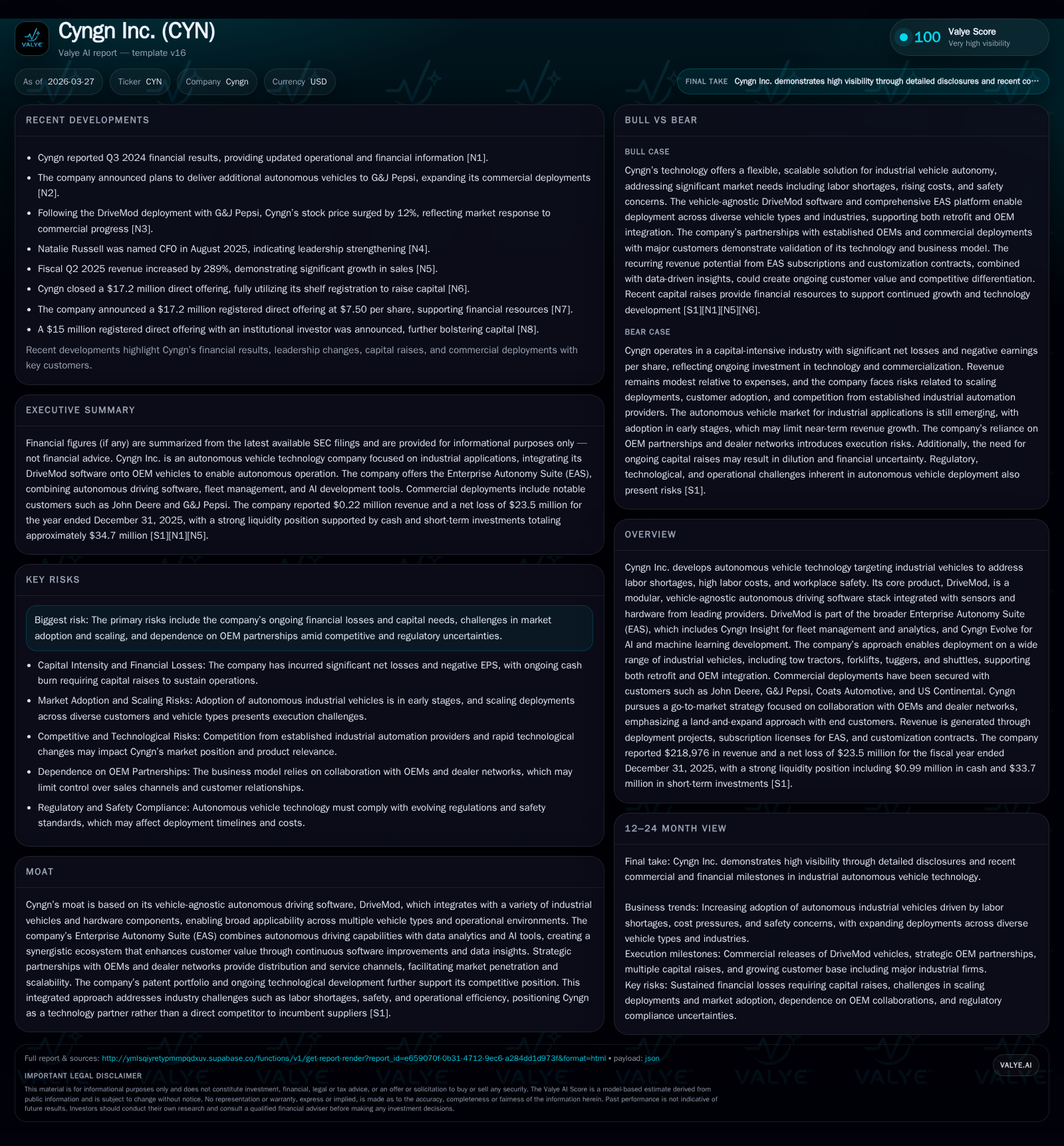
Cyngn Inc. has developed a flexible, vehicle-agnostic autonomous driving software platform, DriveMod, supporting a broad range of industrial vehicles to address labor shortages and operational inefficiencies. Despite its technological advancements and expanding commercial deployments with notable customers including US Continental, the company continues to face significant financial losses reflecting the challenges of scaling autonomous industrial vehicle technology. Strategic collaborations with OEMs and dealer networks form the backbone of Cyngn’s go-to-market approach, while future growth depends on successful scaling of its Enterprise Autonomy Suite amid regulatory and competitive uncertainties.
Transforming Industrial Vehicles: Historical Revenue and Software Deployment Trends
Cyngn Inc.’s progression from concept to commercial presence in the autonomous industrial vehicle market reveals a contrast between innovative product deployments and challenging financial realities. The company’s revenue trajectory exhibits volatility common in emerging tech fields: after generating $262K in FY2022, Cyngn surged to $1.49M in FY2023 before declining sharply by 75% in FY2024 to $368K and further by 40.5% to $219K in FY2025 [F1]. This revenue contraction coincides with intensified operating losses which rose roughly 12.5% year-over-year in FY2025 to nearly -$25.7M.
Operating cash flow similarly worsened, extending net cash used in operations from -$19.2M in FY2024 to -$23.6M in FY2025 reflecting sustained investment into R&D, integration efforts, and go-to-market activities amid nascent adoption cycles [F1]. Capital expenditures have modestly increased (+17% YoY) driven largely by hardware integration and pilot deployments.
Despite these financial pressures, Cyngn has validated its DriveMod technology across multiple industrial vehicle form factors — ranging from stockchaser tuggers capable of towing over 6,000 lbs to electric forklifts and multi-passenger shuttles — displaying true vehicle-agnostic versatility uncommon among competitors restricted by platform specificity [S7],[S10].
The company’s strategic deployments at scale include customers such as US Continental demonstrating DriveMod’s applicability across manufacturing and distribution sectors [S7],[N1]. This growing portfolio underscores an operational footprint extending beyond proof-of-concept projects toward production release.
Historical performance (annual)
| FY | Rev ($) | Net ($mm) | CFO ($mm) | OpInc ($mm) | Rev YoY | Net YoY |
|---|---|---|---|---|---|---|
| 2025 | 218976 | -23 | -24 | -26 | -40.5% | +29.6% |
| 2024 | 368138 | -33 | -19 | -23 | -75.3% | -46.1% |
| 2023 | 1489317 | -23 | -19 | -23 | +468.4% | -18.6% |
| 2022 | 262000 | -19 | -16 | -19 |
Source: SEC companyfacts cache [F1].
Capital returns and efficiency (annual)
| FY | FCF ($mm) | ROE% |
|---|---|---|
| 2025 | -25 | -60.6 |
| 2024 | -20 | 3181.1 |
| 2023 | -21 | -214.5 |
| 2022 | -79.8 |
Source: SEC companyfacts cache [F1].
Revenue growth was highly volatile due to shifting project timelines; operating losses reflect significant R&D investment consistent with early-stage scaling.
Modular Autonomy Meets Market Needs: Evolution of DriveMod and Enterprise Autonomy Suite
Cyngn’s core innovation lies in DriveMod: a modular software stack architected for compatibility across a spectrum of industrial vehicles without necessitating bespoke engineering for each platform. This vehicle-agnostic architecture taps into fundamental building blocks shared across autonomy applications—such as sensor fusion from LiDAR, radar, cameras; real-time dynamic path planning; high-definition mapping; and AI/ML decision-making frameworks—to deliver level-4 autonomy capabilities within novel operational design domains (ODDs) relevant to indoor warehouses or complex yard operations [S4],[S10].
DriveMod integrates with standardized AV hardware kits encompassing industry-leading hardware suppliers’ sensors and computing units—a key factor enabling non-recurring engineering (NRE) cost efficiencies when adapting autonomy to different industrial vehicles like forklifts or tuggers [S6],[S10].
Complementing DriveMod is the broader Enterprise Autonomy Suite (EAS), which comprises two critical platforms:
Cyngn Insight: A configurable fleet management dashboard providing actionable analytics at multiple levels—site-wide visibility down to individual module health—to optimize operational efficiency via predictive maintenance triggers and utilization insights.
Cyngn Evolve: An internal AI/ML development toolkit enabling continuous enhancement of autonomy software using synthetic and real-world data models coupled with sophisticated simulation environments such as "AnyDrive," allowing safe validation of new features prior to deployment [S11].
This tightly-coupled ecosystem creates a synergistic feedback loop where operational data drives AI improvements that enhance vehicle autonomy performance—a crucial differentiator given industry challenges around edge case handling in unstructured environments [S10],[S14]. The system’s ability to retrofit existing fleets also enables gradual adoption aligned with customer risk appetites.
Operational Pivots and Customer Footprint Expansion After FY2024 Declines
Following revenue setbacks during FY2024-25 linked partly to early commercialization hurdles and selective project timing adjustments, Cyngn has recalibrated its go-to-market approach towards deepening integration with existing customers while selectively onboarding marquee clients such as US Continental—a name indicating trust in Cyngn’s solution viability [N1],[S7].
The company increasingly emphasizes a “land & expand” model targeting enterprise end-users deploying heterogeneous fleets across multiple sites. Successfully deploying DriveMod on initial vehicle types allows iterative expansion within customer portfolios—from first-generation tuggers or forklifts into complementary assets—then scaling across geographically distributed facilities leveraging common interfaces provided by EAS [S4],[S7].
This approach mitigates upfront capital strain for customers while accelerating recurring revenue potential through EAS subscriptions. The mix of commercial pilots evolving into paid deployments marks an inflection from experimental engagements towards scalable productization.
Strategic Collaboration as a Growth Engine: OEM Partnerships and Channel Strategy
Cyngn executes a deliberate alliance strategy that prioritizes collaboration over competition within the industrial autonomy ecosystem. By integrating closely with established OEMs—such as BYD for forklifts and Motrec for tuggers—the company gains crucial access to validated hardware platforms that can embed DriveMod during assembly or retrofit phases without extensive re-engineering overheads .
These partnerships extend also into aftermarket dealer networks well-positioned to provide sales coverage, installation services, maintenance support, driving faster market penetration beyond direct sales efforts [S7]. The “partner instead of compete” philosophy acknowledges the complexity of aligning robotics hardware makers, IoT connectivity providers, digital fleet managers, and autonomous software suppliers into an interoperable ecosystem—a necessity for sustained scale in Industry 5.0 contexts.
The simplicity afforded by DriveMod Kits standardizes sensor/computation packages tailored per vehicle use case simplifying integration tasks at OEM production lines or retrofit sites—a strategic advantage enabling diverse operational design domains without prohibitive non-recurring engineering costs typically required in bespoke AGV/AMR solutions [S6],[S10].
Evaluating Financial Health: Continuing Losses, Cash Burn, and Capital Allocation
Financial metrics illustrate Cyngn’s developmental stage status characterized by negative returns despite technological advances. With approximately $219K revenue generated in FY2025 contrasted against an operating loss nearing $25.7M—the largest annual deficit since IPO—the company recorded an approximate return on equity of negative 60.6%, underscoring weak profitability dynamics at present [F1].
Operating cash flow further deteriorated YoY by roughly 22.8%, reaching negative $23.6M indicative of aggressive capital deployment for product refinement and market expansion initiatives exceeding near-term revenue inflows [F1], complemented by moderate increases (~17%) in capex focused on hardware integration pilot projects.
Liquidity presents another challenge; cash reserves dropped sharply from $23.6M at end-FY24 to under $1M at end-FY25 though buffered by short-term investments around $33.7M suggesting runway sufficiency assumptions rest heavily on efficient capital management plus anticipated new funding sources or revenue inflection points as per management disclosures [F1],[S9].
The absence of dividends or share repurchase programs indicates retained capital reinvestment prioritizing technology development rather than shareholder returns presently.
Opportunity versus Risk: Regulatory, Technological, and Competitive Headwinds Ahead
Cyngn operates within a nascent but rapidly evolving regulatory framework for autonomous industrial vehicles where safety certification standards remain fragmented globally. Critical dependencies on OEM partners’ braking and steering systems leave integration vulnerabilities potentially impacting liability exposures if component defects arise causing system failures—risks explicitly acknowledged in SEC filings [S1],[S14].
Technological challenges focus intensely on achieving reliability for “edge cases”: rare but safety-critical scenarios testing the limits of AI perception models during autonomous operations. Despite advances via Cyngn Evolve simulation tools leveraging real-world sensory data streams and synthetic augmentation, absolute assurance remains elusive affecting scaled deployment timelines.
The competitive arena includes tier-one incumbents like Crown Equipment alongside robotic specialists such as Seegrid Corporation; however, Cyngn claims differentiation through its modularity-driven universal AV software stack capable of supporting diverse vehicle types across indoor/outdoor environments—a strategic moat dependent on sustained IP development bolstered by patent activity recorded recently [S17],[S19],[S23].
Data privacy laws including GDPR impose compliance burdens due to continuous collection of operator biometric data captured by AV sensor arrays requiring strict handling protocols failure of which could result in costly penalties undermining corporate reputation .
What Investors Should Watch: Metrics, Milestones, and Market Adoption Signals
Looking ahead encourages focus on several key indicators reflecting Cyngn’s scalability:
- Expansion pace of commercial deployments beyond pilot customers notably into new vertical markets such as agriculture or mining remains a crucial benchmark[N1][S1].
- Growth trajectory within the Enterprise Autonomy Suite subscription revenues signaling deeper software monetization relative to transactional deployment fees.
- Additional OEM announcements confirming broader hardware platform compatibility revealing traction within manufacturing pipelines.
- Advances in edge case handling validated through safety certifications solidifying regulatory approvals essential for mass adoption.
- Cash flow improvements via financing events or organic margin enhancements marking transition toward sustainable operations. Monitoring these vectors will illuminate whether Cyngn can convert technological promises into durable revenue streams sufficient to justify elevated investment risk inherent at this stage.
This analysis is based entirely on information available from SEC filings [F1], company disclosures [S#], recent news releases [N#], with no speculative forecasts or investment recommendations offered herein.
Disclaimer: This is research-only, informational analysis and not investment advice. It may include AI-generated interpretation and general industry context. Always verify important details using primary sources.

Comments