
Actuate Therapeutics’ Evolution: Clinical Progress and Capital Dynamics
Actuate Therapeutics advances its novel GSK-3β inhibitor through pivotal trials while managing liquidity amid ongoing losses.
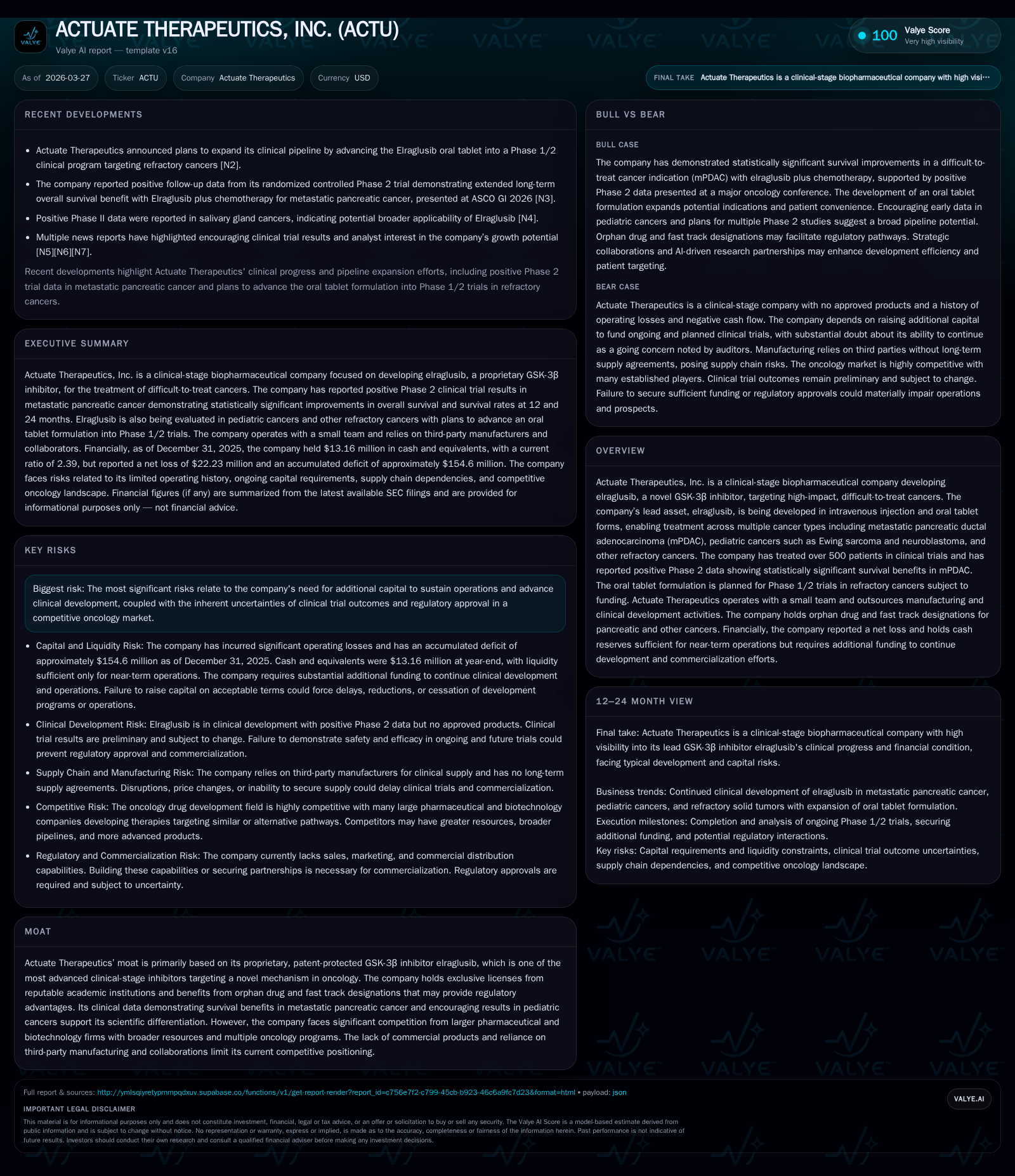
Actuate Therapeutics, a clinical-stage biotech focused on elraglusib — a proprietary GSK-3β inhibitor — continues to demonstrate promising Phase 2 data in metastatic pancreatic ductal adenocarcinoma (mPDAC) following treatment of over 500 patients. However, the firm’s financials reflect persistent operating losses, underscoring capital demands for advancing clinical development. Its strategy relies heavily on external contracts and intellectual property protection, navigating competitive oncology dynamics. Upcoming oral formulation trials represent critical near-term catalysts contingent upon financing.
Historical Financial Performance and Operating Trends
Actuate Therapeutics remains entrenched in the clinical development phase with no commercial revenues reported as of fiscal year-end 2025 [F1]. The company’s operating income improved by about 10.6%, narrowing its operating loss from approximately -$25.2 million in FY2024 to -$22.5 million in FY2025. Net income followed a similar trajectory, with an 18.5% reduction in net losses to -$22.2 million for FY2025 [F1]. Operating cash flow (CFO) losses also decreased by roughly 12%, from -$21.8 million to -$19.2 million year-over-year.
The balance sheet shows an equity increase from just over $100 thousand in FY2024 to nearly $7.9 million in FY2025, signaling significant capital injections or equity financings during the period [F1]. Cash and equivalents stood at $13.2 million by the end of 2025 supporting the company's near-term liquidity needs with a current ratio of 2.39 [F1]. Despite these improvements, return on equity (ROE) remains deeply negative at around -280%, reflecting ongoing early-stage losses typical of development biopharma companies where research and development outlays dominate.
Historical performance (annual)
| FY | Net ($mm) | CFO ($mm) | OpInc ($mm) | Net YoY |
|---|---|---|---|---|
| 2025 | -22 | -19 | -22 | +18.5% |
| 2024 | -27 | -22 | -25 |
Source: SEC companyfacts cache [F1].
Capital returns and efficiency (annual)
| FY | ROE% |
|---|---|
| 2025 | -280.5 |
| 2024 | -26189.1 |
Source: SEC companyfacts cache [F1].
Data sourced from SEC filings [F1]. No revenue available due to clinical stage status.
Clinical Development Trajectory and Key Growth Drivers
At the core of Actuate Therapeutics’ pipeline is elraglusib—an ATP-competitive small molecule inhibitor specifically targeting glycogen synthase kinase-3 beta (GSK-3β). This enzyme is known as a master regulator within oncogenic signaling cascades that drive tumor cell survival, proliferation, migration and invasion while modulating anti-tumor immunity [S1]. Elraglusib’s mechanism positions it as one of the most advanced clinical-stage agents targeting this pathway.
Originally licensed exclusively from University of Illinois-Chicago and Northwestern University under patent protections securing its composition-of-matter and methods-of-use rights [S1], elraglusib embodies what management describes as a 'pipeline in a molecule' due to its multimodal mechanisms potentially applicable across diverse oncologic indications including pancreatic cancer—a historically difficult-to-treat malignancy—as well as pediatric cancers such as Ewing sarcoma and neuroblastoma [S1].
Clinical experience encompasses treatment of over 500 patients via intravenous injections across Phase 1 and Phase 2 studies [S1]. The pivotal Actuate-1801 Part 3B randomized controlled trial enrolled 286 first-line metastatic pancreatic ductal adenocarcinoma (mPDAC) patients demonstrating statistically significant improvements in median overall survival versus control arms [S3], establishing important clinical proof-of-concept for elraglusib in this refractory indication.
This positive Phase 2 data marks a critical inflection point that underpins potential expansion into additional indications and formulations [S3]. The company aims to explore oral tablet formulations with planned Phase 1/2 trials targeting refractory cancers; however, progression hinges on securing adequate funding [S1]. Such multimodality reflects an advanced understanding of tumor microenvironment interactions and immunomodulatory roles that differentiate their therapeutic approach relative to existing kinase inhibitors.
Challenges Impacting Future Expansion and Funding Needs
While scientific advances offer promise, Actuate Therapeutics confronts inherent structural challenges typical of early-stage biopharma enterprises without commercial products [S1]. The firm depends heavily on external capital markets to finance ongoing costly clinical trials amid sustained operating losses evidenced by negative cash flows [F1].
Moreover, development activities are predominantly outsourced—including manufacturing processes and clinical trial execution—which introduces vendor dependency risks but conserves fixed overheads given the company's lean staffing structure capped around twelve full-time employees focused on R&D oversight and administrative governance [S1][S13].
Competition remains intense with larger pharmaceutical companies maintaining expansive oncology portfolios including kinase-targeted therapies benefiting from broader resources and diversified pipelines limiting Actuate's market leverage [S1]. Regulatory environments add complexity: orphan drug designations afford strategic benefits such as market exclusivity but are susceptible to policy shifts at agencies like FDA or EMA which may revise criteria or enforcement strategies impacting pathway timelines or exclusivity periods [S6].
Compounding these are multifaceted healthcare compliance mandates spanning U.S., European Union GDPR privacy protections affecting patient data handling during trials; pharmacovigilance obligations post marketing authorization; pricing scrutiny; and anti-kickback legislation—all raising operational costs while heightening compliance risk profiles worldwide [S4][S10][S14]. These layers underscore the narrow runway for bridging clinical success into sustainable commercial viability.
Upcoming Trials, Regulatory Milestones, and Strategic Watchpoints
Actuate has not publicly announced initiation dates for new oral formulation trials but highlights plans for Phase 1/2 studies targeting refractory cancers contingent on securing sufficient funding commitments [S1][S3]. These studies are poised as crucial near-term catalysts that could expand elraglusib’s therapeutic footprint beyond mPDAC.
Regulatory support includes orphan drug status coupled with fast track designation facilitating accelerated review processes—an advantage leveraged during prior trial phases enhancing communication channels with FDA regulators [S1][S6]. However unpredictable regulatory shifts or delayed enrollment could impose timing setbacks.
Shareholders will likely monitor disclosures related to trial commencement announcements or interim efficacy/safety readouts which may materially alter valuation perceptions ahead of potential licensing deals or partnership expansions. Additionally noteworthy is the company’s exclusivity based on university collaborations underpinning intellectual property portfolio strength—a key element as patent expiration timelines dictate horizon value beyond immediate clinical milestones.
Capital Structure, Returns Analysis, and Shareholder Value Considerations
The financial architecture reveals a company still reliant on periodic equity infusions evidenced by dramatic increases in shareholders’ equity—from approximately $104 thousand at end-FY2024 to nearly $7.9 million post-FY2025—amid persistent net loss generation nearing $22 million annually [F1]. This pattern typifies developmental-stage biopharmas where shareholder dilution risks accompany cash burn profiles demanding strategic capital raises or partnership monetization strategies.
Operating cash flow deficits narrowed modestly yet remain substantively negative (-$19 million FY2025), restricting free cash flow availability for non-operational initiatives or dividends which remain undistributed according to public filings reflecting standard industry practice among R&D-focused firms without product revenues [F1][S19].
Liquidity measured via current ratio stands healthy at 2.39 indicating sufficient short-term asset coverage relative to liabilities post-financing rounds but requiring vigilance towards midterm runway sustainability absent revenue inflows or new financing events [F1]. Return metrics remain deeply negative; ROE approximated at -280% denotes sizable accumulated deficits overshadowing nascent equity bases—common among firms immersed in early innovation stages prior to commercialization breakthroughs.
Investors face classical biotech risk-return trade-offs where upside hinges on successful regulatory approvals catalyzing revenue generation against recurring operational expenditure drag tightening funding flexibility.
Scientific Innovation and Competitive Differentiation in Oncology
Elraglusib’s differentiation pivots on its selective inhibition of GSK-3β—a kinase historically considered challenging due to pleiotropic physiological roles but now understood as central in oncogene signaling networks governing apoptosis resistance and immune evasion mechanisms within tumors [S1]. This targeted action coupled with activity across both solid tumors like mPDAC and hematologic/pediatric malignancies places it strategically amid unmet medical needs where current standards offer limited survival gains.
Patented exclusivity sourced through collaborative licensing agreements with academic institutions buttresses technological moat despite inherent litigation risks prevalent within biotech IP landscapes—the company acknowledges exposure to validity challenges but benefits from broad claim scopes encompassing composition-of-matter and method-of-use patents valid through extended terms post-regulatory approval phases [S17][S18].
Regulatory fast track status expedites interactions facilitating adaptive trial designs aligned with oncology sector best practices emphasizing biomarker-driven endpoint assessments supporting approval path acceleration [S1][S6]. Nevertheless competitors deploying multi-targeted kinase inhibitors or immuno-oncology combinations command formidable market positions requiring Actuate’s programs to substantiate differentiated efficacy/safety profiles compelling clinician adoption.
Disclaimer: This analysis is prepared solely for informational purposes based on publicly available SEC filings as of the date herein without any investment advice or solicitation.
Disclaimer: This is research-only, informational analysis and not investment advice. It may include AI-generated interpretation and general industry context. Always verify important details using primary sources.

Comments