
Clear Channel Outdoor’s Financial Turnaround and Acquisition Path
Sharp revenue growth and profitability rebound frame Clear Channel Outdoor’s ongoing strategic transition amid a $6.2 billion pending acquisition.
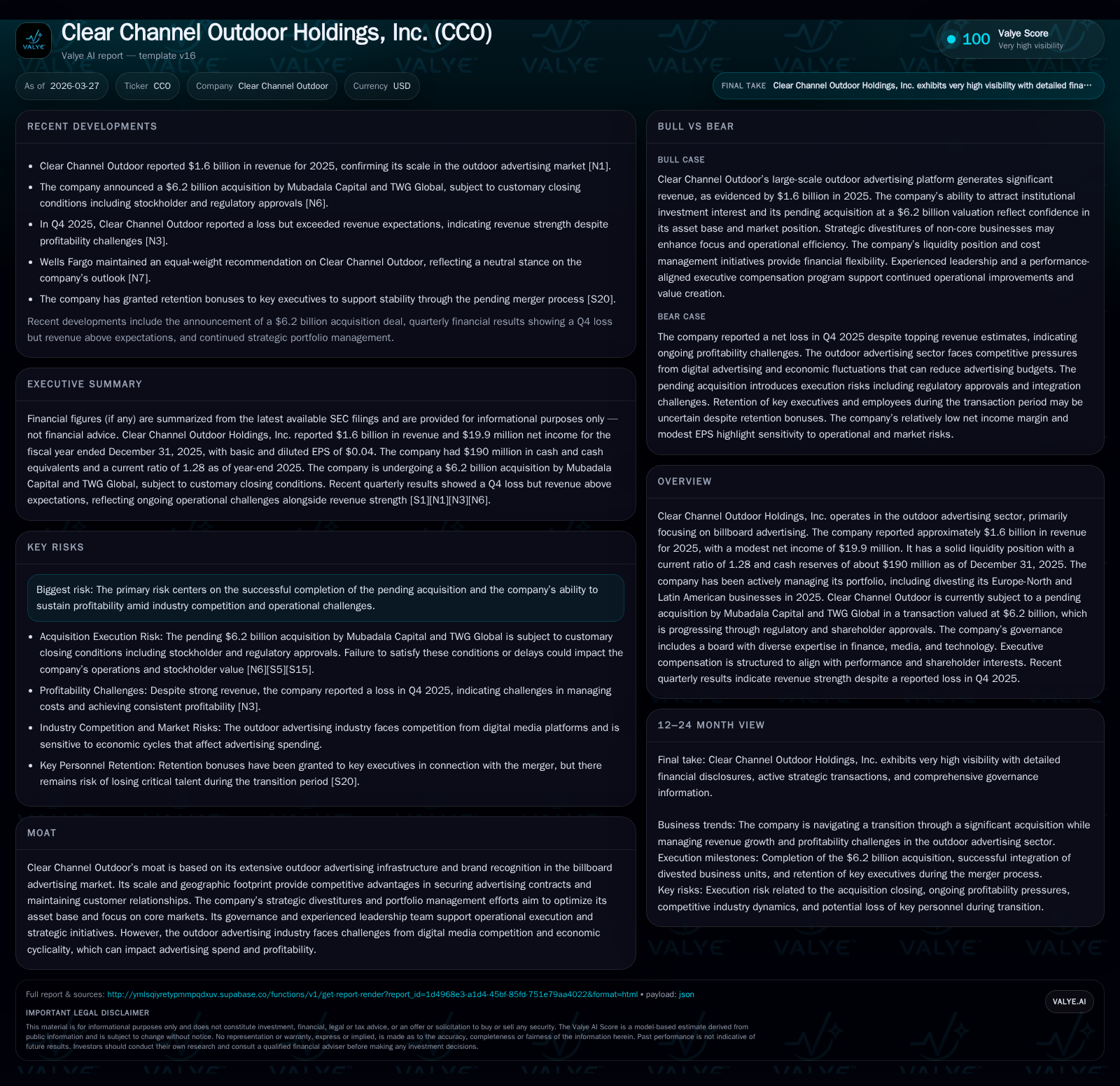
Clear Channel Outdoor Holdings, Inc. demonstrated a significant operational recovery in 2025 driven by portfolio rationalization including key divestitures of its Europe-North and Latin American businesses. Revenue surged 275.9% to $1.6 billion with operating income more than doubling year-over-year, signaling improved cost discipline and market focus. The company is currently subject to a pending $6.2 billion buyout by Mubadala Capital and TWG Global, facing regulatory and shareholder approval risks alongside integration challenges. Cash flow generation strengthened with modest free cash flow, while capital returns remain restrained as the company navigates ownership transition. Clear Channel’s scale and infrastructure maintain a competitive edge amidst digital disruption, supported by aligned governance as it approaches this strategic inflection.
Revenue Resurgence After Strategic Divestitures
Clear Channel Outdoor has undergone a pronounced financial pivot as evident from its fiscal year performance ending December 2025. Revenue landed at approximately $1.6 billion—a striking increase of roughly 275.9% year-over-year compared with $427 million recorded in 2024 [F1]. This surge follows deliberate portfolio rationalization strategies, notably the divestiture of European-North and Latin American operations completed during early 2025 as disclosed in corporate filings and news reports [N1]. These actions effectively concentrated resources on core domestic markets where the company enjoys entrenched customer relationships and infrastructure scale.
This geographic contraction refocused Clear Channel's revenue streams away from lower-margin or less strategically aligned regions, thereby delivering enhanced top-line stability despite overall contraction in international coverage. Practitioners will recognize this as a classic case of portfolio pruning to shore up operational leverage—trimming peripheral units allows for both better capital deployment and sharper strategic attention on higher-return assets.
Historical performance (annual)
| FY | Rev ($bn) | Net ($mm) | CFO ($mm) | OpInc ($mm) | Rev YoY | Net YoY |
|---|---|---|---|---|---|---|
| 2025 | 1.6 | 20 | 115 | 311 | +275.9% | +211.5% |
| 2024 | 0.4 | -18 | 80 | 100 | -32.5% | -172.2% |
| 2023 | 0.6 | 25 | 31 | 124 | -74.5% | +125.6% |
| 2022 | 2.5 | -97 | 140 | 232 |
Source: SEC companyfacts cache [F1].
Capital returns and efficiency (annual)
| FY | FCF ($mm) |
|---|---|
| 2025 | 32 |
| 2024 | -63 |
| 2023 | -135 |
| 2022 | -45 |
Source: SEC companyfacts cache [F1].
Table: Historical Performance Summary (FY2022-2025) quantifies financial recovery post-divestiture with year-on-year percentage changes [F1]
Operational Trends Driving Profitability Improvements
Clear Channel Outdoor’s operational earnings profile mirrored its top-line rebound, displaying compelling margin expansion after years of compression due to economic cyclicality within outdoor advertising spaces.
In particular, operating income soared again by approximately +210% to reach $311 million in fiscal year 2025 from $100 million the prior year [F1]. This was fuelled partly by rigorous deployment of operating cost initiatives targeting efficiency gains in labor, maintenance, and administrative overheads—all critical given exposure to fluctuating advertiser demand influenced heavily by digital media alternatives [S1]. Such EBITDA tailwinds were critical against external pressures of shifting marketing spends toward digital channels.
The company further leveraged its asset-heavy infrastructure—its inventory of billboards continues to anchor steady pricing power especially in high-density urban locales where outdoor visibility is paramount. Despite these advantages, macroeconomic cyclicality constrains upside during downturns—a structural risk highlighted in company disclosures [S4]—making margin sustainability a recurring focus.
Pending Buyout: Terms, Progress, and Deal Risks
A defining event framing Clear Channel’s near-term trajectory is the announced acquisition deal valued at approximately $6.2 billion led by Mubadala Capital alongside TWG Global [N4]. This transaction moves through customary regulatory scrutiny and shareholder voting processes characteristic of large strategic buyouts.
By end March 26, 2026, the 'go-shop' period expired per merger agreement terms—during which management actively solicited alternative proposals but received no superior offers [S3][N4]. The deal relies on equity commitments totaling up to about $3.3 billion coupled with bridge debt financing facilities around $3.4 billion providing necessary liquidity for closure [S7].
Risks remain material: successful completion is contingent on satisfying multiple closing conditions including affirmative shareholder approval majority votes and absence of burdensome regulatory conditions such as restrictive antitrust measures [S5][S8]. The company also faces possible limitations on pursuing strategic or business opportunities throughout merger pendency that could dampen momentum or operational flexibility.
Further concerns encompass potential litigation arising from merger disputes or claims related to termination fees payable if cancelled under certain circumstances [S27]. Moreover, announcements surrounding the process have already impacted share price volatility making careful execution paramount.
Outlook: Post-Merger Growth Catalysts and Challenges
Looking beyond transaction closure anticipated later in fiscal year or early next cycle (timing remains subject to regulatory timelines), growth prospects hinge primarily on achieving scale benefits through focused portfolio asset management combined with enhanced sales initiatives tailored toward digital out-of-home synergy opportunities alluded to increasingly by sector players though specifics remain proprietary here [N2][S4].
Yet caution prevails over potential caps relating to shifts in advertiser budgets increasingly allocated toward programmatic digital platforms—with outdoor billboard advertising still contending for budgets within evolving multi-channel marketing mixes.
Absent explicit forward guidance from management disclosed publicly post-merger announcement phase, key indicators for future monitoring include trends in stabilized net incomes reflecting integration efficiencies, as well as renewals in major advertising contracts signaling continued market relevance.
Capital Allocation: Cash Flow Strength, Dividends, and Shareholder Returns
Capital deployment emphasizes financial prudence aligned with ongoing ownership transition.
Operating cash flows recorded growth of approximately +44% year-over-year hitting $114.9 million while capital expenditures shrank nearly -42%, culminating in free cash flow near $32 million—a critical metric indicating internal funds availability without reliance on external financing [F1].
Despite positive cash generation improvement, returns measured via approximate ROE reflect continued strain at around -3.5%, driven partly by legacy equity deficits accrued from earlier losses [F1]. Dividends remain modest historically with negligible recent buybacks noted indicating focus on balance sheet health rather than aggressive distributions amid merger context [F1][S6][S10][S13]. Liquidity remains robust evidenced by current ratio maintained at approximately 1.28 supported by over $190 million in cash reserves end-2025 sustaining operational flexibility [F1].
Post-acquisition scenarios suggest potential shifts depending on new ownership’s strategic priorities but maintaining capital allocation discipline appears prudent given cyclical industry backdrop.
Outdoor Advertising’s Traditional Moat Confronting Digital Disruption
Clear Channel holds one of the largest inventories among billboard companies providing access across dense urban corridors nationally—the backbone for its brand moat backed by entrenched local client relationships typically requiring high-impact out-of-home placements not easily replicated digitally.
Yet practitioners acknowledge growing challenges posed by programmatic online advertising platforms that offer granular audience targeting unattainable via static physical media points—forcing companies like Clear Channel into integrating digital out-of-home formats combining traditional screens with data-driven ad placements aiming for higher yield per impression.
Ad inventory management tactics such as dynamic pricing models and flexible leasing structures are increasingly adopted industry-wide to sustain pricing power even amid economic fluctuations impacting overall ad spend budgets.
Governance and Leadership: Aligning Interests Ahead of Ownership Change
The board composition reflects an experienced group possessing expertise across finance, media, technology sectors underpinning informed oversight through transactional phases [F1]. Executive compensation frameworks notably tie incentives heavily to Plan Adjusted EBITDA achievements balanced with individual performance goals encouraging alignment with shareholder value creation ahead of merger closure [S13].
Retention arrangements such as double-trigger change-in-control provisions serve dual purposes: mitigating turnover risks among key executives during ownership transitions while preserving operational continuity—a vital consideration given merger-related uncertainties flagged among risk disclosures [S5][S8].
Overall governance practices incorporate best-in-class features minimizing dilution risks from equity grants while enforcing clawbacks aligned with performance measures ensuring prudent stewardship of corporate resources going forward.
Conclusion
Clear Channel Outdoor Holdings presents a case study of financial resurgence propelled by disciplined portfolio rationalization reclaiming earnings power concurrently navigating the complexities imposed by an impending transformative acquisition valued at over six billion dollars. Its capacity to sustain operational improvements amidst inherent sector pressures from digital competitors alongside effective deal execution will determine trajectory beyond this pivotal moment.
Investors should observe forthcoming proxy statements detailing transaction specifics along with quarterly performance updates post-merger closure for concrete evidence on realized synergies and structural shifts shaping Clear Channel’s continued evolution.
This analysis is based solely on publicly available information provided up to March 27, 2026.
Disclaimer: This is research-only, informational analysis and not investment advice. It may include AI-generated interpretation and general industry context. Always verify important details using primary sources.

Comments