
Cantor Equity Partners IV: SPAC Strategy and Capital Future Ahead of Its Business Combination Deadline
Cantor Equity Partners IV operates as a Cayman Islands-based SPAC with $450 million in IPO proceeds and a fixed timeline to complete a business combination.
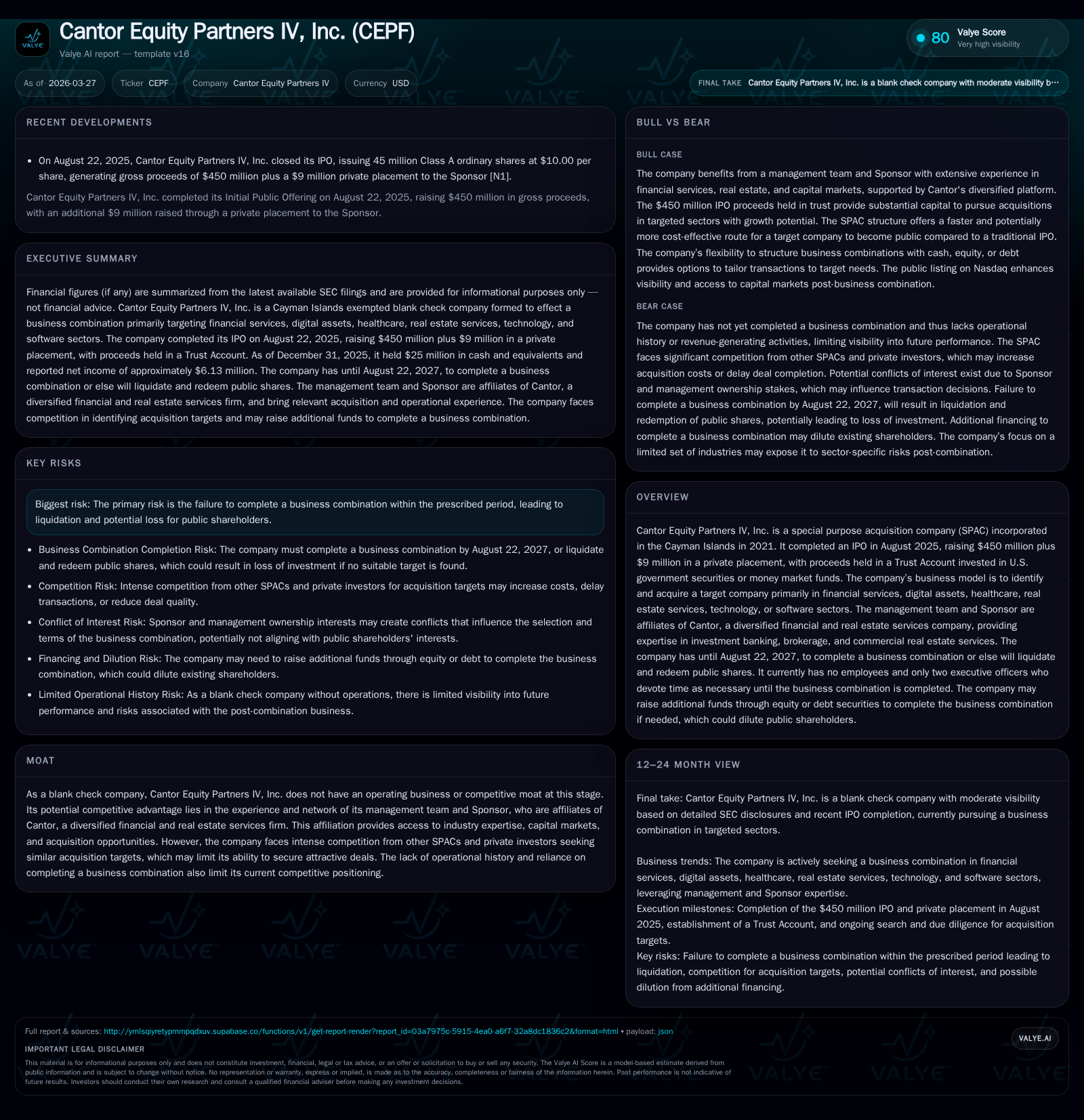
Cantor Equity Partners IV, Inc. launched in 2021 and completed its IPO in August 2025, raising approximately $459 million including a private placement. With no operating business, its value proposition hinges on the strategic expertise of its Cantor-backed management team and Sponsor, who focus on acquiring companies primarily in sectors like financial services, digital assets, and healthcare. The company has until August 22, 2027, to consummate a business combination or else liquidate. Its financials reflect typical SPAC characteristics—operating losses offset by interest income from trust assets—and exhibit high accounting-return metrics driven by capital structure rather than operations. The path forward depends on sourcing attractive targets amid intense competition, managing shareholder redemption rights, and navigating regulatory mechanisms that govern capital allocation and transaction approvals.
From Inception to IPO: Formation and Capital Raise Dynamics
Cantor Equity Partners IV, Inc. was incorporated as a Cayman Islands exempted company on April 30, 2021. This legal status enables it to operate primarily outside the Cayman Islands under a tax-exempt framework while meeting global capital markets norms [S1][S24]. The company executed its Initial Public Offering (IPO) on August 22, 2025, issuing 45 million Class A ordinary shares at $10 per share. This raised gross proceeds of $450 million inclusive of partial over-allotment shares exercised by underwriters [S1][F1]. Simultaneously, a Private Placement to the Sponsor generated an additional $9 million at the same price per share.
The aggregate funds from both offerings were placed into a Trust Account maintained with CF Secured LLC—an affiliate of the Sponsor—which exclusively invests these proceeds in short-dated U.S. government securities or registered money market funds to preserve capital until deployment [S4][S23]. This trust structure aligns with SEC rules designed to protect public shareholders’ capital prior to consummation of any merger or acquisition.
Sponsor Affiliations and Management Expertise as Deal Catalysts
Cantor Equity Partners IV benefits uniquely from its Sponsor affiliation with Cantor, a diversified financial-services conglomerate active across investment banking middle market advisory (CF&Co.), brokerage technology (BGC Group), and commercial real estate services (Newmark Group). The team's collective experience spans deal sourcing, structuring complex transactions across geographies and economic cycles, and accessing varied capital markets instruments [S1][S4][S5].
Brandon G. Lutnick serves as Chairman & CEO; Jane Novak is CFO—with extensive roots in Cantor’s accounting policy group—adding seasoned stewardship to the SPAC’s operations [S1][S24]. Their operational prudence combines with Cantor’s network advantages to pinpoint acquisition candidates fitting CEPF’s sectormatic focus despite increasing competition from peers.
Historical Performance Metrics: A Snapshot of Financial Standing
As typical for early-stage blank check vehicles without commercial operations, CEPF reported minimal operating losses offset by net positive income rooted entirely in interest accrued within its Trust Account. For fiscal year ended December 31, 2025:
Historical performance (annual)
| FY |
|---|
| 2025 |
Source: SEC companyfacts cache [F1].
[F1]
This outsized ROE figure reflects accounting treatment juxtaposing minimal equity dilution with steady interest returns rather than ongoing operating profitability. It underscores SPACs' intent as holding vehicles buffering capital until deployment [F1].
Acquisition Criteria: Target Industries and Strategic Focus
CEPF targets companies primarily within financial services, digital assets, healthcare sectors along with real estate services and technology/software firms—aligning well with Cantor’s domain strengths [S1][S4][S5]. Management pursues targets that exhibit:
- Positive long-term growth prospects
- Competitive advantages often manifest through network effects or proprietary solutions
- Consolidation opportunities within fragmented markets
- Recurring revenue streams or clear pathways toward recurring revenue models
- Operational improvement potential
- Attractive current or potential profit margins
This flexible yet focused screening reflects standard SPAC logic balancing tactical agility against strategic compatibility. The emphasis on recurring revenue mirrors growing investor appetite for predictable cash flows amid market volatility.
Capital Allocation Framework and Shareholder Rights Pre-Combination
Capital allocation before consummation remains rigidly conservative. Funds reside mostly in the Trust Account restricted by SEC regimens to low-risk instruments until used for an approved combination or returned upon liquidation [S4][S6][S7].
CEPF embeds contractual protective measures whereby any amendments affecting shareholder redemption rights require offering redemptions on equivalent cash terms—a mechanism designed to safeguard public investors’ interests pre-deal [S7].
Although provisions exist for affiliates like Sponsor or officers to repurchase public shares privately (subject to Regulation M compliance), no purchases are currently planned [S6][S13]. Dividends and buybacks are absent reflecting typical SPAC non-operating status.
Redemption mechanics offer Public Shareholders options post-announcement either via tender offer procedures regulated under Rule 14e-1 or through proxy vote solicitations ensuring liquidity flexibility independent of voting outcomes [S14][S28].
Constraints and Risks in Completing the Business Combination on Time
CEPF faces a strict deadline: August 22, 2027 marks the terminus for completing one or more qualifying business combinations or liquidating thereafter [S4][S19]. Failure to meet this deadline obligates liquidation—redeeming Public Shares roughly at IPO net asset value but exposing investors to risks including:
- Potential depletion of Trust Account due to transaction expenses or claims prioritization under Cayman insolvency rules,
- Loss of entire sponsor investment,
- No operational revenues until deal completion,
- Heightened competition from numerous other SPACs ramping acquisition efforts making target scarcity an acute challenge.
Furthermore, absence of employees beyond two executives limits internal deal flow generation capabilities relying heavily on Sponsor relationships. Market uncertainty could exacerbate delays or reduce feasible deal valuations.
What to Watch: Milestones and Potential Outcomes Leading to August 2027
Key developments will revolve around CEPF’s ability to secure an appropriate Target Company meeting valuation thresholds (at least 80% fair market value coverage per Nasdaq rules) utilizing internal valuation assessments potentially supplemented by external opinions [S21].
Watch for:
- Announcement timing of definitive agreements,
- Filing proxy statements detailing combination terms including redemption procedures,
- Shareholder votes accepting or rejecting proposed mergers;
- Redemption tallies—excess redemption elections over specified caps could compel adjustments or alternative financing discussions,
- Any disclosures regarding privately negotiated purchases by the Sponsor which may tip deal feasibility odds.
Market conditions impacting debt availability or pricing could alter financing structures particularly if target enterprise values exceed available Trust funds necessitating supplemental capital raises introducing dilution risks [S16][S19].
Completion remains contingent upon rigorous due diligence encompassing financial audits and operational vetting typically spanning months post-announcement culminating in closing prior to mandated expiration.
This analysis is based solely on disclosed regulatory filings as of March 27, 2026. It does not constitute investment advice or recommendations but aims to provide detailed insight into Cantor Equity Partners IV's current status within the highly competitive SPAC space leading up to its business combination deadline.
Disclaimer: This is research-only, informational analysis and not investment advice. It may include AI-generated interpretation and general industry context. Always verify important details using primary sources.

Comments