
uCloudlink Group’s Revenue Decline Contrasts with Margin Expansion and Operational Improvement
uCloudlink advances through evolving monetization models and cloud SIM innovations despite regulatory and market headwinds.
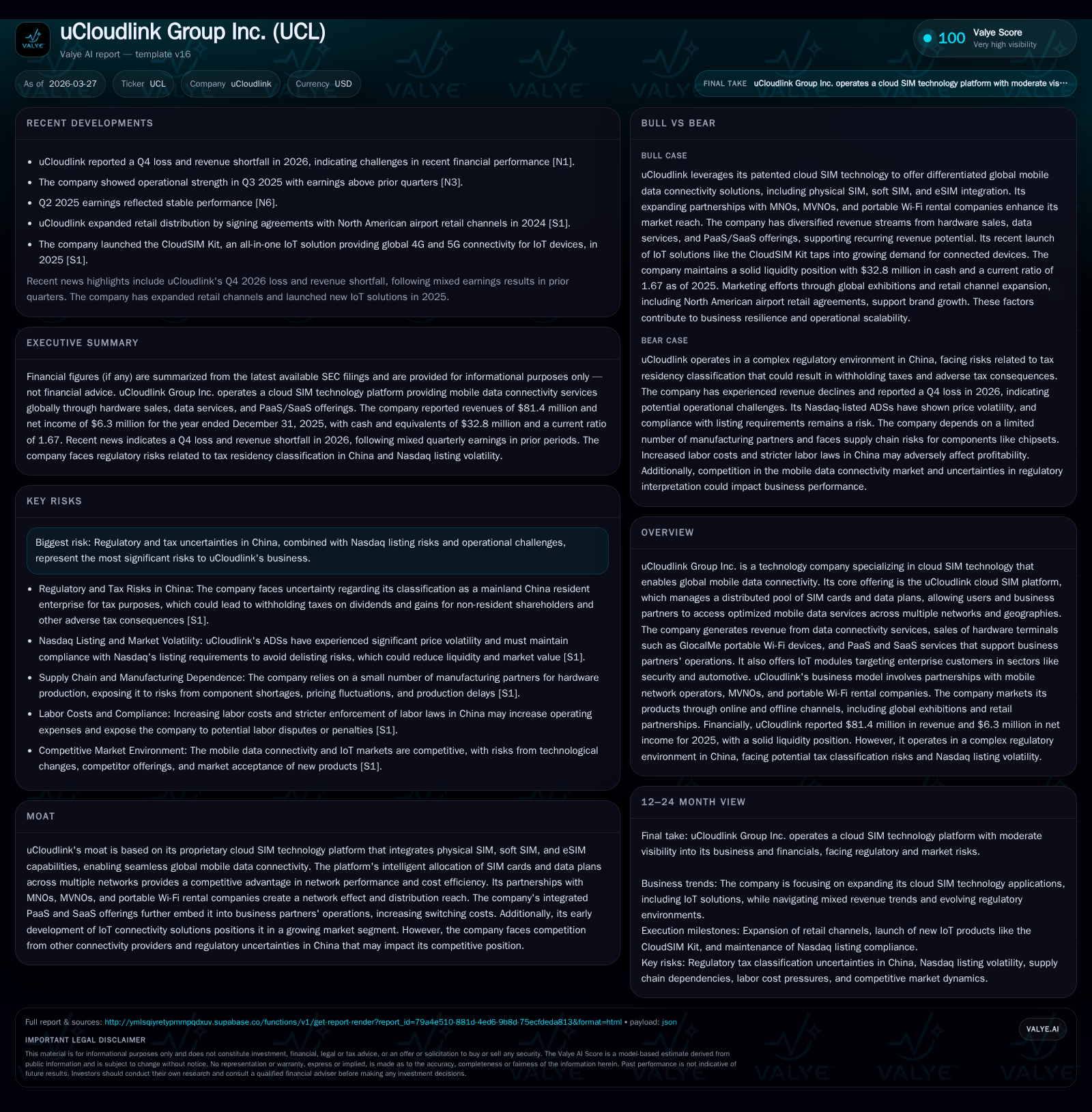
uCloudlink Group Inc. delivered mixed financial outcomes in recent years, with revenue declining 11% from 2024 to 2025 due to softer product sales, yet operating income nearly doubled in the same period reflecting improved margins and cost control. The company’s proprietary cloud SIM platform underpins differentiated offerings spanning global data connectivity, PaaS/SaaS services, and IoT modules. Strategic partnerships and a growing user base support future growth prospects, though regulatory uncertainties in China and competitive pressures remain notable risks. Capital allocation emphasizes operational investment while maintaining a solid liquidity position and moderate use of short-term borrowings.
Company Overview
uCloudlink Group Inc. operates at the intersection of mobile telecommunications and cloud technology, specializing in its proprietary cloud SIM platform that enables flexible wireless data connectivity worldwide. Originating with solutions targeting international travelers (uCloudlink 1.0), it has since evolved toward serving local markets within countries (uCloudlink 2.0), leveraging partnerships with mobile network operators (MNOs) and mobile virtual network operators (MVNOs).
Its product mix includes hardware terminals like the GlocalMe portable Wi-Fi devices, a suite of PaaS/SaaS business solutions related to SIM card management and operations support systems, as well as IoT modules tailored for enterprise applications such as automotive and security sectors [S1][S3][S11][S13][S14].
The company differentiates itself through an integrated technology stack blending physical SIM cards, soft SIM capabilities, and emerging eSIM technology within a cloud-based architecture that dynamically allocates data plans for optimized performance and cost efficiency [S3][S6].
Historical Financial Performance
Revenues grew initially but saw pressure recently due to changes in sales mix:
Historical performance (annual)
| FY | Rev ($mm) | Net ($mm) | CFO ($mm) | OpInc ($mm) | Rev YoY | Net YoY |
|---|---|---|---|---|---|---|
| 2025 | 81 | 6 | 3 | 8 | -11.1% | +38.2% |
| 2024 | 92 | 5 | 9 | 4 | +7.1% | +62.1% |
| 2023 | 86 | 3 | 7 | 3 | +114.2% | |
| 2022 | -20 | 4 | -19 |
Source: SEC companyfacts cache [F1].
Capital returns and efficiency (annual)
| FY | Buybacks ($mm) | FCF ($mm) | ROE% |
|---|---|---|---|
| 2025 | 8 | 2 | 21.9 |
| 2024 | 8 | 5 | 21.1 |
| 2023 | 8 | 4 | 17.5 |
| 2022 | 8 | 4 | -213.7 |
Source: SEC companyfacts cache [F1].
Revenue grew from $85.6M in 2023 to a peak of $91.6M in 2024 but declined thereafter by about 11% primarily due to lower sales of hardware terminals and near disappearance of data-related product sales (down over 98%) in the latest year [F1][S10]. In contrast, revenues from service offerings tied to data connectivity demonstrated resilience.
Operating income almost doubled between 2024 and 2025 from $4.39M to nearly $8M—a testament to improved operational efficiencies, favorable margin shifts mainly influenced by higher-margin services versus products sold, alongside restrained operating expenses—the latter marked by reduced R&D spending amid increased marketing costs [F1][S3][S10][S19].
Despite stronger profitability at the EBIT level, operating cash flow declined sharply from $9.19M in 2024 down to roughly $3.21M in the latest fiscal year reflecting working capital usage shifts particularly on receivables/payables turnover changes [F1][S5][S24]. Capital expenditures receded commensurately as the company took advantage of existing asset capacity [F1][S10].
Business Model Evolution & Revenue Drivers
uCloudlink's evolution is centered on shifting monetization strategies tailored for distinct user groups:
- uCloudlink 1.0: Initially focused on global roaming users with Roamingman portable Wi-Fi rental services leveraging physical terminals.
- uCloudlink 2.0: Expanded into domestic/local markets enabling multi-MNO access through hardware selling (GlocalMe devices) combined with cloud SIM-enabled data packages.
- Future iteration (uCloudlink 3.0, as indicated) anticipates further leveraging user-generated data supply along with broader hyper-connectivity integrations [S1][S6].
Revenue sources diversify across: direct product sales (hardware terminals), data connectivity service fees charged per active terminal or through usage-based plans, PaaS/SaaS subscription fees charged mainly on business partners managing SIM cards/data on uCloudlink’s platform, plus value-added advertising linked to device usage interfaces [S11][S13][S14][S17].
Data usage demand prediction models employing seasonality insights and geo-network performance statistical analysis optimize procurement cost by selectively acquiring cellular data allowances from multiple competitive suppliers spanning over MNOs/MVNOs across more than 160 countries—enhancing bargaining power and cost profiles [S3][S6][S8].
Gross margins differ significantly between revenue streams: services maintain healthy mid-to-high-50s percent margins while hardware/product sales remain constrained at mid-to-high-20s or low-to-mid-30s percent range depending upon mix fluctuations [F1][S3]. This balance explains operating leverage shifts corresponding with revenue composition changes.
Market Geography & Customer Base
Key geographic contributors comprise Mainland China which increased its revenue share notably to over one-third by end-2025 from just over one-eighth three years prior; Japan remains a large single market albeit shrinking slightly as a percentage; North America holds steady around the mid-teens; while Southeast Asia and Europe represent smaller yet meaningful presences [S15].
Customer relationships are anchored around B2B collaborations with telecom companies (MNOs/MVNOs), portable Wi-Fi rental firms like travel agencies/airlines who distribute rental devices through various channels including airports/online platforms; retail customers purchasing owned devices on marketplaces such as Amazon; plus enterprise clients adopting IoT connectivity modules [S11][S17].
Brand strategies include participation in major consumer electronics exhibitions such as CES, Viva Tech, IFA Berlin; targeted advertising campaigns embedded within travel media channels; partnerships with online travel platforms (Trip.com etc.) for Roamingman rentals; plus enhanced e-commerce presence for GlocalMe products across critical market regions [S13].
Capital Structure & Liquidity Profile
As of December 31, 2025, uCloudlink held cash & cash equivalents totaling about $32.8 million USD alongside current assets of roughly $61 million versus current liabilities near $36.7 million—yielding a current ratio approximating a healthy ~1.67x [F1]. The company utilizes short-term bank loans denominated largely in RMB aggregating approximately US$12 million equivalent at low-interest rates (circa sub-4%) for working capital needs [S9][S16][S18]. Historically, all other short-term borrowings were fully repaid within respective periods.
Capital expenditures dropped considerably year-over-year driven by completion of major terminal asset builds supporting existing operations [F1][S10]. Research & development expenses also declined modestly while sales & marketing expenses expanded significantly tied to broader promotional activities aiming for growth acceleration [F1][S19].
The company has not paid dividends nor engaged materially in share buybacks during recent periods focusing resources instead on technological innovation and market expansion initiatives [F1][S25].
Future Growth Prospects & Risks
Analyst attention should focus on uCloudlink’s ability to scale its core cloud SIM-enabled service offerings internationally amid intensifying competition from alternative mobile data connectivity providers including telecom incumbents deploying competing eSIM models or MVNOs expanding digital footprints.
Growth pillars rest on:
- Increasing active user terminals and boosting average data consumption per unit via bundling innovative monetization schemes.
- Expanding PaaS/SaaS adoption by business partners unlocking recurring revenue streams tied closely to ecosystem dependency.
- Penetration into underpenetrated regional markets exploiting first-mover advantages.
- Leveraging hyper-connectivity solutions integrating IoT verticals offering upsell opportunities.
Counterbalancing these prospects are significant risks elucidated extensively:
- Regulatory uncertainties especially concerning PRC cybersecurity laws, foreign exchange controls impacting outbound earnings repatriation or operational structures.
- Tax residency debates under Chinese tax administration potentially imposing retroactive liabilities or higher taxation burdens [S23][N1].
- Nasdaq listing risks including possible delisting threats tied to regulatory compliance or geopolitical factors.
- Supply chain volatility notably semiconductor chipset shortages affecting device manufacturing costs/delivery schedules.
- Competitive landscape evolving rapidly necessitating sustained R&D investments preserving differentiation.
Milestones & What To Watch Next (Analysis)
While explicit forward-looking revenue or earnings guidance is not provided publicly beyond risk disclosures and strategic outlines [N1], monitoring:
- Quarterly user growth statistics broken down by geography,
- Changes in subscription proportions favoring PaaS/SaaS vs hardware sales,
- Margins progression reflecting procurement efficiency improvements,
- Updates on regulatory interactions or tax rulings, will be instrumental to assessing trajectory. Moreover, announcements regarding upcoming product launches such as anticipated uCloudlink version upgrades or broader IoT service rollouts could materially influence future revenue composition. Those interested should track filings post-Q1/2026 for incremental disclosures.
Summary Table: Selected Financial Metrics (USD thousands)
| Year Ended Dec31 | Revenue | Operating Income | Net Income | Operating Cash Flow | Capex |
|---|---|---|---|---|---|
| FY2023 | 85,576k | 2,587k | 2,811k | 6,507k | 2,065k |
| FY2024 | 91,635k | 4,385k | 4,558k | 9,186k | 3,998k |
| FY2025 | 81,449k | 7,966k | 6,301k | 3,208k | 924k |
- Margins approximated between narrative sections: total gross margin rose from ~48% (2024) to ~52% (2025).
- Operating cash flow contraction highlights working capital management nuances despite profit growth.
Concluding Remarks
uCloudlink Group presents an intriguing balance of innovation-driven growth potential rooted in its cloud SIM platform alongside naturally evolving industry dynamics marked by competitive pressures and external regulatory complexities particularly arising from its Chinese operational nexus and Nasdaq listing framework. The company's ability to capitalize on diverse monetization streams — spanning global roaming services down to enterprise IoT connectivity — while navigating margin enhancement against top-line softness signals operational discipline albeit amidst somewhat volatile financial flows seen via shrinking operating cash. Prudent capital spending controls juxtaposed against increased marketing investments reflect prioritization towards scaling brand presence globally. Investors monitoring uCloudlink should focus closely on regional expansions executed through partner ecosystems coupled with progress around regulatory clarity within China – both likely pivotal determinants shaping medium-term operational feasibility.
This analysis is based solely on reported financial statements filed with the SEC dated March 27th 2026 ([F1]), supplemental press releases ([N1]), and detailed risk/business disclosures contained therein ([S1]-[S28]). No investment advice or price forecasts are offered herein.
Disclaimer: This is research-only, informational analysis and not investment advice. It may include AI-generated interpretation and general industry context. Always verify important details using primary sources.

Comments