
Space Asset Acquisition Corp.: Charting a Path from SPAC Inception to Space Economy Entry
This report outlines the foundational financial and strategic positioning of Space Asset Acquisition Corp. as it embarks on its mandate within the burgeoning space economy.
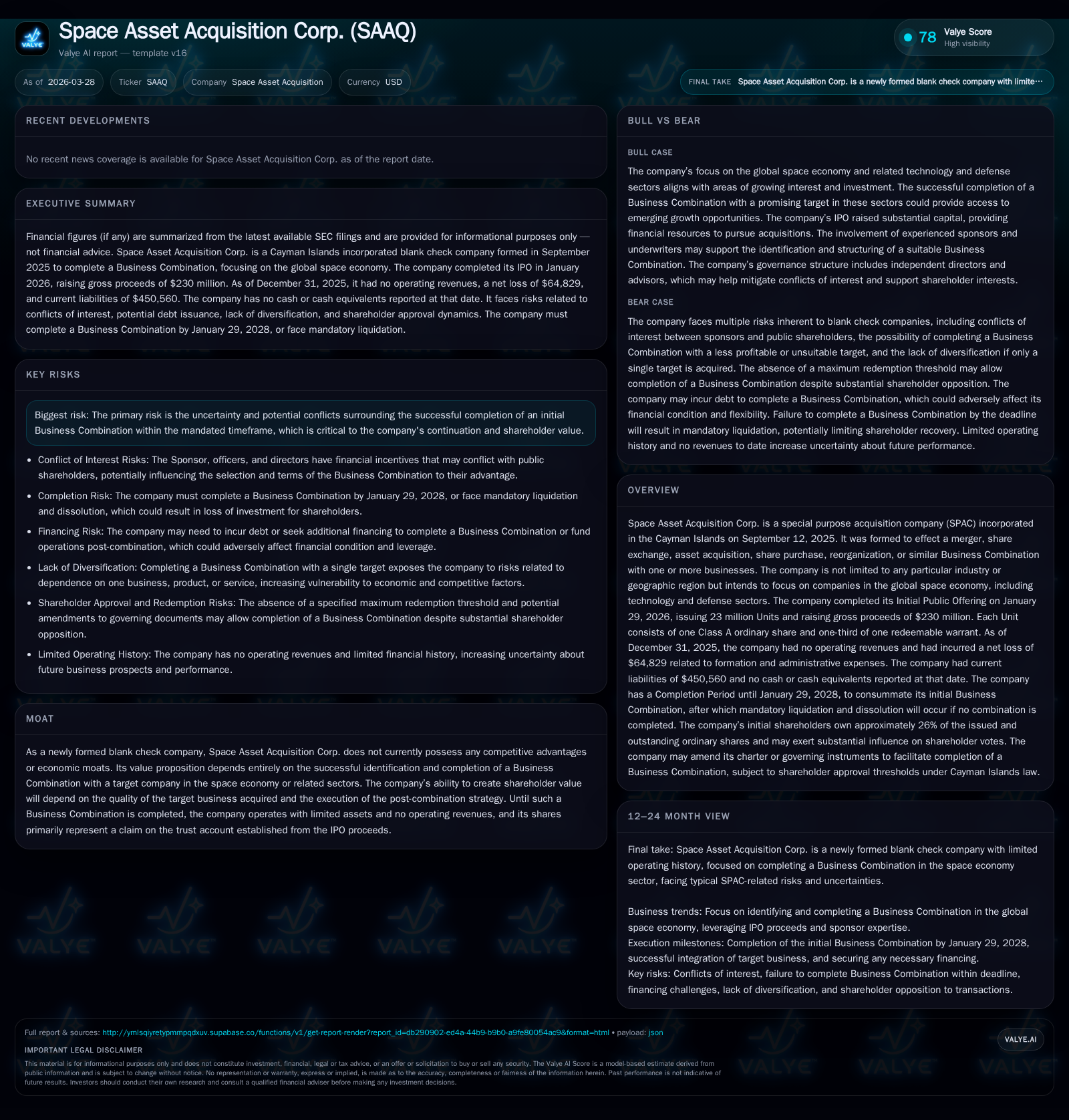
Space Asset Acquisition Corp. (SAAQ) launched as a blank check company in late 2025 with a Cayman Islands incorporation and completed its IPO in early 2026, raising $230 million through a 23 million Unit offering focused on the global space economy. To date, the company has no operating revenues and minimal expenses related to its formation, reflecting typical SPAC early-stage financials. Its pathway forward hinges entirely on identifying and consummating a business combination with a space sector target, amid risks posed by timing constraints and inherent sponsor conflicts. Investors should monitor crucial milestones such as target announcements and shareholder votes, while understanding capital remains securely held in a trust account pending deal closure.
Foundational Formation and IPO Highlights
Space Asset Acquisition Corp. was incorporated on September 12, 2025, in the Cayman Islands with the express purpose of executing a Business Combination—such as mergers or asset acquisitions—in companies primarily within the expanding global space economy. Completing its Initial Public Offering (IPO) on January 29, 2026, SAAQ issued 23 million Units at $10 per Unit, generating gross proceeds of $230 million. This included the full exercise of the underwriter’s overallotment option for three million Units.
Each Unit comprises one Class A ordinary share with a par value of $0.0001 plus one-third of one redeemable warrant exercisable for a Class A share at an exercise price of $11.50 [S1][S3]. Parallel to the IPO, the Sponsor and underwriter participated in a simultaneous private placement totaling 645,000 Units at $10 per Unit for aggregate proceeds of approximately $6.45 million—$4.15 million contributed by Space Asset Acquisition Sponsor LLC alone.
The funds raised via both public offering and private placements were placed into a trust account invested principally in U.S. government treasury obligations with maturities of up to 185 days or qualifying money market funds [S1]. This trust account functions as collateral ensuring capital preservation for public shareholders until completion of an initial Business Combination or refund upon redemption.
While SAAQ is not limited by geography or industry for acquisition targets, its strategic focus is clearly articulated toward companies operating within the global space economy including technology innovation and defense sectors [S1]. This selective emphasis distinguishes it from more broadly scoped blank check companies that cast wider nets without thematic anchors.
Historical Financial Snapshot: Operating Losses and Capital Structure
For the initial reporting period from inception through December 31, 2025, Space Asset Acquisition Corp. operated without generating any revenues or conducting substantive operations beyond organizational tasks necessary to prepare for the IPO [S1][F1]. The company recorded a net loss amounting to $64,829 attributable predominantly to formation-related costs and general administrative expenses.
Current liabilities stood at $450,560 as of year-end 2025 [F1], representing accrued expenses consistent with pre-operational startup outlays typically seen among SPACs prior to deal execution steps.
Notably, traditional profitability metrics such as Return on Equity (ROE) appear artificially elevated—here calculated near +162.8% based on minimal equity base combined with net losses—but these figures must be interpreted cautiously given that SAAQ holds no operating business to date [F1]. The elevated ROE largely reflects accounting nuances rather than operational performance.
Cash flows from operations were effectively neutral during this early phase as non-cash accrual adjustments offset nominal losses [S1], while capital expenditure is absent given service nature and non-operating status.
Historical Financial Summary (USD)
Historical performance (annual)
| FY |
|---|
| 2025 |
Source: SEC companyfacts cache [F1].
Business Model Focus: Targeting the Global Space Economy
SAAQ’s stated mission revolves around forming strategic combinations with businesses specifically linked to space industry growth vectors—including but not limited to technology innovators pushing frontier capabilities—and defense entities dependent on aerospace advancements [S1]. This sector-centric approach leverages growing governmental budgets worldwide focused on satellite deployment, launch infrastructure development, orbital services, and digital space technologies.
By explicitly avoiding geographic restrictions yet maintaining industry concentration on aerospace-relevant domains, SAAQ aims to blend flexibility with thematic investment rigor. The absence of any active revenue generation prior to acquisition aligns with standard blank check company models wherein value creation initiates post-merger through operational scale-up.
Navigating Risks: Early Conflicts and Shareholder Value Challenges
Like many SPACs structured under contemporary regulatory regimes, SAAQ faces intrinsic conflicts tied to incentive asymmetries between sponsors—who have invested substantial sweat equity plus initial capital—and outside public shareholders [S1]. Sponsors risk losing their entire equity stake (Founder Shares) if no qualifying deal materializes within prescribed windows (typically two years).
Although an independent valuation opinion from a FINRA-member banking firm will be sought to ensure fairness regarding transactions involving affiliates or related parties,[S1] residual conflicts remain inevitable due to differing economic motivations when assessing potential targets.
Moreover, time constraints legislated by SPAC rules place pressure on management teams to identify viable targets promptly; failure results in liquidation distributing trust assets back to investors but often at less than original offering values after costs.
Public shareholders possess redemption rights allowing them to exit before consummation of combination transactions but these may trigger dilution effects if exercised extensively [S1]. Hence shareholder protections exist but also introduce complexity in deal structuring.
Capital Allocation Outlook: Trust Account Management and Sponsor Stakes
Proceeds from IPOs totaling approximately $236.45 million (including private placements) were subject to customary transaction costs aggregating near $12.6 million—including underwriting fees partly offset by reimbursements—as disclosed in SEC filings [S1]. These costs reduce net cash available for investment post-offering.
All net proceeds are securely invested within the Trust Account primarily through short-dated U.S. Treasury securities or approved money market instruments pursuant to strict investment mandates established under Rule 2a-7 guidance [S1]. This approach emphasizes principal protection assuring liquidity for potential redemptions and final Business Combination financing needs.
Founder Shares issued to the Sponsor represent roughly one-quarter ownership after IPO but hold value only if an initial Business Combination closes successfully [S1]. Concurrently, Private Placement Units purchased by Sponsor entitle holders to warrants exercisable above IPO price thresholds but become worthless otherwise.
No dividends or share repurchase programs exist at this juncture consistent with standard SPAC lifecycle models which prioritize capital retention ahead of deal consummation phases.
What Investors Should Monitor: Upcoming Milestones and Market Signals
Key near-term events warrant attentive observation:
- Announcements detailing identification or exclusivity arrangements concerning merger targets,
- Shareholder vote scheduling required under NASDAQ listing rules approving combination deals,
- Exercise activity surrounding publicly traded warrants affecting dilution potential,
- Sponsor participation rates both in lock-up periods post-deal announcement and follow-on funding rounds,
- Trading liquidity patterns indicating market confidence levels in SPAC’s execution capabilities [S3].
Transparency around negotiations coupled with third-party fairness opinions materially influences investor sentiment during critical merger phases.
This analysis provides an objective snapshot reflecting Space Asset Acquisition Corp.’s status as an emerging blank check entity positioned within the fast-growing space sector ecosystem. Given absence of operating history beyond foundation expenditures and capital formation measures completed early in 2026, valuation metrics remain constrained largely by prospective deal outcomes rather than underlying operational cashflows. Investors following SAAQ should carefully weigh timing pressures intrinsic to SPAC structures alongside sector-specific growth dynamics while monitoring forthcoming disclosures confirming path towards a transformative business combination.
Disclaimer: This report is prepared solely for informational purposes without suggesting investment advice or recommendations regarding buying or selling securities mentioned herein.
Disclaimer: This is research-only, informational analysis and not investment advice. It may include AI-generated interpretation and general industry context. Always verify important details using primary sources.

Comments