
Gesher Acquisition Corp. II: Capital Strategy and Growth Outlook of a Cayman-Based SPAC
Gesher Acquisition Corp. II pursues strategic capital management and target identification focused on Israeli tech with international scale under a clear deadline framework.
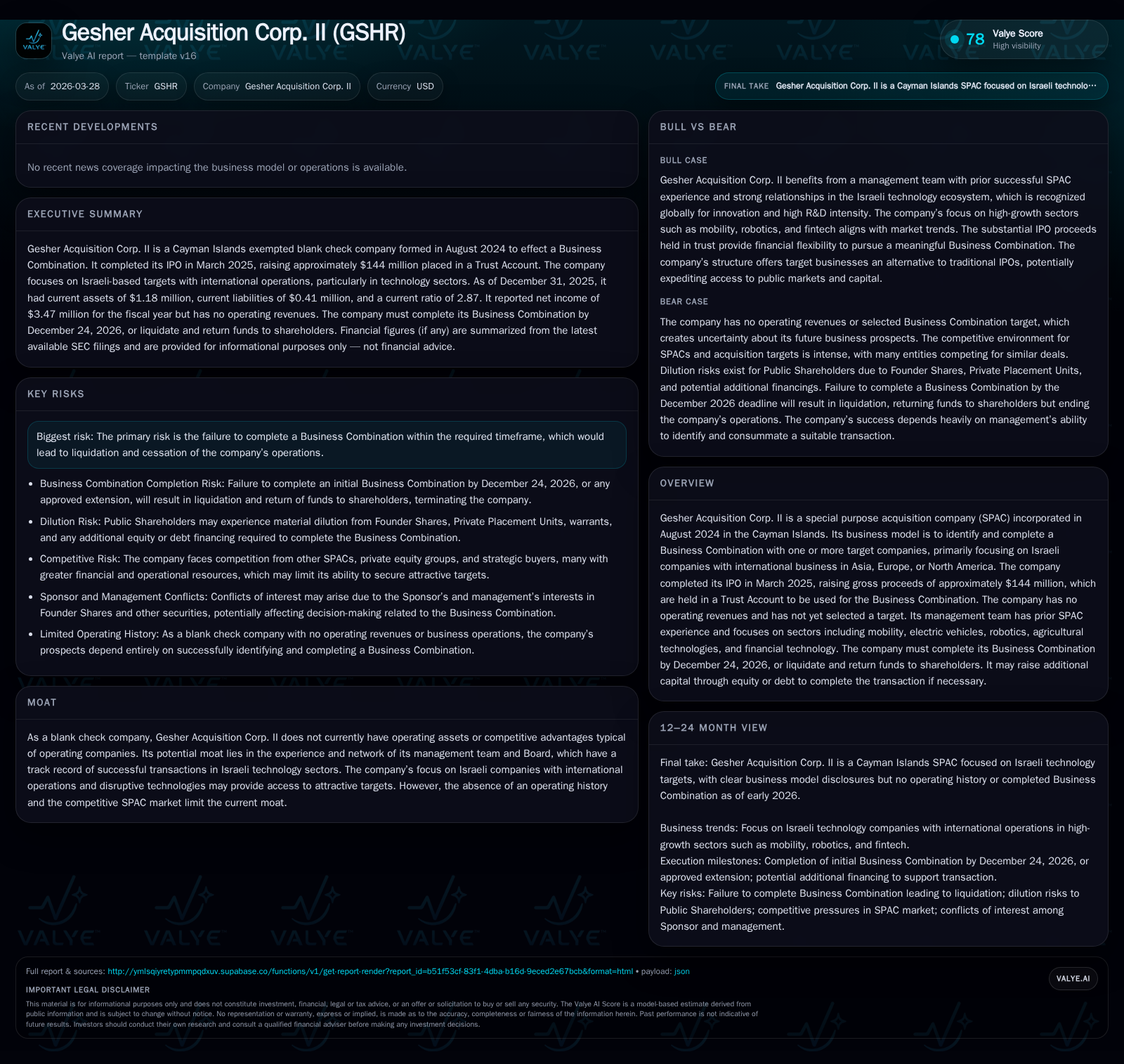
Gesher Acquisition Corp. II is a Cayman Islands-incorporated special purpose acquisition company formed in August 2024, which raised approximately $144 million in its March 2025 IPO. It has not yet generated any operating revenues nor selected a business combination target, focusing primarily on Israeli companies with international operations outside China, Hong Kong, and Macau. The company must complete its business combination by December 24, 2026, or liquidate, with the management’s prior SPAC experience and sector focus providing a potential strategic advantage amid competitive pressures. Capital allocation adheres strictly to trust account regulations, while shareholder redemption rights and sponsor commitments shape investor protections.
From IPO to Now: Gesher’s Financial Trajectory Without Operating Revenues
Gesher Acquisition Corp. II entered the public market via an IPO on March 24, 2025, raising approximately $144 million through the sale of Public Units priced at $10 each [S1]. Since incorporation in August 2024 as a Cayman Islands exempted company, it has recorded no operating revenues given its status as a blank check company established solely for executing a business combination. Financially, the latest annual filing for FY2025 documents an operating loss near $1.07 million alongside net income of approximately $3.47 million — this positive bottom-line figure reflects investment income rather than operations [F1].
Current assets largely comprise trust account balances held under fiduciary control ($1.18 million), standing against current liabilities slightly above $400K, yielding a current ratio of ~2.87 indicative of short-term liquidity sufficiency [F1]. Nevertheless, the firm reports a deeply negative return on equity at -81.8%, underscoring the typical financial profile of pre-revenue SPACs where diluted equity absorbs operational costs and interest expenses [F1].
Historical performance (annual)
| FY |
|---|
| 2025 |
Source: SEC companyfacts cache [F1].
This financial snapshot typifies early-stage SPACs using proceeds conservatively while preserving capital for future combinations.
Strategic Focus: Targeting Israeli Tech with Global Operations
Gesher’s declared search criteria emphasize businesses incorporated in Israel that maintain substantial international operations across Asia (excluding Greater China), Europe, or North America [S1][S18]. The management team leverages sector expertise focusing on mobility & electric vehicles, robotics & autonomy, agricultural technologies (AgTech), and financial technology verticals [S23]. Such focus aligns with Israel’s well-established innovation ecosystem boasting high scientist density and favorable tax regimes supporting R&D [S23].
Notably excluded from its geographic scope are target companies domiciled or principally operated in China, Hong Kong or Macau due to regulatory and geopolitical considerations [S1][S18]. This exclusion narrows potential competition but constrains access to some large tech markets.
Israeli startups with cross-border scale ambitions often seek capital infusions enabling public listing via SPAC deals as an efficient alternative to traditional IPOs—a dynamic that Gesher aims to capitalize on by combining localized insight with global growth vehicle structuring.
Understanding the Deadline: Business Combination and Liquidation Risks
By mandate of its Amended and Restated Articles of Association and regulatory stipulations tied to its Nasdaq listing requirements, Gesher must consummate its initial business combination by December 24, 2026 — approximately twenty-one months post-IPO closing — unless an earlier liquidation is board-approved or an extension is approved by shareholders [S1][S9][S21].
Failure to complete within this timeframe mandates cessation of all activities aside from winding up obligations, redemption of Public Shares at pro-rata trust account prices (approximately $10.35 per share as of December 31, 2025), followed by dissolution [S9][S13]. This hard deadline creates calendar-driven deal pressure exacerbated by competitive SPAC deal environments chasing overlapping targets.
Investors retain redemption rights regardless of transaction support or abstention; however, the lack of a deal would return capital less costs rather than delivering operational upside [S9]. This binary outcome underscores the existential risk unique to the SPAC model prior to post-merger trading commencement.
Capital Allocation Mechanics in Early-Stage SPACs
Gesher maintains original IPO proceeds plus private placement funds totaling approximately $144 million within a trustee-controlled Trust Account—monies reserved exclusively for consummating the business combination or returning capital upon liquidation [S1][S3][S4][S26].
Sponsor and affiliates hold Private Placement Units mirroring Public Units but have waived redemption rights on founder shares per contractual Letter Agreements to align incentives toward deal completion while managing dilution exposures [S4][S5][S9].
Share repurchases from public shareholders outside redemption rights may be undertaken under Rule 10b-18 safe harbor conditions to manage shareholder base composition when appropriate; such actions require disclosure of purpose and volume in SEC filings ensuring transparency [S3][S6][S17]. Nonetheless, sponsor-directed share transactions remain uncommitted contingencies executed only under regulatory compliance.
The Trust Account funds cannot be used for settlement costs unrelated to the Business Combination except for limited dissolution expenses capped contractually at $100K if triggered by failure to complete a transaction [S9].
Redemption Rights and Sponsor Commitments: Balancing Shareholder Interests
Public Shareholders benefit from defined mechanisms enabling share redemptions either coincident with proxy vote approvals or through tender offers conducted under SEC Regulation 14E—choice governed at the Company’s discretion based on timing and legal considerations [S4][S5][S21].
Redemptions require procedural compliance such as timely delivery of physical certificates or electronic transfers via DWAC systems typically stipulated two business days prior to shareholder votes ensuring orderly processing and reducing administrative friction [S4]. This mitigates delays that might otherwise cascade into protracted cash outflows.
Sponsor founders waive similar rights on their founder shares consolidating alignment with public investors’ interests around successful deal closure but may purchase redeeming public shares privately subject to disclosure—raising possible dynamics around shareholder activism or negotiating influence pre-close should such transactions occur [S5][S6].
"Street name" holders face customary intermediaries’ constraints increasing operational complexity but inheriting overall rights symmetrically.
Financing Flexibility and Liquidity Structure: Navigating Pre-Dealmaking Dynamics
While currently capitalized primarily through IPO proceeds held in trust supplemented by Private Placement contributions from Sponsor and BTIG totaling approximately $5.65 million acquired simultaneously at IPO pricing ($10/unit) [S1], Gesher retains discretionary ability to raise additional funds before or concurrent with its Business Combination via equity-linked securities issuance or indebtedness facilities including backstop agreements or forward purchase agreements [S8][S10][S11][S24].
These financing tools provide critical optionality should target valuations exceed available cash after satisfying pro-rata redemptions or minimum cash covenants required for transaction approval by counterparties while introducing dilution risk shared among shareholders accordingly [S8]. Debt instruments carry senior ranking potentially limiting operational flexibility post-combination until retired.
Upfront clearances will depend heavily on prevailing market conditions and counterparties accessible credit lines reducing certainty about execution though standard practice among blank check entities seeking larger targets.
Potential Catalysts and What to Watch Next in Gesher’s Deal Pipeline
Though no explicit public announcements have emerged concerning specific target selections as of Q1-2026 filings, key milestones include:
- Initiation of definitive agreement announcements once internal due diligence completes,
- Proxy materials issuance presenting combination terms alongside redemption election instructions,
- Scheduling shareholder votes or tender offers consistent with SEC Deadline timelines,
- Any proposed amendments extending deadlines contingent upon shareholder approval which itself opens redemption windows. Monitoring these developments offers insight into timeline adherence versus opportunistic delay strategies common within the lifecycle constraints imposed by exchange rules governing SPACs.
Risks Beyond the Clock: Competitive Pressures and Market Challenges
Fundamental risks facing Gesher include failure to close a qualifying deal within prescribed deadlines resulting in mandatory liquidation—hierarchically foremost among risk factors disclosed repeatedly in SEC documents reflecting market realities faced across SPAC issuance waves since 2020 [S14][S22].
Beyond structural temporal limits lies an intensely competitive environment saturated with SPAC sponsors vying for overlapping Israeli technology deals accelerated by geopolitical exclusions limiting viable candidate pools e.g., prohibitions related to Chinese jurisdiction involvement constrain alternatives [S1][S18].
However, Gesher mitigates some challenges via a management team possessing prior track records investing in Israeli sectors such as mobility technologies evidenced through their affiliated entities’ historic success raising credibility and reputational capital among sellers reluctant to engage unknown sponsors—an important intangible moat albeit insufficient absent operational history confirming sustainable competitive advantages typical in operating companies but not blank check vehicles.
Early-stage uncertainties compounded against evolving macroeconomic conditions could compress valuations or elongate timelines adversely impacting shareholder returns prospectively.
This report is prepared solely for informational purposes without offering investment advice or recommendations. Information herein relies strictly on verified filings and company disclosures as referenced; no extrapolations beyond documented data have been made.
Disclaimer: This is research-only, informational analysis and not investment advice. It may include AI-generated interpretation and general industry context. Always verify important details using primary sources.

Comments