
Immix Biopharma’s Path from Clinical Data to Commercial Ambitions
Immix Biopharma’s advancements in CAR-T therapy for AL Amyloidosis are juxtaposed against financial pressures, outlining a pivotal phase towards regulatory clarity and capital sustainability.
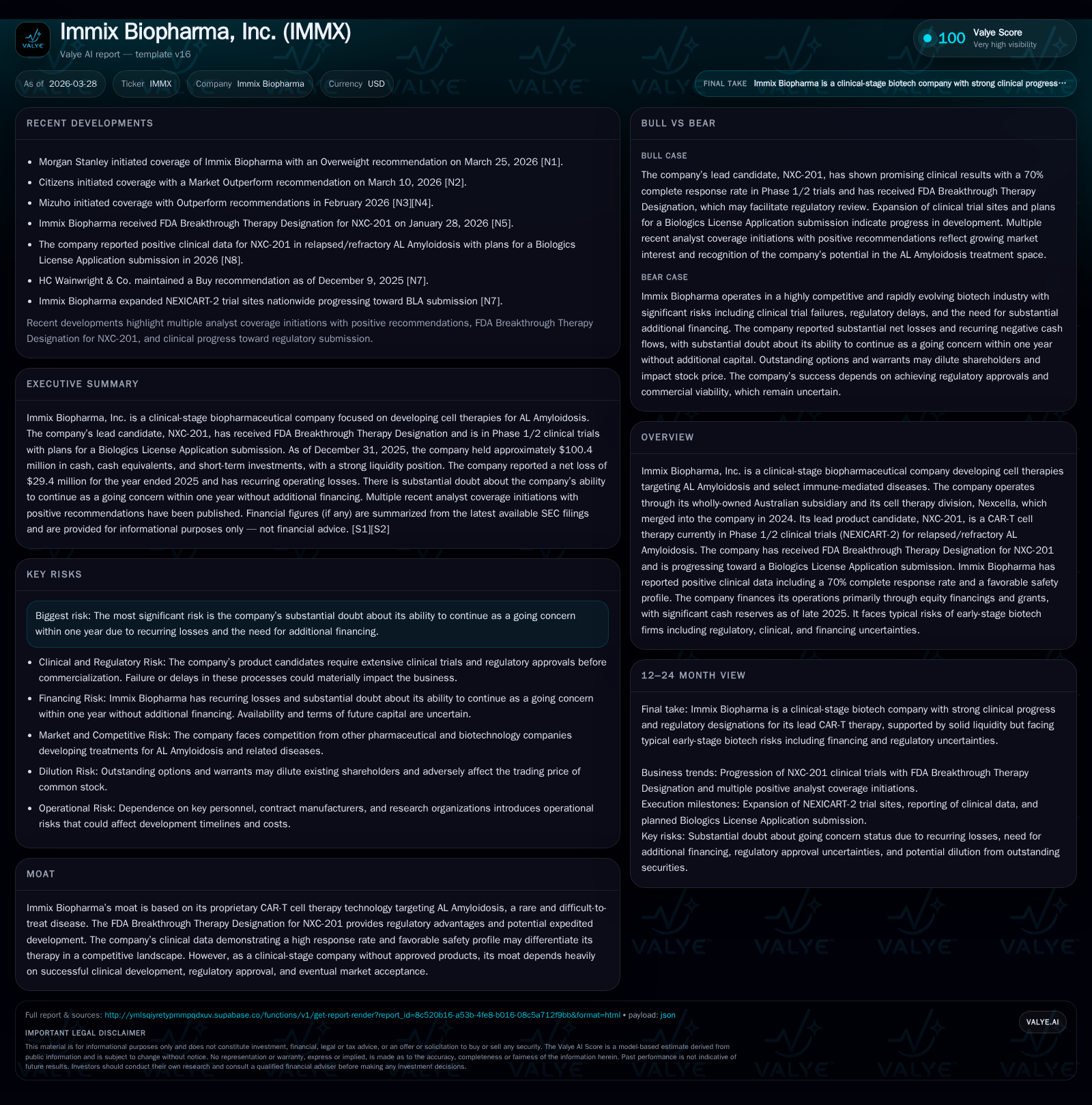
Immix Biopharma is progressing with its lead CAR-T cell therapy candidate NXC-201, boasting a noteworthy 70% complete response rate in Phase 1/2 trials and the benefit of FDA Breakthrough Therapy Designation. However, as a clinical-stage biotech without commercial products, its growth hinges on successful development milestones and FDA approvals. Financially, the company has experienced escalating losses outpacing stagnant revenue, relying heavily on equity financings and grants to extend runway through at least late 2026. The robust cash position following large equity raises provides breathing room but dilution risk and going concern uncertainties remain significant. Investor sentiment remains cautiously optimistic, underpinned by recent sell-side initiations recommending overweight or outperform positions.
Clinical Advancements Fueling Recent Growth
Immix Biopharma’s most salient driver of growth is its lead candidate NXC-201 — a chimeric antigen receptor T-cell (CAR-T) therapy focused on relapsed/refractory AL Amyloidosis. This rare systemic disorder results from misfolded light chain protein deposits causing organ dysfunction. The company’s NEXICART-2 Phase 1/2 study has produced compelling clinical data including a reported ~70% complete response rate alongside a favorable safety profile, a meaningful benchmark given the disease's complexity and prior lack of targeted treatments [N1][N2][F1]. The mechanism capitalizes on targeted immune engagement via CAR-T reprogramming of patient T cells to eliminate amyloidogenic plasma cells.
Such promising efficacy metrics underpin the FDA’s granting of Breakthrough Therapy Designation — a regulatory status designed to expedite development and review timelines through enhanced FDA collaboration due to preliminary evidence indicating substantial improvement over existing therapies. This designation not only supports faster patient access upon approval but can reduce administrative burdens typically encountered in biologics licensing pathways [N1][N3].
The company also operates through its fully consolidated Australian subsidiary and cell therapy division Nexcella, which merged into Immix in mid-2024 providing an integrated platform for manufacturing and development critical to autologous cellular therapies.
From Breakthrough Designation to Regulatory Milestones: What Lies Ahead
With Breakthrough Therapy status secured for NXC-201, Immix anticipates leveraging this facilitated regulatory pathway towards submission of a Biologics License Application (BLA). While no explicit filing date has been publicly provided yet, filings note ongoing preparations for registration-enabling studies influenced by interim Phase 1/2 data outcomes [S3]. This stage often involves scaling patient enrollment across multiple sites to confirm efficacy/safety durability before FDA acceptance.
The company amended its At-The-Market (ATM) Offering Agreement recently which reflects strategic intent to maintain flexible financing capability during this critical period when costly late-stage trials demand incremental capital [S3]. This structural agility aligns with regulatory risk mitigation but highlights inherent dependency on both clinical success and capital availability.
Financial Performance Trends: Increasing Losses Despite Stable Revenue
Immix's latest full-year financial data reveal steady top-line figures around $20 million across recent years largely derived from grants like those from California Institute for Regenerative Medicine (CIRM) rather than product sales [F1]. Operating income tells a more stark story: losses expanded substantially year-over-year with operating income deteriorating from -$22.7 million in 2024 to nearly -$30 million in 2025 (-32.1% YoY) signaling accelerated investment primarily in research & development infrastructure and clinical trial execution [F1]. Net losses widened commensurately.
Operating cash flow trends reinforce the burn-rate picture — with CFO plunging over -64% to approximately -$23.9 million in 2025 — exacerbating liquidity demands especially as capex modestly decreased to roughly $730k reflecting fixed asset acquisition scaling back after prior buildouts [F1][S22].
This pattern typifies early-stage biotech companies advancing cell-based therapeutics where upfront expenses precede any revenue-generating product launch.
Capital Structure, Financing History, and Cash Runway Analysis
To underwrite these costly clinical programs , Immix has pursued multiple sizeable equity raises including ATM offerings completed starting June 2025 which generated several millions in incremental funding during that summer quarter alone [S4][S5]. A notable late-stage inflection occurred with the December 2025 underwritten offering yielding net proceeds estimated at $93.7 million after discounts — swelling cash and cash equivalents past $93 million by year-end including short-term Treasury securities investments totalling approximately $6.5 million [F1][S7][S16].
Combined with residual CIRM grant availability (~$3-$4 million range as per latest disclosures), total liquidity positions Immix comfortably into late Q4 2026 under current burn assumptions according to management commentary while formally acknowledging “substantial doubt” about longer term going concern status beyond that timeframe due to recurring operating losses necessitating renewed financing or partnership arrangements [S5][S7].
Existing outstanding instruments add complexity: over 2.95 million shares issuable on vested options averaging exercise price near $2.04 plus close to 5.25 million warrants exercisable around $1.43 present latent dilution risks should exercised fully — potentially dampening share price performance due to market overhang [S2][S8].
Risks Embedded in Early-Stage CAR-T Development
Immix discloses customary biopharmaceutical sector risks centered on developmental uncertainties including clinical attrition inherent in novel CAR-T platforms targeting rare diseases like AL Amyloidosis where trial enrollment hurdles may arise due to patient scarcity. Regulatory pathway dependency remains critical; failure or delay obtaining marketing authorization could impair business viability significantly given absence of commercialized products and corresponding revenues [S21][S27]. Equity dilution looms as continued capital raises are integral yet exert downward pressure on share valuation.
Additional risks encompass operational contingencies such as reliance on third-party contract manufacturing organizations (CMOs), intellectual property protection challenges amid competing innovation advances, potential adverse litigation outcomes related to patents or safety profiles, and retention of key scientific talent essential for sustained pipeline progress [S21].
Analyst Coverage and Market Sentiment Insights
Recent sell-side research initiations underscore a consensus positioning Immix Biopharma as an overweight or outperform idea premised mainly on differentiated clinical efficacy signals for NXC-201 coupled with regulatory acceleration benefits granted by the FDA’s Breakthrough Therapy Designation [N1][N2][N3]. Analysts acknowledge funding risks driving stock volatility but view upcoming trial readouts and regulatory interactions as important catalysts capable of re-rating valuation multiples should data continue positively.
Morgan Stanley’s March 25 initiation specifically highlights the robustness of the response rates observed while emphasizing manageable safety events characteristic of CAR-T interventions relative to competitors [N1]. Citizens Bank and Mizuho follow suit advocating favorable fundamental momentum balanced against typical developmental-stage company execution risks [N2][N3].
Key Metrics and What Investors Should Monitor Next
The table below consolidates key annual financial metrics illustrating Immix's historical top-line stability offset by intensifying losses and growing negative operating cash flow reflective of R&D ramp:
Historical performance (annual)
| FY | Rev ($mm) | Net ($mm) | CFO ($mm) | OpInc ($mm) | Rev YoY | Net YoY |
|---|---|---|---|---|---|---|
| 2025 | 20 | -29 | -24 | -30 | 0.0% | -36.2% |
| 2024 | 20 | -22 | -15 | -23 | 0.0% | -40.1% |
| 2023 | 20 | -15 | -11 | -16 | ||
| 2022 | -7 | -8 |
Source: SEC companyfacts cache [F1].
Capital returns and efficiency (annual)
| FY | Buybacks ($) | FCF ($mm) | ROE% |
|---|---|---|---|
| 2025 | -25 | ||
| 2024 | -16 | -163.1 | |
| 2023 | 99963 | -11 | -94.0 |
| 2022 | 99963 | -7 |
Source: SEC companyfacts cache [F1].
Note: All figures USD per SEC filings; revenue comprised primarily of non-product sources such as grants.
Looking forward over the next 12–18 months stakeholders should closely watch:
- Interim and final data releases from ongoing NEXICART-2 multi-site Phase trials,
- Progression decisions toward pivotal registration-enabling studies,
- Timing of BLA submission filings under FDA Breakthrough Therapy accelerated programs,
- Updates on cash burn relative to planned trial expansions,
- Movements in equity issuance plans or partnership/license deal announcements mitigating dilution pressures.
This juncture represents a tension point balancing bullish therapeutic promise against fragile capital endurance common among emerging gene-cell therapy biotechs.
This analysis reflects information sourced strictly from SEC filings ([F1], [S#]) and verified news reports ([N#]). It aims to provide an informed overview without making investment recommendations or forecasts beyond documented data points.
Disclaimer: This is research-only, informational analysis and not investment advice. It may include AI-generated interpretation and general industry context. Always verify important details using primary sources.

Comments