
DBV Technologies Advances Peanut Allergy Treatment Amid Commercial Transition
DBV Technologies leverages positive Phase 3 trial data and manufacturing partnerships as it shifts toward commercializing its Viaskin Peanut patch, while navigating substantial financial and regulatory challenges.
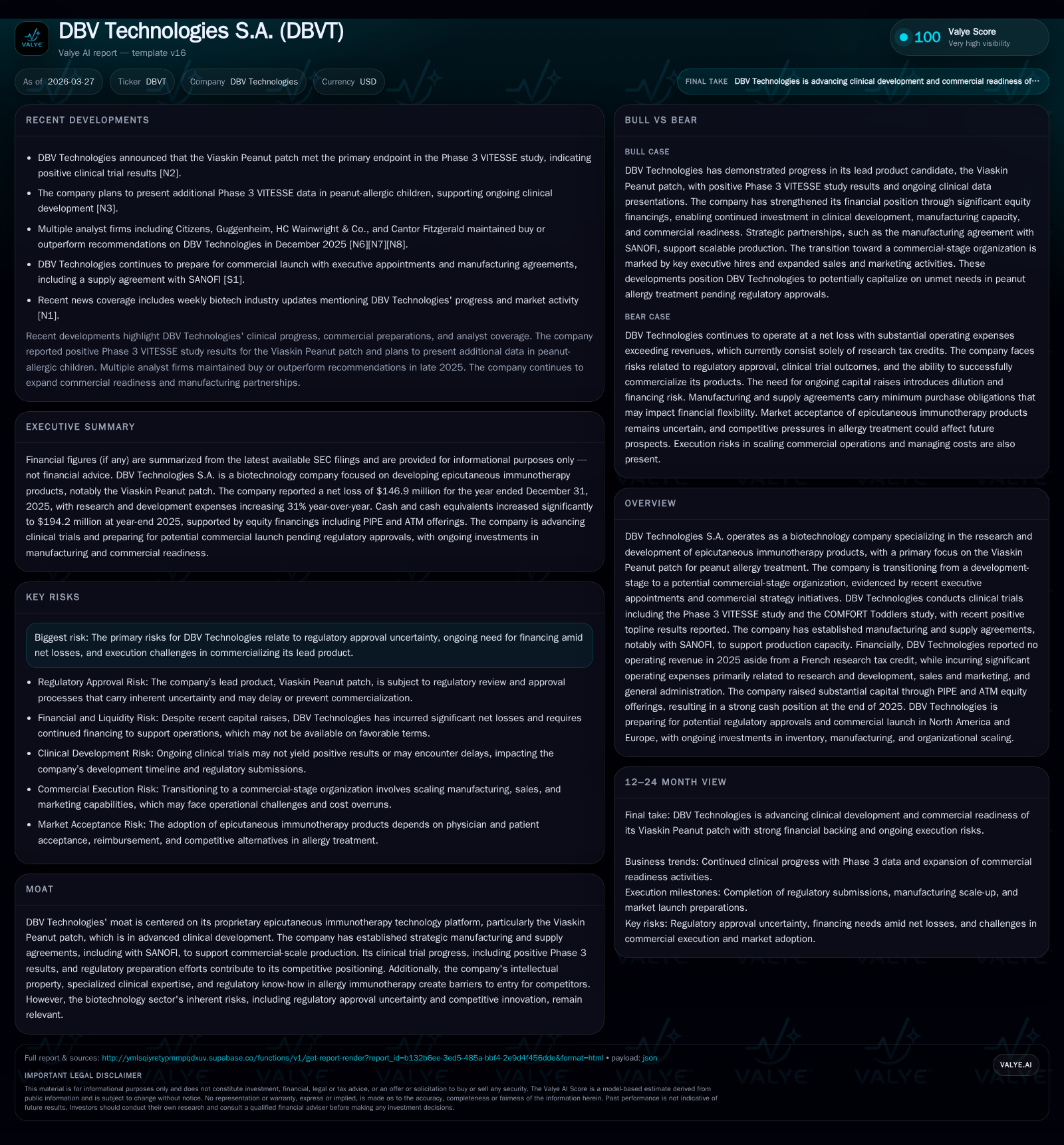
DBV Technologies is progressing from a development-centric biotech into a commercial-stage player with promising clinical results for its Viaskin Peanut patch, notably the Phase 3 VITESSE trial. Despite no operating revenues from product sales, the company has ramped R&D and sales readiness expenses considerably. Supported by significant equity financings and manufacturing agreements, DBV prepares for potential U.S. and European market entry. However, its high cash burn, net losses, and need for ongoing capital injections underscore execution risks in this crucial transition period.
Clinical Innovation: Milestones Driving Growth
DBV Technologies’ cornerstone asset is the Viaskin Peanut patch, an epicutaneous immunotherapy device designed to treat peanut allergies by delivering allergen proteins through intact skin to induce desensitization. The company’s recent announcement of meeting the primary endpoint in its pivotal Phase 3 VITESSE study represents a pivotal breakthrough in validating this approach [N2]. Further data presentations planned for allergic children across varying severity levels reinforce Viaskin Peanut’s clinical promise [N3]. Concurrently, the ongoing COMFORT Toddlers study is evaluating efficacy and safety in younger pediatric populations, which could broaden the patch’s label scope.
This epicutaneous delivery platform differentiates itself mechanistically from oral or sublingual immunotherapies prevalent in allergy treatment pipelines. It leverages skin-resident Langerhans cells to modulate immunological tolerance without systemic allergen exposure typically associated with adverse events—an important competitive moat feature. Additionally, DBV has secured manufacturing partnerships with established entities such as Sanofi to underpin commercial-scale production capacity [S1]. These agreements highlight strategic foresight in supply chain scalability essential for eventual market launch.
Revenue Evolution and Operating Performance Trends
Despite these scientific advances, DBV remains pre-revenue from product sales, relying primarily on French research tax credits accounting for $5.6 million in operating income for 2025 (up 36% vs. prior year) [F1][S10]. This modest inflow contrasts sharply with escalating expenditures reflecting the company’s transition phase.
Operating expenses swelled by $32 million (26%) year-over-year to nearly $153 million by end-2025 [F1], driven principally by a $27 million jump in research and development costs. Within R&D, external clinical expenses heightened due to trial activations including COMFORT Toddlers initiation alongside milestone payments tied to VITESSE’s progress. A notable highlight is inventory build-up growing over tenfold to $16 million as DBV prepares commercial goods stockpiles [S10]. Sales & marketing spend ascended 21%, evidencing early go-to-market capabilities being put in place.
The net loss increased to roughly -$147 million [F1], with operating cash flow consumption rising concomitantly to -$121 million despite very limited capital investment capped at around half a million dollars annually [F1][S18]. This operational cash burn underscores inherent scaling costs typical for biotechnology enterprises crossing from developmental into commercial stages.
Historical performance (annual)
| FY | Rev ($mm) | Net ($mm) | CFO ($mm) | OpInc ($mm) | Rev YoY | Net YoY |
|---|---|---|---|---|---|---|
| 2025 | 6 | -147 | -121 | -147 | +35.8% | -229.0% |
| 2024 | 4 | 114 | -104 | -117 | -73.6% | +256.6% |
| 2023 | 16 | -73 | -80 | -76 | +224.7% | +24.5% |
| 2022 | 5 | -96 | -56 | -97 |
Source: SEC companyfacts cache [F1].
Capital returns and efficiency (annual)
| FY | FCF ($mm) | ROE% |
|---|---|---|
| 2025 | -122 | -87.1 |
| 2024 | -107 | 416.0 |
| 2023 | -80 | -51.9 |
| 2022 | -56 | -49.5 |
Source: SEC companyfacts cache [F1].
Fiscal year end data sourced from company filings [F1]. Revenue relates solely to research tax credit incentives; operating losses reflect heavy investments preceding anticipated commercial revenues.
Strategic Moves in Governance and Commercialization
DBV has actively reshaped its leadership footprint consistent with a pivot towards market entry readiness [S1]. The January-November timeframe of 2025 saw key appointments: James Briggs as Chief Human Resources Officer overseeing organizational scaling; Kevin Trapp installed as Chief Commercial Officer tasked with steering global commercial strategy specifically for Viaskin Peanut; and board refreshment incorporating Dr. Philina Lee signaling enhanced governance oversight aligned with commercial imperatives.
Such moves are customary inflection points as biotech companies graduate beyond lab-driven operations toward broader stakeholder management encompassing payors, regulators, physicians, and patient advocacy groups during launch windows.
Future Growth Drivers and Regulatory Outlook
The twin pillars supporting DBV’s growth outlook hinge on sustained positive clinical outcomes culminating in regulatory approvals across core geographies—the United States leading with the FDA—and successful scale-up of manufacturing capacity supported by strategic supply agreements notably with Sanofi [N2][S22]. The VITESSE Phase 3 success materially de-risks regulatory pathways but does not assure approval given complexity around immunotherapy regulations.
Peak growth will depend on timely BLA submissions, expedited review pathways potentially available given unmet medical need status for peanut allergy treatments, and effective market adoption driven by payor acceptance and real-world evidence post-launch support [S24]. Risks include inevitable regulatory uncertainties plus operational challenges inherent in launching a novel therapy requiring dermatologist/pediatrician education on epicutaneous modality specifics.
Financial Health: Liquidity, Capital Structure, and Risk Factors
Financially, DBV demonstrates both resilience and fragility reflective of its late-stage pipeline posture [S4][S19]. Cash and equivalents ballooned to $194 million at fiscal year-end due to multiple capital raises aggregating over $276 million gross proceeds during calendar 2025—including sizeable PIPE financings early in the year augmented by ATM equity sales targeting up to $150 million [S4][S18][S25]. This liquidity buffer extends cash runway into Q2/2027 under current spending assumptions [S11].
Total equity surged consequent to these placements reaching approximately $169 million by end-2025 compared with just under $27 million prior year [F1], signaling reliance on external funding absent product revenue streams or debt issuance.
Liabilities mostly comprise trade payables ($41 million) and accrued social debts associated with workforce expansions ($14 million), all current maturities supporting working capital needs rather than long-term leverage burdens [S7][S21].
While going concern doubts flagged in late-2025 quarterly disclosures due to persistent losses have been alleviated post-financings, sustainable liquidity hinges on executable commercialization plans alongside potential additional financings if revenue ramps deviate adversely [S19][S11].
Capital Allocation: R&D Investment, Cash Flows, and Shareholder Returns
Given the clinical trial intensiveness of epicutaneous immunotherapy advancement coupled with imminent launch preparations, DBV’s capital allocation priorities remain sharply skewed towards sustained R&D investments—as highlighted by a $117 million spend in research-related activities during FY25—supporting both ongoing trials and inventory accumulation efforts required ahead of commercial debut [S10][F1].
Capital expenditures remain minimal (~$0.5 million), indicating negligible fixed asset requirements consistent with capped facility infrastructure reliance on outsourcing partners rather than internal manufacturing plants at this stage [F1][S9].
Significantly, no dividends or buybacks have been recorded nor are expected near term given priority deployment toward product development milestones versus shareholder distributions common among clinical-stage biotechs striving for market validation [S23][S29].
Cash flow trends reveal increasing operating cash burn reaching approximately $121 million annually—a cautionary metric reflecting scaling organizational breadth but also creating urgency around successful product commercialization validating investment spend [F1][S18].
Key Catalysts to Watch for Market Impact
Looking ahead, critical binary outcome events will shape DBV’s near-term trajectory:
- Regulatory submissions timing including Biologics License Application (BLA) filings based on VITESSE data sets;
- Interim readouts from COMFORT Toddlers study expanding clinical applicability;
- Manufacturing scale-up progress aligning with supply contract commitments ensuring launch readiness;
- Market access developments including reimbursement policies within U.S., Europe;
- Potential partnerships or licensing deals enhancing commercial reach or pipeline diversification. Monitoring company communications for FDA interactions or advisory panel outcomes will be essential given their pivotal gating role in DBV’s progression beyond development into sustainable commercial viability [N1][N2][N3][S24].
This analysis is intended solely for informational purposes based on publicly available data from company financial statements and reports without any investment recommendation or opinion.
Disclaimer: This is research-only, informational analysis and not investment advice. It may include AI-generated interpretation and general industry context. Always verify important details using primary sources.

Comments