
Sportradar Group AG’s Growth Fueled by Technological Integration and Expanding Sports Betting Markets
Sportradar leverages exclusive partnerships and AI-driven technologies to fortify its position in the global sports betting data ecosystem.
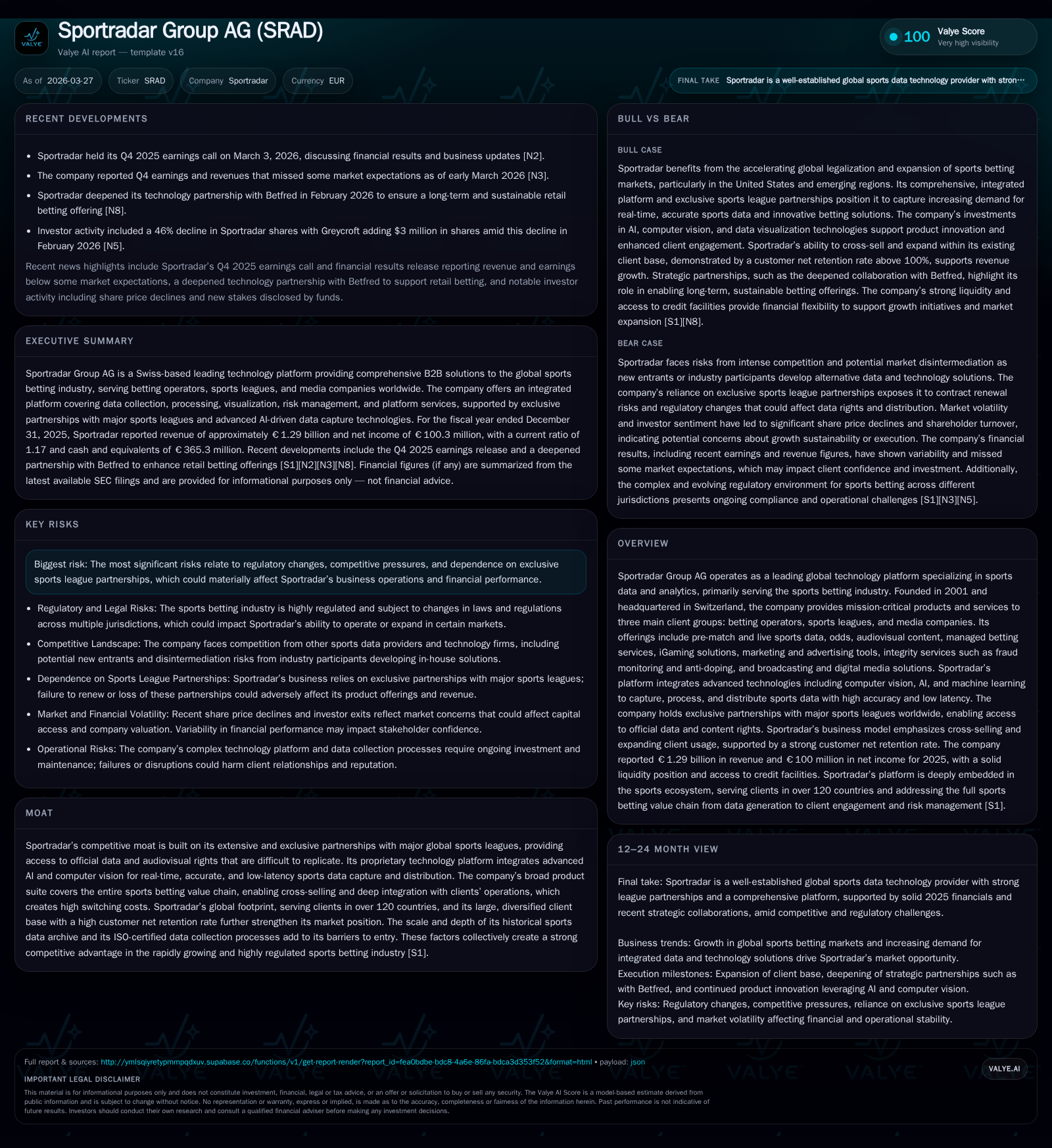
Sportradar Group AG, a leading sports data and analytics platform headquartered in Switzerland, has demonstrated robust revenue and profit growth over recent years, driven by expanding legalized sports betting markets and continuous product innovation. Its competitive moat rests on exclusive partnerships with major sports leagues and proprietary technology integrating advanced AI and computer vision. The company’s global footprint and comprehensive product suite enhance client retention and growth prospects, especially in emerging markets like the United States. While financial performance has improved significantly, risks from regulatory changes, litigation, cybersecurity threats, and legacy systems persist. Capital allocation prioritizes reinvestment into technology and selective acquisitions to reinforce market leadership.
Company Overview
Sportradar Group AG stands as the foremost B2B provider of sports data solutions globally, primarily servicing sports betting operators alongside sports leagues and media companies [S1]. Founded in 2001 and headquartered in Switzerland since its reorganization as a Swiss stock corporation in 2021 [S1][S12], Sportradar offers a full spectrum of products including pre-match and live sports data feeds, odds generation, audiovisual content distribution, managed betting services (MTS), platform services, integrity monitoring (fraud/doping), marketing tools, and broadcasting technology. Leveraging proprietary technology infrastructure featuring AI, computer vision, machine learning, and data visualization enables Sportradar to deliver accurate low-latency data vital to its clientele.
Past Growth and Historical Performance
Since 2022, Sportradar has experienced significant revenue growth driven by expansions in legalized sports betting markets—especially the U.S.—and enriched product offerings [F1][S20]. Annual revenue advanced from €730 million in FY2022 to approximately €1.29 billion by FY2025 representing about 16.6% year-over-year growth between FY2024-25 [F1]. Correspondingly, net income exhibited dramatic improvement from €10 million in FY2022 to over €100 million by FY2025 (nearly a tripling from the prior year), illustrating operating leverage within their scalable business model [F1].
Historical performance (annual)
| FY | Rev ($mm) | Net ($mm) | Rev YoY | Net YoY |
|---|---|---|---|---|
| 2025 | 1290 | 100 | +16.6% | +198.5% |
| 2024 | 1107 | 34 | +26.1% | -0.8% |
| 2023 | 878 | 34 | +20.2% | +223.1% |
| 2022 | 730 | 10 |
Source: SEC companyfacts cache [F1].
Capital returns and efficiency (annual)
| FY | ROE% |
|---|---|
| 2025 | 10.3 |
| 2024 | 3.6 |
| 2023 | 3.9 |
| 2022 | 1.4 |
Source: SEC companyfacts cache [F1].
Note: Revenue shows consistent double-digit growth; net income growth reflects margin expansion.
This trajectory underscores effective scaling via expanded market share amid growing legalized betting jurisdictions [S12][S20]. Operating margins have benefited from high-operating leverage inherent to software platforms combined with value-added services such as managed trading solutions.
Competitive Moat
Sportradar's defensibility stems primarily from its exclusive global rights agreements with prominent sports leagues granting access to official real-time data and audiovisual content [S1]. Such contracts generate significant switching costs for clients reliant on authenticated data streams necessary for regulated market compliance.
Moreover, Sportradar possesses vast historical sports databases maintained through ISO-certified data collection processes supporting complex analytics [S12][S14]. Its end-to-end integrated platform—covering risk management to client engagement tools—enables bundled offerings difficult for competitors to replicate seamlessly across international jurisdictions [S13][S20]. Advanced proprietary capabilities in computer vision enable automated remote data extraction from broadcast feeds enhancing operational efficiency [S14].
The company’s presence across over 120 countries diversifies risk exposure while its deep relationships facilitate continual cross-selling of new technology solutions such as AI-driven personalization features tailored for the iGaming ecosystem [S20][S23]. The customer net retention rate of the top ~200 clients was reported at a healthy 109% for FY2025 (down slightly from exceptional prior-year levels) confirming strong embeddedness within client operations [F1][S13].
Future Growth Prospects
Looking forward, Sportradar's primary growth driver is expected to remain legal expansion of sports betting markets worldwide—particularly the U.S., where Sportradar holds number one operator market share supported by significant strategic investments [S1][S20]. Regulatory momentum continues albeit at varying paces globally.
Product innovation focused on Managed Trading Services (MTS), marketing platforms, fully integrated software suites covering odds trading/risk management, AI enhancements including immersive tech features promise incremental wallet share gains within existing accounts while attracting new operators [S23]. Expansion aims also include broadening league partnerships beyond traditional high-profile leagues into emerging sports categories geographically diversified across Europe, Americas, Asia Pacific [S1][S23].
Acquisition remains part of Sportradar's strategy to augment capabilities—recent transactions like IMG ARENA illustrate moves toward expanding digital video content assets complementing core offerings [S16][N2]. Continued R&D investment centered on automation of data processing (AI/computer vision) supports sustainable margin improvement potential [S16][S27].
Technology modernization addresses legacy infrastructure risks highlighted in regulatory filings ensuring systems scale efficiently reducing downtime risks while enhancing cybersecurity resilience—a material operational focus given recurring cyber-attack threats documented historically [S4][S18][S22]. Regulatory compliance evolution around data privacy frameworks such as the EU-US Data Privacy Framework (DPF) also necessitates ongoing adaptive investments potentially impacting costs or technical architecture [S18].
Forecasts / Milestones / Expectations
While Sportradar does not appear to provide explicit forward guidance for revenues or profits in public filings or recent earnings releases available up to early March 2026 [N2][N3], key indicators to monitor include:
- Pace of legalized sports betting market openings especially federally-driven changes or new state licenses within the U.S.
- Incremental client wins or expansions particularly leveraging MTS adoption rates
- New league partnership announcements including geographic diversification
- Success of technology integration programs targeting scalability improvements
- Outcomes or updates regarding patent litigation settlements already resolved but indicative of IP risk management effectiveness [S4]
Operationally significant capex levels related to sport rights license capitalization trends serve as milestones signaling content availability critical for premium product tiers [S16][N2].
Returns / Capital Allocation
The company reported a return on equity of roughly 10.3% for FY2025 based on net income relative to equity balances [F1], reflecting efficient utilization of invested capital amidst rapid top-line scaling.
Cash & equivalents grew modestly to €365 million at year-end FY2025 providing liquidity comfort alongside an undrawn revolving credit facility totaling €220 million offering flexibility for opportunistic acquisitions or working capital needs without immediate refinancing pressures [F1][S3][S15]. Sportradar has not indicated dividend payments which aligns with strategic reinvestment priorities typical of rapidly evolving tech-driven sectors; instead capital allocation focuses on:
- Substantial R&D outlays aimed at software enhancement and new product development including AI capabilities [S16][S27]
- Selective acquisitions contributing complementary technologies or market reach as per historical practice exemplified by IMG ARENA transaction details provided around cash flow movements [N2][F1]
- Share repurchase programs have been utilized sparingly with cash usage rising notably in FY2025 though offset partially by other financing activities indicating active capital management without aggressive buyback reliance [F1][S9]
Financial covenants tied to credit agreements impose leverage ratio constraints limiting excessive borrowing which requires balancing growth funding with prudent liquidity management amid cyclical market shifts especially regulatory-driven uncertainty [S6][S15].
Risks
Key enterprise risks encompass:
- Regulatory uncertainty remains paramount given diverse international legal frameworks governing gaming/sports betting where changes can restrict provision or alter economics dramatically (e.g., licensing requirements for B2B suppliers) [S4][S7][S18]
- Cybersecurity threats present ongoing operational hazards potentially disrupting services impacting reputation among demanding clients; though no material incidents disclosed historically some risks persist due to sophisticated attacks including potential nation-state involvement [S4]
- Intellectual property litigation risk despite recent settlement agreements signals continuing vulnerability given reliance on proprietary software plus patented methods; IP protection variably enforced across jurisdictions heightening exposure especially against competitors claiming infringement or anti-competitive practices historically asserted against Sportradar brands/products plus concerns over trade secrets maintenance amidst workforce agility challenges [S4][S5][S7]
- Legacy IT system dependency creates scalability bottlenecks; modernization initiatives must succeed lest performance degradation harms customer experience or operational availability particularly for latency-critical live data services leveraging emerging AI techniques requiring robust infrastructure investment ongoing through multiple fiscal cycles [S22]
- Foreign currency volatility impacts recognized revenues/costs due largely to derivation of U.S.-dollar denominated contracts while reported results consolidate Euro-based accounting units; fluctuating exchange rates can distort quarterly profitability trends adding complexity for forecasting accuracy [F1][N2]
Industry Context Analysis (Uncited)
The global sports betting industry continues steady expansion driven by broader legalization trends especially post-U.S. Supreme Court repeal of PASPA enabling states’ regulatory autonomy determining sports wagering frameworks fueling demand for licensed official data providers like Sportradar that ensure compliance through verified delivery channels.
Additionally technological advancements such as machine learning-enabled personalized betting experiences are becoming critical differentiators facilitating client operator end-user engagement and retention boosting average revenue per user metrics—a focus area increasingly evident through solution portfolio innovations offered by leading providers consolidating multi-product suites under single platform ecosystems.
Conclusion
Over two decades evolving from early-stage innovator into leader securing top revenue share globally in B2B sports betting solutions showcases Sportradar’s executional acumen combining intellectual property control via exclusive league agreements with cutting-edge AI-driven platforms tailored for multiple stakeholder groups across industry verticals. Its proven capacity to expand revenue bases organically complemented by targeted acquisition activity alongside ongoing investments addressing system modernization while navigating complex regulatory landscapes underscore its capacity for sustained profitable growth. Nonetheless, vigilance remains warranted around regulatory developments globally especially concerning gaming laws, emerging cybersecurity threats invoking substantial mitigation investment needs alongside IP defense costs maintaining market advantages crucial amid intensifying competition. Financial discipline evidenced through measured capital allocation balancing scale-up against covenant constraints positions it well financially heading into subsequent years yet necessitates close monitoring of cash flow dynamics tied tightly with incremental licensing obligations linked to content rights renewals affecting long-term earnings visibility.
This analysis is based solely on publicly available information including SEC filings ([F1],[S#]), recent news reports ([N#]), and sector-specific contextual considerations without suggesting any investment action.
Disclaimer: This is research-only, informational analysis and not investment advice. It may include AI-generated interpretation and general industry context. Always verify important details using primary sources.

Comments