
Himax Technologies’ Market Leadership and Strategic Growth Drivers
Examining how Himax’s integrated solutions, fabless model, and capital strategy underpin its position in display semiconductor markets.
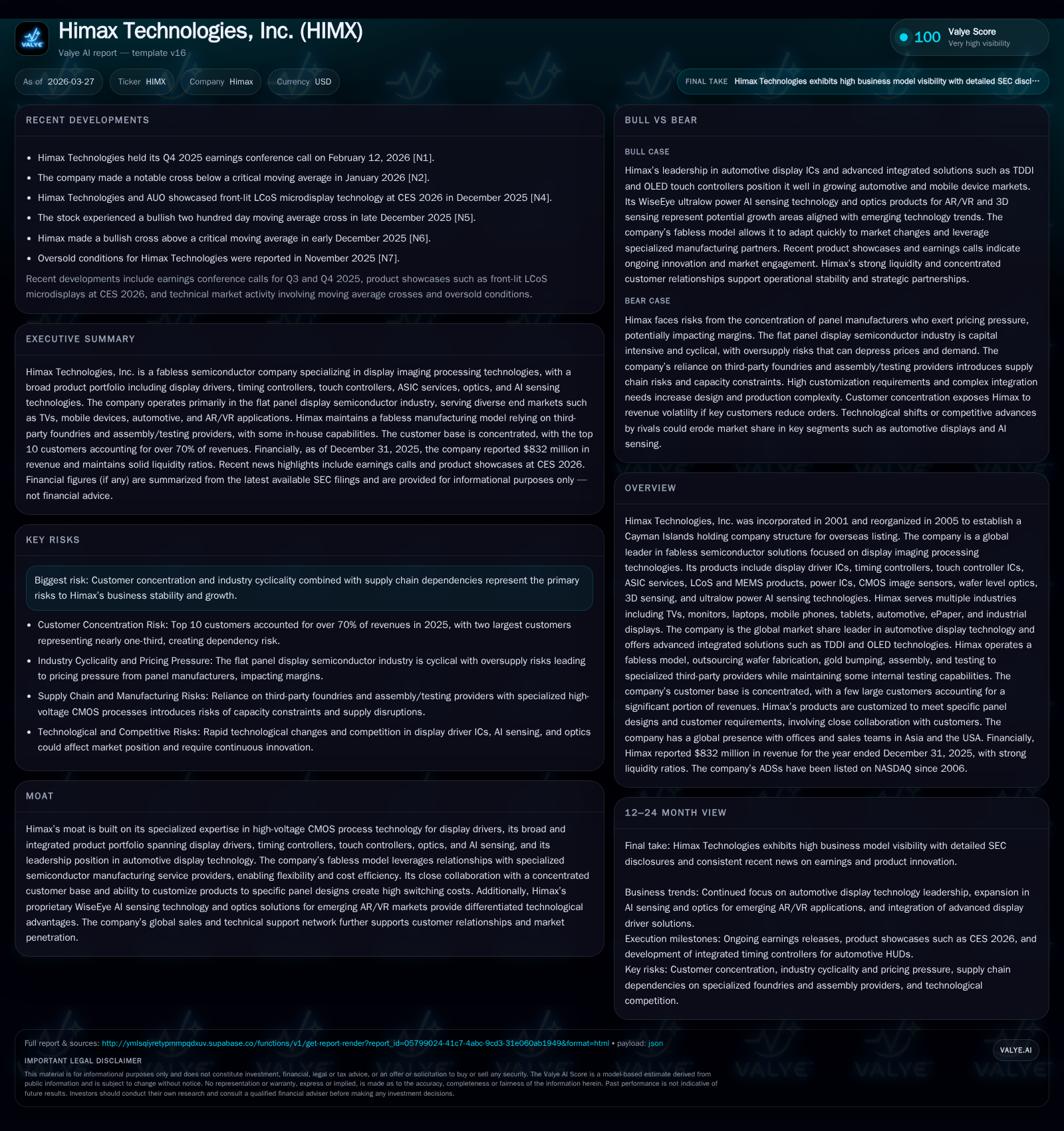
Himax Technologies operates a fabless semiconductor model focused on display imaging processing technologies with leadership in automotive display ICs and ultralow power AI sensing. Its historical performance shows revenue declines from FY2014 to FY2017 alongside surging capital expenditures signaling strategic investments. The company's product portfolio spans display drivers, timing controllers, touch controller ICs, wafer level optics, and specialized AI sensing solutions, supported by deep collaborations with panel manufacturers. While customer concentration and supply chain dependencies remain risks, Himax’s capital allocation toward dividends and facility expansions illustrates disciplined financial management amid cyclical headwinds.
Foundations of Growth: Historical Financial Performance and Drivers
Himax Technologies’ revenue trend from FY2014 through FY2017 paints a nuanced picture of a firm navigating an intensifying cyclical semiconductor market. The top-line declined from $840.5 million in 2014 to $685.2 million in 2017, equating to a -14.7% year-over-year contraction from 2016 to 2017 [F1]. Operating income displayed even greater volatility: from a peak of $72.7 million in 2014 down to just $8.15 million in 2017—a sharp -86.2% drop indicative of tightened margins amidst pricing pressures in the flat panel semiconductor segment.
Net income mirrored these pressures but retained some resilience, falling -45.1% to $27.97 million in FY2017 [F1]. Operating cash flow also receded by approximately 42.5% YoY while capital expenditures experienced a remarkable spike of over 400%, reflecting strategic capital deployment particularly for expanding production capacity for wafer level optics (WLO) and internal test program development [F1][S24].
Historical performance (annual)
| FY | Rev ($mm) | Net ($mm) | OpInc ($mm) | Capex ($mm) | Rev YoY | Net YoY |
|---|---|---|---|---|---|---|
| 2017 | 685 | 28 | 8 | 40 | -14.7% | -45.1% |
| 2016 | 803 | 51 | 59 | 8 | +16.1% | +102.1% |
| 2015 | 692 | 25 | 31 | 10 | -17.7% | -62.2% |
| 2014 | 841 | 67 | 73 | 11 |
Source: SEC companyfacts cache [F1].
Capital returns and efficiency (annual)
| FY | Div ($mm) | ROE% |
|---|---|---|
| 2017 | 41 | 6.1 |
| 2016 | 22 | 10.9 |
| 2015 | 51 | 5.7 |
| 2014 | 46 | 14.1 |
Source: SEC companyfacts cache [F1].
This period underscores the impact of cyclicality intrinsic to the TFT-LCD panel industry which affects Himax's components demand and pricing.
Specialized Product Portfolio and Industry Positioning
Himax's core competency lies in its proprietary high-voltage CMOS process technology that enables the production of mixed-signal display drivers—high-voltage devices operating typically within voltage ranges up to 50 volts depending on source or gate driver application [S4]. This specialization restricts competition due to limited fabs capable of high-volume high-voltage manufacturing.
The product suite is diverse: encompassing display driver ICs (source/gate drivers), timing controllers (TCON), touch controller ICs including innovative TDDI single-chip solutions for in-cell touch displays, low power ASIC services, wafer level optics including diffraction optical elements (DOE), LCoS microdisplays suitable for AR/VR applications, MEMS products, power ICs for voltage regulation, CMOS image sensors tailored for machine vision, and ultralow power AI sensing via the WiseEye platform [S6][S9][S21][S25].
Notably, Himax commands global market leadership in automotive display technologies delivering integrated plastic OLED-based TCONs with local dimming support and full area selectable local dewarping functionalities designed explicitly for advanced Head-Up Displays (HUDs) [S21]. The integration complexity of combining analog/digital circuits on a single die combined with high-voltage requirements enhances switching costs.
Furthermore, its optical solutions extend beyond mere components to full module integration such as co-packaged optics (CPO) involving silicon photonics—a leading innovation fusing WLO technologies with photonic chips yielding bandwidth enhancement and miniaturization critical for next-gen data centers [S18].
Customer-Centric Innovation and Customization Capabilities
Himax maintains close collaborative relationships primarily with a concentrated pool of large panel manufacturers concentrated in Asia; these partnerships are essential due to the bespoke nature of display drivers which require gamma curve optimization and design customization per unique panel layouts—a highly technical task ensuring peak performance aligned tightly with OEM specifications [S3][S4][S10].
The company’s field applications engineering teams work alongside customer engineers through the semiconductor design and qualification lifecycle providing significant value-add through shortened time-to-market windows—crucial given rapid iteration cycles within smartphone and automotive displays [S7][S10]. Such tailoring creates elevated switching costs reflecting sector norms where replacing a trusted vendor involves multi-month requalification periods causing reluctance among panel makers.
Beyond standard products, Himax offers ASIC-based co-development models enhancing ecosystem alignment enabling joint R&D on future tech needs such as OLED-on-cell capacitive touch controllers boasting over-45 dB signal-to-noise ratios adaptable for glove or wet finger operation under automotive conditions [S21].
Growth Prospects Shaped by Market Dynamics and Technology Trends
Looking forward, growth levers include expanding penetration into burgeoning automotive infotainment segments where HUD demand rises alongside higher resolution OLED cockpit displays integrating touch capabilities [N1][S21]. Additionally, emerging AR/VR applications fueled by wafer level optics and microdisplay shipments represent an accelerating addressable market supported by Himax's vertical integration in optical-semiconductor modules [S18].
Strategic investments expand the sensor portfolio into thermal imaging platforms through stakes such as Obsidian Sensors—broadening coverage into machine vision domains that complement existing ultralow power AI sensing offerings potentially opening new verticals like surveillance cameras or smart doorbell applications sensitive to privacy concerns [S25].
Nevertheless, challenges persist notably around client concentration—with two top customers contributing over one-third of revenues—and supply chain bottlenecks inherent in relying on external foundries possessing requisite high-voltage CMOS capabilities limiting rapid scale-up agility [S3][S11][S19].
Navigating Supply Chain Challenges and Customer Concentration Risks
Himax's fabless model is reliant on niche external partners for wafer fabrication such as Taiwan Semiconductor Manufacturing Company Limited (TSMC), Globalfoundries Singapore, SMIC Shanghai alongside specialized assembly houses proficient in tape automated bonding (TAB) or chip-on-glass (COG) packaging techniques—critical differentiating steps requiring gold bumping processes not widespread across all foundries [S19][S20]. Timing capacity allocations depend heavily on credible forecasts given high fixed cost footprints at foundries constraining flexibility.
Similarly, the concentration among panel manufacturers exerts pricing pressure limiting bargaining leverage typical within oligopolistic supplier dynamics [S4][S11]. Efforts to mitigate these depend on maintaining close design collaboration creating product stickiness plus broadening the ecosystem via multi-tier partnerships especially in nascent AR/VR or AIoT end-markets aiming for first-mover advantage.
Capital Allocation Strategy: Dividends, Buybacks, and Cash Flow Management
Despite recent earnings softness driven partially by elevated R&D investment phases and capex expansions ($39.8 million capex recorded in FY2017 showing +404% YoY increase against preceding year) [F1], Himax has sustained consistent dividend payouts scaling back from peak distributions seen around fiscal years prior but still amounting to over $41 million paid out as dividends in FY2017 [F1][S8][S14][S23].
Share repurchase programs exist historically though recent buybacks have been modest with $5.3 million ADS repurchased under the active program at end-February 2026 suggesting conservative capital return amid growth investment priorities [S13][S17].
Cash flow from operations remains positive ($29.4 million CFO), but after subtracting capex results in negative free cash flow of roughly -$10 million underscoring reinvestment into facility expansions such as Fab2 building for WLO production scale-up begun since March 2017 [F1][S24]. The approach indicates a balance between rewarding shareholders while sustaining technology leadership platforms that require substantial upfront investments.
Financial Health Indicators: Operating Metrics and ROE Insights
At December 31, 2017 end-of-year metrics reveal a solid liquidity position evidenced by a current ratio near two times (1.96), indicating comfortable coverage of short-term liabilities with current assets [$661M/$337M] [F1]. Equity stands at $456 million producing an approximate ROE of ~6%, reflective of margin pressures amid cyclical headwinds coupled with significant asset base reinvestment demands [F1].
Operating margins have compressed sharply but continued positive net income signals resilience supported by diversified product lines offsetting some component-level margin erosion consistent with pricing pressures endemic to the flat panel supply chain environment [F1][S22].
What to Watch: Upcoming Milestones and Sector Developments
Going forward it will be important to monitor how Himax advances commercialization timelines for next-gen integrated TDDI drivers across broader OLED applications especially within automotive displays requiring certification compliance related to functional safety standards highlighted during recent earnings call discussions [N1].
Developments on scaling mass production volumes for wafer level optics catering to AR glasses also warrant attention as they hold potential to unlock new growth niches beyond traditional displays leveraging proprietary DOE technologies partnered closely with Tier-1 suppliers [N1][S18].
Furthermore, shifts in customer mix or foundry partnership diversification could mitigate concentration risks if successfully executed alongside continuous innovation maintaining competitive edge relative to peers like Novatek Microelectronics or Synaptics active in similar markets [S5][S11].
This analysis consolidates data exclusively from provided financial statements, SEC filings, and recent news disclosures without speculative forecasts or opinion recommendations regarding hismax technologies’ securities or investment suitability.
Disclaimer: This is research-only, informational analysis and not investment advice. It may include AI-generated interpretation and general industry context. Always verify important details using primary sources.

Comments