
Proem Acquisition Corp. I Launches SPAC with $130M Capital to Target Disruptive Tech
Proem Acquisition Corp. I completed its IPO in early 2026, aiming to acquire a high-growth technology company within two years.
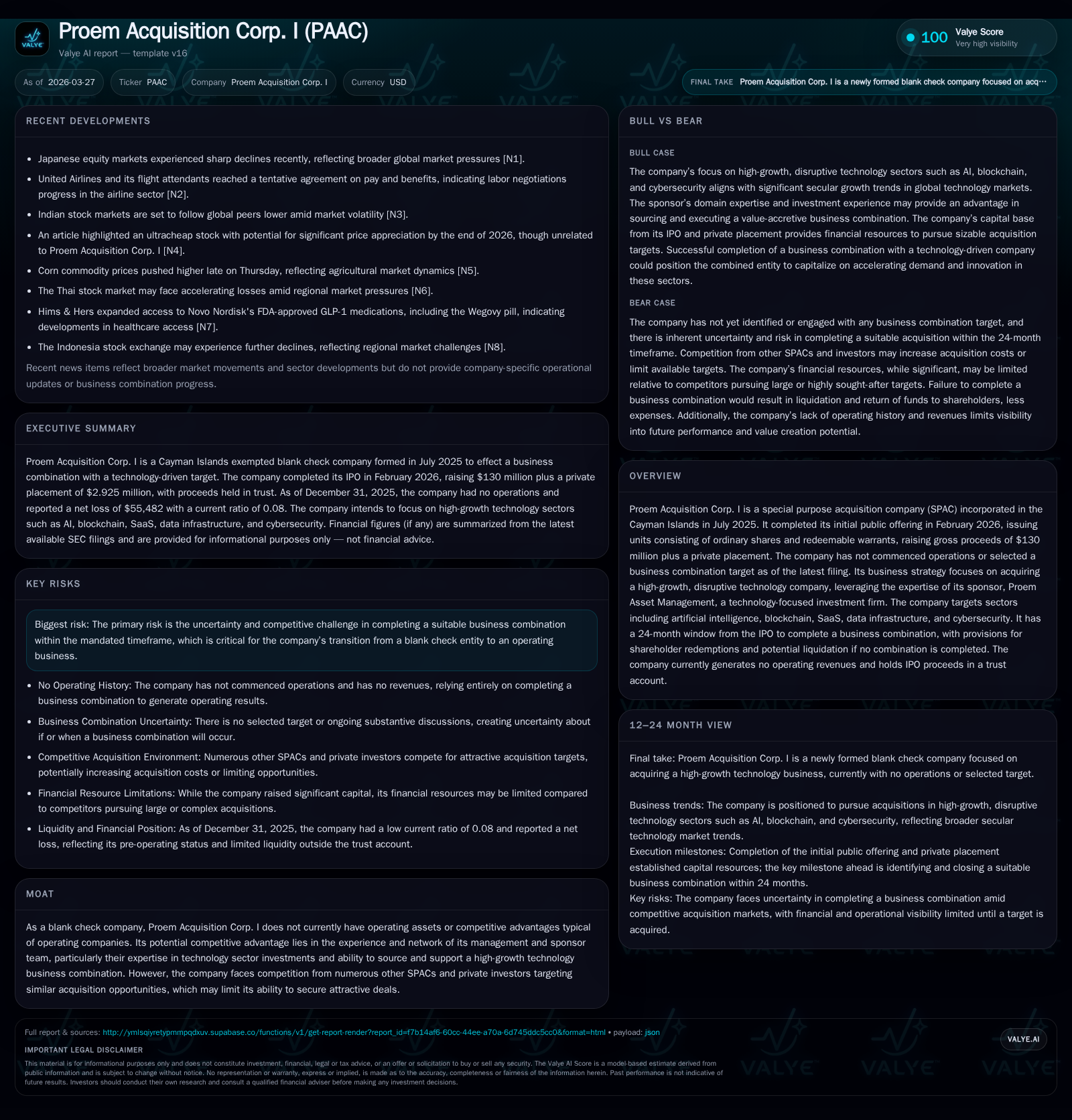
Proem Acquisition Corp. I (PAAC) is a Cayman Islands-incorporated SPAC formed in July 2025 and went public in February 2026. It raised $130 million of gross proceeds through its IPO, plus additional funds from a private placement by its sponsor, Proem Asset Management. The company focuses on targeting disruptive technology sectors such as AI, blockchain, SaaS, data infrastructure, and cybersecurity for its initial business combination. With no revenues or operations to date, its future hinges critically on successfully identifying and closing an acquisition within the 24-month timeframe mandated by exchange rules. Its competitive edge stems primarily from the experienced sponsor team specializing in technology investments.
Company Background and IPO Structure
Proem Acquisition Corp. I (ticker: PAAC) was incorporated in July 2025 as an exempted company under Cayman Islands law with the explicit purpose of effecting a business combination—commonly known as a Special Purpose Acquisition Company (SPAC). The firm conducted its initial public offering (IPO) on February 13, 2026, issuing 13 million units at $10 per unit. Each unit consists of one ordinary share with $0.0001 par value plus one-half of a redeemable warrant exercisable at $11.50 per share [S1][S3][S11].
Concurrently with the IPO, the sponsor entity, Proem SPAC Partners I LLC, purchased approximately 292,500 units at the same price, contributing an additional $2.9 million via a private placement [S11][S13]. The underwriters also received approximately 97,500 "representative shares" that are subject to transfer restrictions until the completion of a business combination. The net proceeds less underwriting fees ($4.55 million deferred commissions) totaled roughly $130 million and have been placed in trust for the benefit of public shareholders [S11][S13][S20].
Historical Performance and Financial Position
As a blank check company newly incorporated in mid-2025 with an IPO closed only in early 2026, Proem Acquisition Corp. I has no meaningful operational history or revenues. Activities through December 31, 2025 were limited to organizational tasks and preparation for going public [S12]. The financial statements confirm zero operating income or revenues; operating losses amounted to approximately $55 thousand for the period ending December 31, 2025 [F1].
The company’s balance sheet reflects current assets around $13.9k versus current liabilities of approximately $164.8k yielding a low current ratio near 0.08—typical for SPAC startups that hold liquid funds largely off-balance sheet in trust accounts inaccessible outside prescribed conditions [F1].
Historical performance (annual)
| FY |
|---|
| 2025 |
Source: SEC companyfacts cache [F1].
Note: All financial data pre-business combination; no revenue reported.
Business Strategy and Target Market Focus
Proem Acquisition Corp.’s stated strategy centers explicitly on acquiring a disruptive technology company with high-growth potential rather than launching independent operations [S1][S12]. The firm's sponsors emphasize targeting sectors including artificial intelligence (AI), blockchain technology, software-as-a-service (SaaS), data infrastructure platforms, and cybersecurity [S12][S14]. These areas have been chosen for their secular tailwinds — projections estimate AI markets reaching over $1.8 trillion by 2030 at a CAGR of approximately 36%, with blockchain similarly expected to grow at nearly twice that pace from mid-2020s onward [S14].
The Sponsor’s founder Mr. Khan brings experience from managing Proem Asset Management since 2019—a technology-focused long/short investment fund with demonstrated sector insights and hands-on portfolio involvement [S16]. This background is leveraged not only for deal sourcing but also for post-merger operational support.
Primary transaction considerations include:
- Scalability with ability to efficiently grow revenues and operations,
- Possession of disruptive or differentiated technology platforms creating sustainable competitive moats,
- Strong management teams open to collaborative governance post-deal,
- Operating within favorable market dynamics characterized by robust demand growth,
- Readiness for public market scrutiny including robust financial controls and governance standards,
- Durable revenue streams often subscription-based or involving innovative monetization frameworks like tokenization or platform fees [S4][S8][S14].
Risks Related to Business Combination Execution
As documented extensively in regulatory filings [S1][S5][S19], the predominant risk lies in the successful identification and consummation of an appropriate initial business combination within the license window—24 months following IPO close (i.e., by Feb 2028) [S9]. Failure results in mandatory liquidation wherein all public shareholders receive pro rata distributions approximating IPO price plus interest minus permitted expenses.
Competitive pressures are acute given the wealth of capital chasing late-stage privately held tech companies necessitating liquidity access via public markets [S7][S18]. Other SPACs and private equity funds compete aggressively for targets with similar profiles creating upward pressure on valuations and compressed deal terms.
Furthermore, legal complexities arise due to incorporation in Cayman Islands where enforcement procedures differ materially from U.S jurisdictions—potentially complicating shareholder protections against directors or sponsors post-transaction [S19]. Lastly, substantial dilution risk exists as private units held by Sponsor convert post-merger minus carveouts tied to stock price performance.
Forecasts and Outlook: What To Watch
Currently without any announced target or substantive discussions publicly disclosed [S1], milestones will pivot around:
- Announcement of definitive merger agreement(s) by board approval (expected before deadline).
- Whether the transaction involves high-profile names or emerging technology entrants aligned with stated sector focus.
- Terms potentially involving warrants exercise pricing triggers influencing capital structure.
- Shareholder approval requirements based on deal size relative to trust assets.
- Possible extension requests which would require shareholder consent if preliminary timelines slip [S9].
Monitoring communications filed via proxy statements or tender offer materials will be crucial when business combinations advance toward consummation.
Capital Allocation Policies and Returns Profile
Given its status as a SPAC without current operating revenues or assets other than cash held in trust accounts, capital allocation largely revolves around:
- Deployment of IPO proceeds towards acquisition consideration either wholly in cash or combined with debt/equity securities issued post-closing,
- Redeemability provisions allowing shareholders redemption rights near merger vote,
- Absence of dividends; no buybacks are possible prior to merged company formation,
- Sponsor’s equity stake derived via private placements entitle them to registration rights but limit transferability until transaction closure [S6][S9][S11][S13].
Return on equity metrics derived from preliminary net losses are not meaningful; once operational integration occurs following merger execution returns will be driven entirely by target company fundamentals [F1].
Industry Context Analysis
SPACs focused on disruptive tech remain one avenue amid turbulent capital markets seeking innovation exposure while mitigating direct venture investment risks. However, this space faces headwinds given increased regulatory scrutiny worldwide on SPAC disclosures alongside stretched valuations for tech companies adjusting expectations after pandemic era exuberance faded.
An emerging trend is prioritizing sustainable revenue models emphasizing subscriptions or recurring services combined with AI-enabled platforms harnessing network effects — aligning well with Proem Acquisition's stated criteria.
The technological themes targeted correlate closely with those favored by institutional venture funds transitioning mature portfolio companies toward public markets through alternatives like direct listings or SPAC mergers — enhancing transaction pipeline potential yet demanding rigorous due diligence disciplines which Proem's sponsor aims to deliver leveraging years’ expertise.
Summary
Proem Acquisition Corp. I represents a fresh entrant within the highly competitive tech-focused SPAC arena as of early 2026 raising significant capital ($130m+). It leverages seasoned management experience with investments centered on AI/blockchain/SaaS etc., aiming to capture secular growth trends through an initial business combination within two years of IPO closure.
While lacking operating history or revenue streams till date—as expected for blank check entities—its prospects depend on execution success amid rampant competition for quality targets coupled with regulatory constraints tied to governance structure under Cayman Islands law. Capital remains safely parked pending deployment but shareholder returns remain latent until combined entity emerges viable.
Observers should focus keenly on future announcements regarding target identification progress including terms disclosed via SEC filing updates along with sponsored guidance concerning expected deal timing or potential extensions beyond original windows laid out post-offering.
This analysis is intended solely for informational purposes reflecting publicly available filings as of March 27, 2026 and does not constitute investment advice.
Disclaimer: This is research-only, informational analysis and not investment advice. It may include AI-generated interpretation and general industry context. Always verify important details using primary sources.

Comments