
Werewolf Therapeutics Confronts Cash Constraints While Advancing Tumor-Selective Immunotherapy Platform
The company is progressing its PREDATOR platform immunotherapy assets amid significant workforce cuts and financial uncertainty.
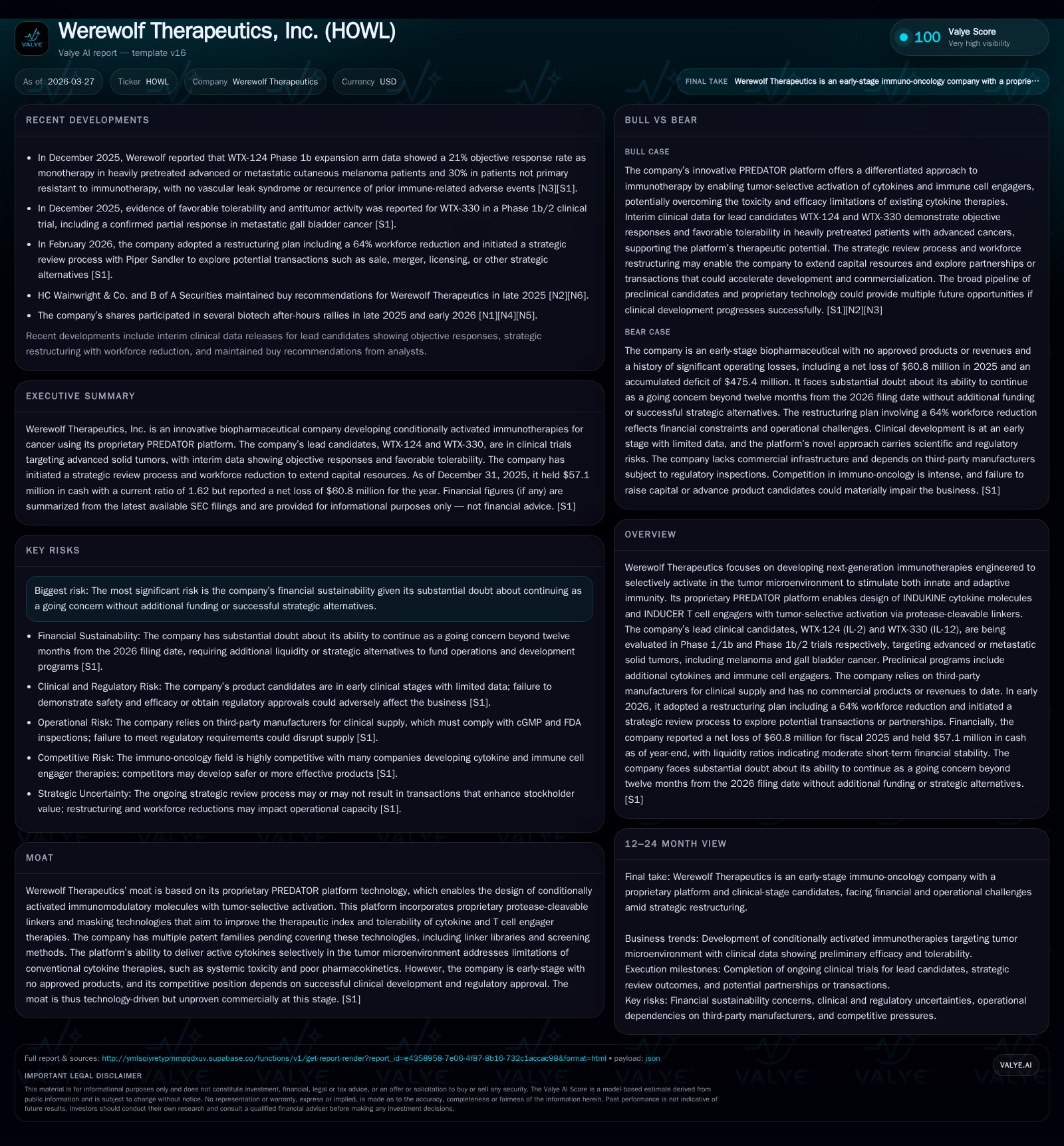
Werewolf Therapeutics, a clinical-stage biotech innovating tumor-selective immunotherapies using its proprietary PREDATOR platform, reported ongoing operating losses and implemented a major restructuring to extend its capital runway. Key clinical candidates WTX-124 (IL-2) and WTX-330 (IL-12) remain in early trials targeting advanced solid tumors. Despite technological differentiation, financial sustainability poses the largest risk, with cash sufficiency expected into late 2026 only if current plans hold. The firm is actively exploring strategic alternatives while managing substantial accumulated deficits and no approved products or revenues to date.
Company Background and Platform Overview
Werewolf Therapeutics is a clinical-stage biopharmaceutical company developing novel immunotherapies engineered for selective activation within the tumor microenvironment (TME). Its proprietary PREDATOR platform designs conditionally activated INDUKINE cytokine molecules and INDUCER T cell engagers that employ protease-cleavable linkers to spatially restrict activity. This approach aims to stimulate both adaptive and innate immunity while mitigating systemic toxicities seen with traditional cytokine therapies [S1].
The lead product candidates are WTX-124, an IL-2 molecule in Phase 1/1b clinical trials as monotherapy and combined with Merck’s KEYTRUDA (pembrolizumab), and WTX-330, an IL-12 molecule advancing through Phase 1b/2 studies targeting advanced solid tumors such as melanoma and gall bladder cancer [S1]. Additional preclinical programs leverage the same tumor-selective activation platform.
Historical Financial Performance
Werewolf has incurred significant operating losses consistent with its early-stage status lacking commercialized products or revenues. The recent financial results show continued negative earnings but some improvement from prior years:
Historical performance (annual)
| FY | Net ($mm) | CFO ($mm) | OpInc ($mm) | Capex ($mm) | Net YoY |
|---|---|---|---|---|---|
| 2025 | -61 | -60 | -61 | 0 | +13.7% |
| 2024 | -71 | -56 | -74 | 0 | -88.7% |
| 2023 | -37 | -33 | -41 | 1 | +30.6% |
| 2022 | -54 | -41 | -56 | 4 |
Source: SEC companyfacts cache [F1].
Capital returns and efficiency (annual)
| FY | FCF ($mm) | ROE% |
|---|---|---|
| 2025 | -60 | -245.2 |
| 2024 | -56 | -96.1 |
| 2023 | -33 | -33.6 |
| 2022 | -44 | -44.0 |
Source: SEC companyfacts cache [F1].
The operating loss improved by approximately 17.6% year-over-year from FY2024 to FY2025 while net losses decreased by roughly 13.7%. Operating cash flow remained deeply negative at around $60 million in FY2025. Capital expenditures dropped sharply to zero reflecting tightened cost controls amid financial pressures. Equity decreased substantially due primarily to accumulated losses over time [F1].
Strategic Restructuring and Outlook
In response to financial constraints including an accumulated deficit exceeding $475 million at December 31, 2025, Werewolf announced a restructuring initiative in early 2026 that included a workforce reduction of approximately 64%. This move aligns costs with available capital while initiating a comprehensive strategic alternatives review process supported by Piper Sandler & Co., exploring potential sale transactions or licensing arrangements aimed at extending liquidity or accelerating development [S1].
Management projects that existing cash reserves of about $57 million will fund operations into the fourth quarter of 2026 under current plans; however, securing additional financing or completing strategic transactions is critical to avoid operational disruptions beyond that timeframe [S1].
Technology Differentiation: The PREDATOR Platform
At the core of Werewolf’s value proposition is its PREDATOR technology enabling selective activation of immune-stimulatory molecules via tumor-associated proteases. This conditional activation aims to improve therapeutic indices by limiting systemic exposure and toxicity typically associated with cytokines such as IL-2 and IL-12.
Patent filings cover key aspects including protease-cleavable linker technology and methods for screening molecules for tumor-specific activation. The platform also extends to bispecific immune cell engagers using similar conditional activation principles broadening potential therapeutic applications [S18].
Clinical Development Milestones
WTX-124 is currently evaluated in Phase 1/1b trials assessing safety as monotherapy and in combination with KEYTRUDA across multiple advanced solid tumors. WTX-330 is in Phase 1b/2 studies targeting indications including melanoma and gall bladder cancer where IL-12’s potent pro-inflammatory effects might overcome resistance when confined selectively within tumors [S1].
Given their early-phase status without reported regulatory approvals or marketing authorizations to date, upcoming clinical readouts focusing on safety and tolerability will be pivotal for shaping subsequent development strategies.
Capital Allocation and Financial Sustainability
Werewolf does not generate commercial revenues nor pay dividends or repurchase shares. Funding historically derives from equity issuances supplemented by a term loan facility subject to restrictive covenants limiting dividends, incurrence of additional debt, asset disposals without approval, and stock repurchases [S11]. These restrictions constrain financial flexibility during ongoing strategic evaluations.
Operating cash flow remains significantly negative (-$60.3 million FY2025), consistent with operating losses despite recent cost-cutting measures including elimination of capital expenditures last fiscal year [F1]. Approximate return on equity based on FY2025 figures is deeply negative (-245%), reflecting heavy losses relative to shareholders’ equity typical for pre-revenue biopharma firms.
Risks: Financial Viability Dominates Considerations
The foremost risk identified involves substantial doubt regarding continuing as a going concern absent additional funding or successful strategic alternatives within projected timelines. The lack of approved products or revenue intensifies reliance on external financing which may be constrained by regulatory filing limitations affecting equity sales volumes through ATM offerings [S1][S11].
Additional risks include achieving clinical validation necessary for regulatory approvals alongside challenges protecting intellectual property rights amid competitive patent landscapes potentially impacting exclusivity benefits upon commercialization [S18][S19]. Compliance complexities around promotion of unapproved uses also pose regulatory considerations once products advance toward market entry .
Summary
Werewolf Therapeutics exemplifies an early-stage biopharmaceutical enterprise advancing innovative immunotherapy platforms addressing oncology treatment challenges through selective tumor-targeted activation technology. Despite scientific progress embodied within ongoing Phase I trials for lead candidates WTX-124 and WTX-330—both leveraging the proprietary PREDATOR platform—the company faces acute financial pressures necessitating restructuring and active pursuit of strategic alternatives.
Existing cash resources are forecasted to sustain operations only into late Q4 2026 absent new funding or transformative transactions. Consequently, near-term developments around liquidity solutions alongside clinical trial progress will critically influence the firm's trajectory.
This analysis is prepared solely based on public information without investment advice or recommendations.
Disclaimer: This is research-only, informational analysis and not investment advice. It may include AI-generated interpretation and general industry context. Always verify important details using primary sources.

Comments