
Calidi Biotherapeutics Advances Oncolytic Platforms While Managing Capital Strain
Calidi Biotherapeutics continues clinical-stage progress in novel cancer immunotherapies as it navigates financial pressures inherent to early biotech development.
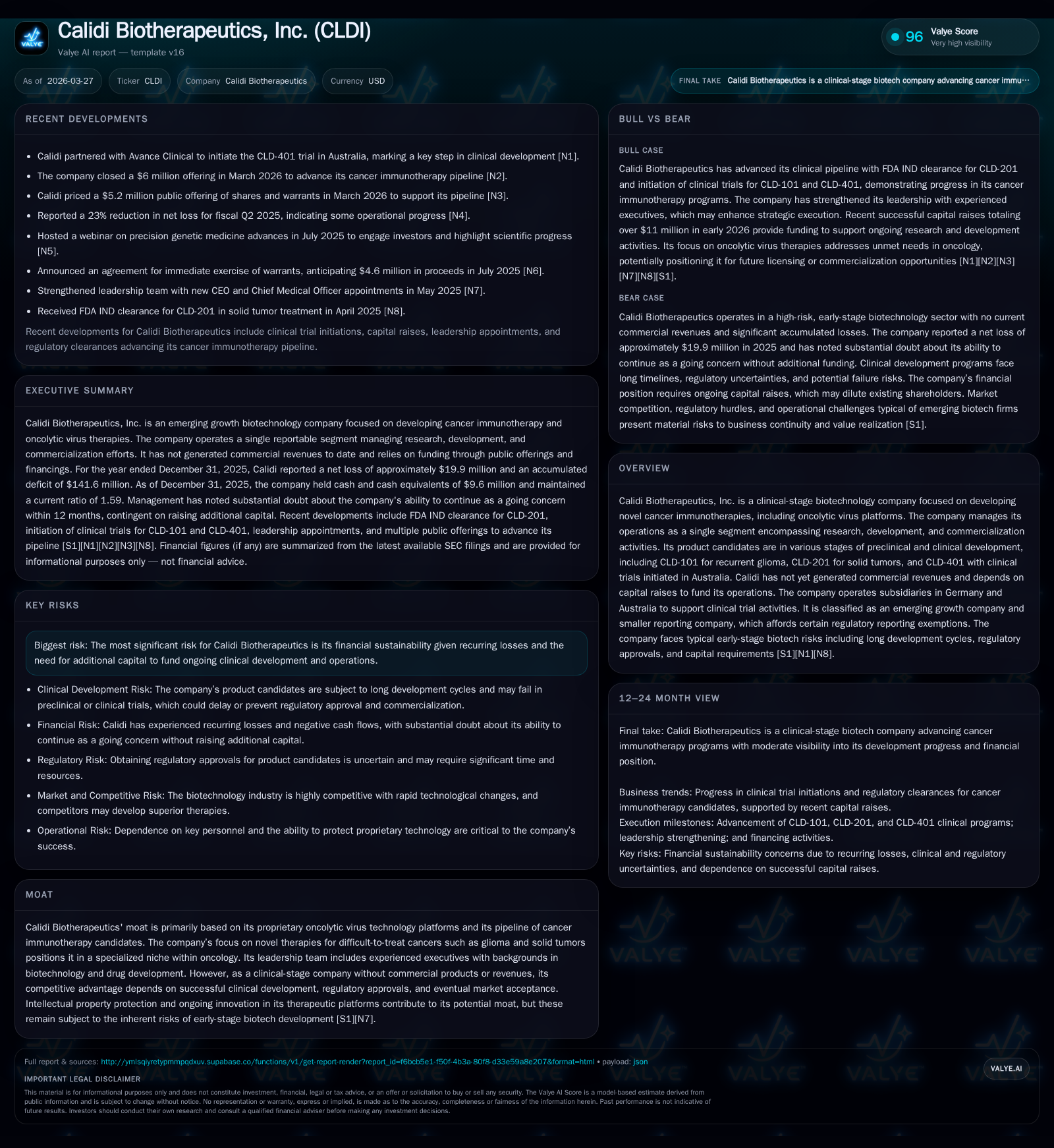
Calidi Biotherapeutics operates as a clinical-stage biotech firm specializing in proprietary oncolytic virus immunotherapy platforms targeting difficult cancers like glioma and solid tumors. Despite no commercial revenues, the company has steadily advanced multiple clinical programs, including recently initiated trials in Australia. Financially, Calidi endures significant operating losses and negative cash flow, relying heavily on multiple equity raises and reverse stock splits to maintain runway. Intellectual property and focused R&D efforts underpin its technological moat, but ongoing capital demands and typical biotech risks present challenges ahead.
Early Growth: Clinical Pipeline Expansion and Investment Trends
Historical performance (annual)
| FY | Net ($mm) | CFO ($mm) | OpInc ($mm) | Net YoY |
|---|---|---|---|---|
| 2025 | -20 | -21 | -20 | +10.1% |
| 2024 | -22 | -20 | -22 | +24.2% |
| 2023 | -29 | -27 | -29 | -927.6% |
| 2022 | 4 | 0 | -5 |
Source: SEC companyfacts cache [F1].
Capital returns and efficiency (annual)
| FY | ROE% |
|---|---|
| 2025 | -529.6 |
| 2024 | -1443.5 |
| 2023 | 354.8 |
| 2022 | -67.8 |
Source: SEC companyfacts cache [F1].
Calidi Biotherapeutics has carved a niche within the challenging oncology sector by focusing on novel cancer immunotherapies based on proprietary oncolytic virus platforms. The company's leading candidates—CLD-101 targeting recurrent glioma, CLD-201 aimed at various solid tumors, and CLD-401 currently undergoing clinical trials—illustrate progressive pipeline maturation [S1]. Notably, trial operations are supported internationally through subsidiaries in Germany (StemVac GmbH) and Australia (Calidi Biotherapeutics Australia Pty Ltd), emphasizing the global scope of its research activities [S1].
Recent developments include the initiation of clinical trials for CLD-401 in Australia facilitated by a partnership with Avance Clinical, signaling strategic expansion of the program's geographic footprint [N1]. These steps reflect continuous investment into early-stage development despite the lengthy timelines inherent to oncology drug development. Operating income trends over the past four years reveal persistent negative results but show modest improvement from -$28.9 million in FY2023 to -$20.2 million by FY2025, indicative of reducing operating losses paralleling focused pipeline advancement [F1]. This phase typifies early-stage biotechnology enterprises where heavy upfront R&D expenditure contrasts with absent product revenues.
Financial Snapshot: Revenue Void and Persistent Operating Losses
Calidi remains firmly pre-commercial; it has yet to generate any commercial revenues from its product candidates [S1][F1]. Consequently, all financial performance is characterized by negative earnings driven chiefly by research and development outlays. Net income mirrored operating income trends with losses narrowing slightly from -$29.2 million in FY2023 to -$19.9 million in FY2025 [F1]. Year-over-year improvements in operating income (approximately 7%) reflect controlled spending rather than top-line gains—a hallmark of clinical-stage biopharma companies.
Operating cash flow suffered a deterioration of approximately 8% between FY2024 and FY2025 reaching an outflow of roughly $21.3 million as investing activities remained minimal [F1]. This underscores ongoing intensive expenditure during clinical trial progression phases which typically absorb considerable capital before any prospective commercialization.
A striking metric illustrating the financial profile is Calidi’s approximate return on equity of negative 529%, consistent with companies heavily allocating resources toward pipeline generation without inbound revenue streams [F1]. This underscores a high-risk profile often faced by emerging public biotechnology firms.
Capital Strategy: Funding Clinical Trials and Managing Dilution
To sustain its ambitious clinical agenda amid mounting cash burn, Calidi has undertaken multiple equity raises recently. In early 2026 alone, the company completed offerings exceeding $11 million through public sales of common stock units paired with warrants [N2][N3]. Such fundraisings were critical given the operating cash consumption exceeding $21 million annually.
These equity injections were accompanied by structural changes to share count via reverse stock splits—a 1-for-10 split in mid-2024 followed by a more substantial 1-for-12 split effective August 2025 [S4]. Such consolidations aim to adjust trading liquidity and market perception but carry dilution implications that typically generate investor concerns reflected in share price declines observed post-offering announcements [N4]. The repeated share consolidation reflects sustained efforts to rationalize share structure amid substantial issuance volumes needed for capital.
Despite these measures, the company displays continued dependency on external capital infusions for liquidity continuity. The dilution impact derives not only from outright share issuances but also from the exercise of numerous warrants attached to offerings, expanding outstanding common stock over time [S4][S16].
Technological Moat: Proprietary Oncolytic Virus Platform and IP Positioning
Calidi’s moat primarily rests on its proprietary technology that leverages engineered oncolytic viruses designed to selectively infect and kill malignant cells while stimulating anti-tumor immune responses. This biological approach targets difficult-to-treat cancers such as gliomas—often resistant to conventional modalities—and various solid tumors [S1].
The specialized mechanism confers high barriers to entry due to the complex biology underlying viral engineering combined with ongoing evolution of related intellectual property protections encompassing constructs, manufacturing processes, and therapeutic methods [S1][N7]. Moreover, successful translation through preclinical phases into first-in-human trials underpins scientific validation crucial for competitive differentiation.
Nonetheless, this moat is contingent upon meticulous execution of clinical protocols demonstrating safety and efficacy—as failure at any stage would substantially erode distinctiveness given the competitive oncology landscape rich with innovative immunotherapies beyond oncolytic strategies.
Future Outlook: Clinical Milestones to Watch and Development Hurdles
Absent explicit forward guidance from management regarding timelines or expected pivotal data releases necessitates reliance on tracking key developmental milestones as indicators of future value inflection [N1][S1]. These include interim safety or efficacy readouts from ongoing Phase I/II trials of CLD-401 (Australia focus) as well as progress updates for CLD-101 and CLD-201 pipelines across current geographies.
Partnerships such as that with Avance Clinical provide operational leverage enabling broader patient enrollment capacity critical for timely study completion [N1], though delays typical within biotech due to recruitment challenges or regulatory feedback remain risks. Furthermore, success hinges on eventual regulatory approvals contingent upon robust data packages meeting evolving agency criteria.
Financial constraints pose an ongoing cap; while recent capital raises improve near-term runway, management acknowledges substantial doubt regarding continuing operations without additional financing beyond 12 months [S11]. This precarious funding dynamic may delay or limit development pace if future raises encounter market resistance.
Cash Flow Dynamics and Return Metrics: Scrutinizing Sustainability
Analysis of cash flow reveals consistent operational cash outflows intensifying modestly from $19.7 million in FY2024 to $21.3 million in FY2025 [F1], underscoring escalating R&D costs linked with advancing clinical studies without offsetting revenue inflows. Capital expenditures remain small relative to operating expenses (~$0.12 million), thus free cash flow approximates negative $21.3 million annually.
Debt profile indicates limited outstanding borrowings ($0.6 million net long-term debt) following scheduled repayments prior years' term notes bearing high-interest rates around mid-teens percentages annually [S5][S10], demonstrating preference for equity over debt financing amidst risk considerations.
No dividends or share repurchase programs exist—standard practice at this stage given focus on resource allocation toward product development rather than shareholder returns [S8]. Negative return metrics stem from large accumulated deficit (~$141.6 million) reflecting historical cumulative investments absent revenue generation [F1][S11]. These indicators collectively highlight non-sustainable free cash flows dependent entirely on future capital injections.
Regulatory and Risk Considerations in a Competitive Landscape
Calidi’s risk environment incorporates typical challenges endemic to early-stage biotechnology firms concentrated within oncology therapies developing first-in-class agents. Key risks identified encompass potential failure or delay in clinical trials impacting regulatory approval prospects; dependence on continuous capital access given no product sales; protection vulnerabilities surrounding intellectual property; competitive advances by peer entities developing alternative immunotherapies; possible adverse regulatory decisions impacting marketing authorization; and market uptake uncertainties pending eventual launch [S6][S22].
Legal proceedings appear minimal but monitoring regulatory updates remains prudent given industry volatility [S6]. Considerations related to foreign currency exposures exist due to European and Australian subsidiaries though regarded as immaterial currently [S1]. Overall, these factors necessitate cautious assessment balancing scientific promise against structural execution risks inherent within nascent therapeutic development pipelines.
This analysis synthesizes available financial filings alongside recent corporate disclosures without projecting investment guidance or price targets. Given Calidi Biotherapeutics’ status as an emerging growth company without commercial products, continued review of forthcoming clinical data releases and capital formation activities is essential for evaluating operational viability over ensuing periods.
Disclaimer: This is research-only, informational analysis and not investment advice. It may include AI-generated interpretation and general industry context. Always verify important details using primary sources.

Comments