
Abercrombie & Fitch Charts Brand Momentum Amid Margin Pressures
The company’s evolution in brand performance and geographic sales mixes reveal a nuanced growth narrative challenged by rising costs and margin compression.
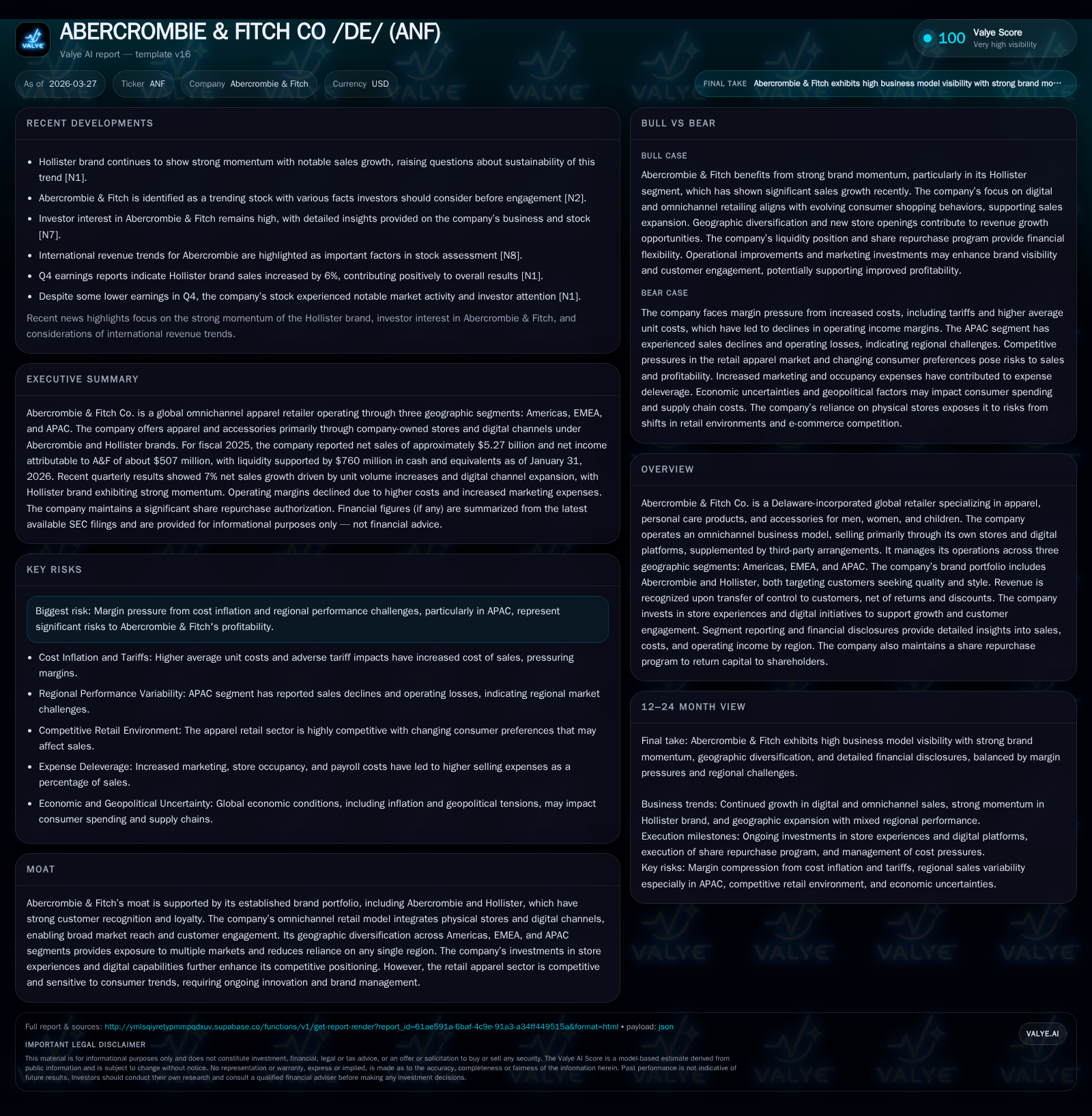
Abercrombie & Fitch Co. has demonstrated steady revenue growth from FY2023 to FY2025, driven by the momentum of its Hollister brand contrasting with softer overall comp sales. While the Americas remain its revenue stronghold, APAC presents ongoing operational and margin challenges despite strategic digital investments in EMEA. Operating income has declined due to inflationary pressures and increased selling expenses, even as the company aggressively pursues share repurchases funded by robust operating cash flow. Legal contingencies and cost inflation pose risks to sustain profitability amid a competitive retail apparel market.
Revenue Growth Patterns and Brand Performance Across Segments
Abercrombie & Fitch Co. reported net sales of $5.27 billion in FY2025, up 6.4% from $4.95 billion in FY2024 and a significant increase from $4.28 billion in FY2023, illustrating its continued top-line expansion over recent years [F1]. This revenue growth trajectory reflects a deceleration from prior double-digit comparable sales gains noted in earlier periods down to mid-single digits more recently [N2]. Notably, the Hollister brand stands out as a key driver, with recent reports indicating a 6% year-over-year uplift contributing disproportionately to overall portfolio growth [N6]. This suggests an internal shift toward quality growth within specific brands rather than broad-based volume gains.
Industry-standard comparable sales metrics corroborate this trend where comp store/digital sales softened overall but were buoyed by Hollister’s enhanced consumer resonance. This branded portfolio composition highlights Abercrombie’s strategic focus on differentiated brand identity and product mix optimization within the competitive apparel retail sector.
Geographic Influence: Americas, EMEA, and APAC Divergences
The company’s geographic segmentation assigns net sales primarily to Americas, EMEA (Europe, Middle East, Africa), and APAC regions based on fulfillment location [S4]. Americas remains the strategic core with $4.29 billion in FY2025 revenue, showing stable contribution and operational profitability [F1]. Meanwhile, EMEA generated $818 million with incremental progress underpinned by digital expansion efforts aimed at enhancing omnichannel penetration [N1].
APAC’s performance contrasts markedly; it posted only $158 million in revenue but incurred an operating loss of $27.6 million attributable to elevated cost structures, regional operational complexities, and margin pressure [S4]. Management’s CODM-driven resource allocation decisions reflect prudence here as inventory positioning and investments prioritize long-term growth potential amidst these headwinds.
Margin Compression and Its Impact on Operating Income
Despite growing revenues, operating income contracted to $699 million in FY2025 from $741 million in FY2024—a decline of approximately 5.6% YOY—signaling margin compression [F1]. Analysis reveals inflationary pressures primarily driving cost of sales higher to $2.03 billion versus $1.77 billion previously [F1], compounded by elevated selling expenses which rose to approximately $1.81 billion [S1]. These factors collectively erode gross margins through adverse mix shifts and heightened cost absorption demands.
Moreover, fixed overhead elements linked to store occupancy costs remain substantial though partially mitigated via lease negotiations and productivity initiatives [S17]. Selling expense escalations align with intensified promotional activities aimed at offsetting competitive pressure yet reduce operating leverage [N3]. The retail jargon frames this as balancing ‘cost absorption’ against ‘gross margin mix shifts’ amid broader industry inflation.
Digital Transformation and Omnichannel Initiatives Driving Consumer Engagement
Aligned with sector trends emphasizing integrated fulfillment models, Abercrombie & Fitch continues channel expansion through digital investments alongside upgraded store experiences [N4],[N5]. This duality aims not only at capturing incremental online penetration—an increasingly pivotal KPI—but also at enhancing localized inventory turns via data analytics-driven planning.
The company’s omnichannel framework thus mitigates risk inherent in purely physical retail models while aiming to maintain customer loyalty through experiential differentiation across brands. Such initiatives are critical as fashion retail faces rapid trend cycles fostering consumer demand volatility.
Capital Deployment: Buybacks, Dividends, and Balance Sheet Health
Abercrombie & Fitch exhibits disciplined capital allocation marked notably by aggressive share repurchases totaling approximately $451 million in FY2025—double the prior year’s buyback levels—under an open-ended $1.3 billion authorization approved in 2025 [F1], [S6], [S7], [S13]. These buybacks serve dual purposes: returning excess cash to shareholders while offsetting dilution from share-based compensation programs.
Dividends remain suspended since FY2020 reflecting management’s preference for reinvestment and balance sheet strengthening strategies rather than cash payouts [F1]. Operating cash flow generation remains robust although trended downward YOY from $710 million (FY2024) to $619 million (FY2025), partly reflecting working capital dynamics amidst rising inventory levels [$730 million vs ~$575 million prior] [F1],[S2]. Capital expenditures increased sharply (+31.6%) to nearly $241 million driven by store refurbishments and digital infrastructure upgrades [F1],[S17], emphasizing reinvestment for sustained brand relevance.
Liquidity ratios support flexibility with a current ratio around 1.49x indicating reasonable short-term coverage of liabilities by assets [F1]. Debt reduction efforts include redeeming senior notes in alignment with covenant compliance frameworks under asset-based revolving credit facilities [S9],[S11]. The approximate ROE stands at a healthy ~36%, underscoring effective profitability on equity capital deployed [F1].
Risks from Cost Inflation and International Challenges
Cost inflation emerges as a salient threat constraining margin recovery prospects despite revenue advances; the inability fully to pass inflation through pricing without impacting demand remains a challenge described as 'inflation pass-through' risk in filings [S1],[S5]. APAC regional operations exacerbate this risk given localized economic volatility and supply chain disruptions hindering profitability.
Legal proceedings disclosed convey uncertainties albeit without definitive contingent liabilities exceeding accrued reserves at present; however, ongoing litigation exposures underscore potential adverse outcomes that could materially affect financial results if resolved unfavorably [S5]. Consumer trend sensitivity intrinsic to retail apparel necessitates continuous innovation lest brand positioning erode under shifting preferences.
Looking Ahead: Market Expectations and Key Watchpoints
Market consensus reflected Q4/FY26 earnings beats primarily driven by Hollister's sustained momentum though tempered by Q4 operating income softness provoking stock price retracements post-earnings release [-8% drop] highlighting investor caution towards near-term profit volatility [N2],[N3]. Critical monitoring areas include updates on comparable sales progression particularly internationally combined with segment-level revenue guidance highlighted in public disclosures as leading indicators for sustainability of growth narratives.[N8],[N9]
Valuation discourse among analysts hints at possible undervaluation relative to fundamentals presenting opportunities contingent on execution of omnichannel initiatives and successful international scaling which remain pivotal for expanding market footprint beyond core Americas operations.
Historical performance (annual)
| FY | Rev ($bn) | Net ($mm) | CFO ($mm) | OpInc ($mm) | Rev YoY | Net YoY |
|---|---|---|---|---|---|---|
| 2025 | 5.3 | 507 | 619 | 699 | +6.4% | -10.5% |
| 2024 | 4.9 | 566 | 710 | 741 | +15.6% | +72.6% |
| 2023 | 4.3 | 328 | 653 | 485 | +15.8% | |
| 2022 | 3.7 | -2 | 93 |
Source: SEC companyfacts cache [F1].
Capital returns and efficiency (annual)
| FY | Buybacks ($mm) | FCF ($mm) | ROE% |
|---|---|---|---|
| 2025 | 451 | 378 | 36.1 |
| 2024 | 230 | 527 | 42.4 |
| 2023 | 0 | 496 | 31.7 |
| 2022 | 126 | -167 |
Source: SEC companyfacts cache [F1].
Table summarizes key annual financial metrics evidencing growth acceleration tapering with compressed operating margins amid rising expenditures.
This analysis synthesizes Abercrombie & Fitch Co.’s evolving financial results alongside operational drivers that illuminate strengths in brand momentum balanced against tangible risks from inflationary pressures and regional challenges particularly within APAC markets. Continued emphasis on omnichannel integration is crucial to sustaining competitive advantage while capital allocation favors shareholder returns via buybacks over dividends supported by solid cash generation albeit with cautious eyes on margin resilience moving forward.
Disclaimer: This report is for informational purposes only and does not constitute investment advice or recommendations regarding Abercrombie & Fitch Co.'s securities or prospects.
Disclaimer: This is research-only, informational analysis and not investment advice. It may include AI-generated interpretation and general industry context. Always verify important details using primary sources.

Comments