
ParaZero Technologies Advances Drone Safety with Aerospace-Grade Autonomy Amid Financial Challenges
Examining ParaZero’s journey from pioneering autonomous drone safety systems to expanding counter-UAS solutions while managing persistent operational losses.
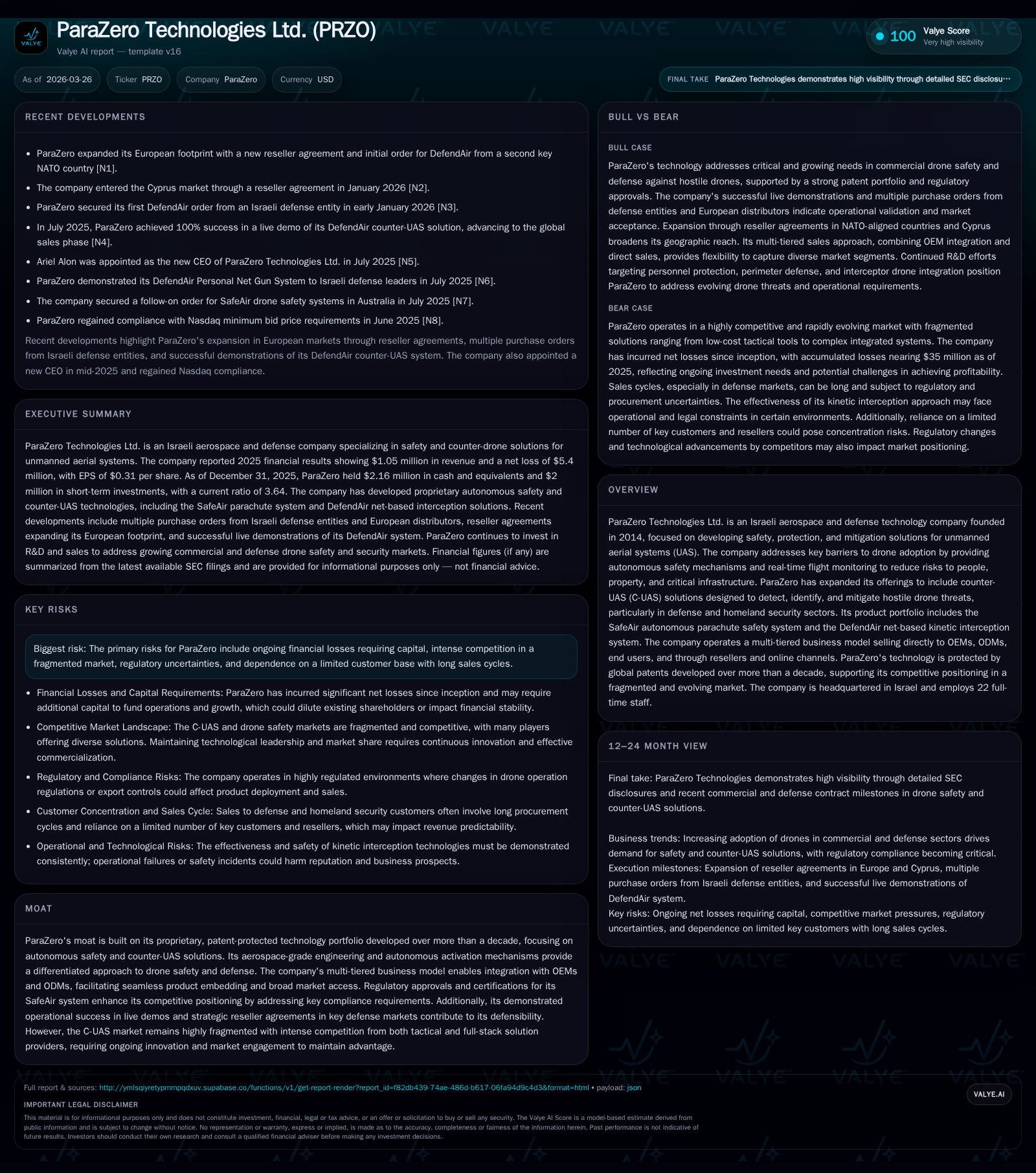
ParaZero Technologies Ltd., an Israeli aerospace and defense company, has steadily grown its revenue through innovative safety and counter-UAS products such as SafeAir and DefendAir, supported by a robust patent portfolio. Despite a 12% revenue increase in FY2025, the company continues to face net losses driven by heavy R&D spending and long sales cycles typical of defense sectors. Regulatory dynamics and fragmented competition pose ongoing challenges, although recent defense orders and European channel expansions bolster its future market opportunities. Capital raises have provided liquidity for operations, but sustained profitability remains elusive.
Growth in Mission-Critical UAV Safety Solutions: Historical Financial and Operational Review
ParaZero Technologies has demonstrated consistent top-line growth through fiscal years 2023 to 2025, with revenues increasing from approximately $620K in 2023 to $1.05 million in 2025, marking a compounded annual growth rate that highlights rising commercial traction [F1]. This growth trajectory is counterbalanced by widening operating losses—operating income deteriorated from -$2.8 million in FY2023 to nearly -$7.5 million in FY2025—which reflects the considerable investment in research, development, sales, and marketing required to establish leadership in the UAV safety domain [F1]. Net losses narrowed notably in FY2025 compared to the prior year ($-5.4 million versus $-11 million), suggesting some operational leverage or cost management initiatives beginning to yield benefit.
Operating cash flows have remained negative across these years with an FY2025 outflow of approximately $-5.8 million after capex of just $27.8K—a figure signaling a focus on R&D-heavy innovation over substantial fixed asset expansion [F1]. The company’s balance sheet improved sufficiently to support these investments with a current ratio of approximately 3.6x at year-end 2025, underpinned by a cash position above $2.1 million [F1].
Historical performance (annual)
| FY | Rev ($) | Net ($mm) | CFO ($mm) | OpInc ($mm) | Rev YoY | Net YoY |
|---|---|---|---|---|---|---|
| 2025 | 1046664 | -5 | -6 | -8 | +12.3% | +51.0% |
| 2024 | 932154 | -11 | -5 | -6 | +50.2% | -193.1% |
| 2023 | 620508 | -4 | -3 | -3 |
Source: SEC companyfacts cache [F1].
Capital returns and efficiency (annual)
| FY | FCF ($mm) | ROE% |
|---|---|---|
| 2025 | -6 | -171.5 |
| 2024 | -5 | 3547.1 |
| 2023 | -3 | -61.8 |
Source: SEC companyfacts cache [F1].
Note: Revenues increased consistently but net losses remain significant despite improvement in FY25's bottom line [F1].
Driving Factors Behind Revenue Growth and Expanding Tech Portfolio
ParaZero’s founding innovation centers on aerospace-grade engineering that ensures reliability under safety-critical conditions—core to its SafeAir autonomous parachute system that mitigates ground risk during drone malfunctions. This technology benefits from autonomous activation mechanisms that meet stringent regulatory standards such as FAA waivers for flight-over-people operations [S6][S16]. The company also extended its portfolio into defense-focused Counter-UAS (C-UAS) solutions under the DefendAir product line featuring kinetic net launchers capable of intercepting hostile drones with minimal collateral damage—a middle-ground approach between limited tactical point defenses and complex full-stack C-UAS architectures [S4][S5][S17].
ParaZero holds a diversified intellectual property portfolio with over twenty global patents protecting rapid parachute deployment methods and net-launch interception systems integral to their product suite [S13]. The multi-tiered business model fosters integration with OEMs/ODMs facilitating embedded systems adoption alongside direct sales to end-users and partnerships with resellers offering cross-regional distribution advantages [S5][S12][S17]. These efforts align product maturity with broad access across commercial drone operators requiring FAA-approved safety enhancements as well as defense clients seeking scalable drone threat solutions.
Emerging Constraints on Market Penetration and Regulatory Complexity
Despite technological progress and demand momentum, regulatory uncertainty persists as a critical market constraint. Rules governing UAS operation—such as airspace management policies and permissible drone mitigation methods—are evolving rapidly and vary widely by jurisdiction [S6][S14]. For instance, deployment of C-UAS technologies often requires governmental certifications limiting customer segments primarily to authorized entities within military or homeland security spheres.
Government procurement processes further impose lengthy sales cycles characterized by rigorous compliance demands including bidding protocols and contract performance monitoring which lengthen revenue realization timelines [S6][S21]. Additionally, exporting controlled aerospace technologies subjects ParaZero to layered export controls like ITAR/EAR regimes in the U.S., European dual-use regulations, and Israeli defense export laws that can delay market entry or necessitate licensing [S9][S21]. Such complexities restrict rapid scaling despite growing end-customer interest.
Future Prospects: Product Pipeline, Defense Orders, and Channel Expansion
The company's recent receipt of purchase orders from multiple branches of the Israeli defense establishment underscores growing governmental trust in ParaZero’s DefendAir capabilities [S5][S16]. These orders encompass not only hardware delivery including specialized net pods but also comprehensive training packages integrating simulation-based tactics—crucial for effective field deployment.
Strategic reseller agreements inked throughout Western Europe broaden ParaZero’s footprint into NATO-aligned defense markets via partners who bring both local regulatory familiarity and established military relationships [S19]. Demonstrations attended by senior officers elevate credibility further. While explicit earnings guidance remains unavailable formally from management [S16], these development milestones represent key indicators of near-term revenue inflection potential.
Ongoing R&D initiatives target multiple threat dimensions including compact personal protection nets for frontline soldiers as well as integration with interceptor drones operated by third parties—showing an intent to expand applicability across tactical environments [S7][S17]. Furthermore, commercialization efforts around DropAir for precision battlefield logistics exemplify technology spin-offs rooted in core UAV safety expertise.
Capital Allocation Strategy: Balancing Heavy R&D Investment with Liquidity Preservation
Capital expenditure remains modest relative to total expenditures ($27.8K vs operating expenses scaling into millions), reflecting the intangible-heavy nature of ParaZero’s investment primarily focused on personnel-driven R&D rather than large-scale manufacturing facilities [F1][S7][S8]. The company completed an equity financing round raising approximately $4 million through private placements involving ordinary shares and pre-funded warrants at roughly $0.75 per unit intended for general corporate purposes including working capital management [S3][S20][S23].
Equity stands positive as of FY2025 at nearly $3.2 million after recovering from negative territory in FY2024; however accumulated deficits approaching $35 million highlight ongoing funding needs before achieving profitability can be contemplated [F1]. No dividends or buybacks have been declared during this loss-incurring phase consistent with industry early-stage practices aimed at reinvestment over capital returns.
Competitive Terrain: Fragmented C-UAS Market and Differentiation Challenges
The C-UAS segment presents a mosaic of competitors ranging from low-cost tactical point solutions optimized for quick handheld interception operations to advanced full-stack platforms combining detection sensors with command-and-control frameworks supporting layered mitigation measures [S4]. Competitors offering interceptor drones introduce complexity through airborne capture methods but may face scale-up barriers due to operational costs.
ParaZero situates itself strategically between these extremes by providing highly automated net-based kinetic interceptors featuring patented aerospace-grade autonomous activation—enabling flexible configurations from stationary launchers to drone-mounted pods suitable for urban environments where collateral damage minimization is paramount [S4][S17]. This mid-tier positioning addresses niche gaps unfulfilled by single-purpose or prohibitively expensive integrated systems while leveraging strong patent protection as a technical moat extending product lifecycle value.
Risks Surrounding Regulation, Supply Chain Stability, and Prolonged Losses
Regulatory flux related both to UAS operation rules and defense export controls constitutes principal external risk variables potentially impacting deployment speed or geographic reach [S6][S9][S14]. Government contracting risks include strict compliance audits which could lead to penalties or restricted future bidding if unmet. While supply chain risks are acknowledged generally given Israel-centric manufacturing concentration among trusted suppliers [S15], no quantifiable disruptions are disclosed publicly.
Financially prolonged net losses mandate successive capital raises exposing ParaZero to dilution risk and possible investor sentiment volatility. Cybersecurity governance policies appear robust with dedicated oversight structures mitigating data breach impacts—a noteworthy strength given elevated cybersecurity threats against tech companies within defense sectors [S26][S24]. Nevertheless uncertainties persist given highly competitive markets populated by legacy aerospace contractors alongside agile startups pursuing similar mission spaces.
Key Performance Metrics and What Analysts Should Monitor Next
ParaZero’s financial snapshot evidences:
- Revenue rising steadily: $620K FY23 → $1.05M FY25 (+12.3% latest YoY)[F1]
- Operating income deepening loss: -$2.8M → -$7.54M (FY25)[F1]
- Net income improving but still negative at -$5.41M (FY25), representing ~-171% ROE based on current equity levels[F1]
- Operating cash flow increasingly negative totaling near -$5.8M after capex[F1]
- Current ratio approximated at ~3.6x suggesting sufficient liquidity coverage[F1]
Analysts should watch for confirmation of order backlog expansion particularly following announced Israeli defense purchase orders as leading indicators of commercial traction [S16]. Regulatory developments enabling easier C-UAS deployment beyond government-only use cases may unlock new addressable markets affecting topline visibility. Additional capital raises or shifts toward profitability will remain critical sentiment drivers given current cash burn trends.
This analysis compiles publicly filed financial data up to December 31, 2025 alongside management disclosures from March 2026 forms without projecting forward-looking estimates outside stated facts. The report refrains from making buy-sell recommendations or price assessments per mandated editorial guidelines.
Disclaimer: This is research-only, informational analysis and not investment advice. It may include AI-generated interpretation and general industry context. Always verify important details using primary sources.

Comments