
Oaktree Acquisition Corp. III Life Sciences Faces Growth Uncertainty Before Initial Business Combination
SPAC structure limits current financial performance; future hinges on successful life sciences merger.
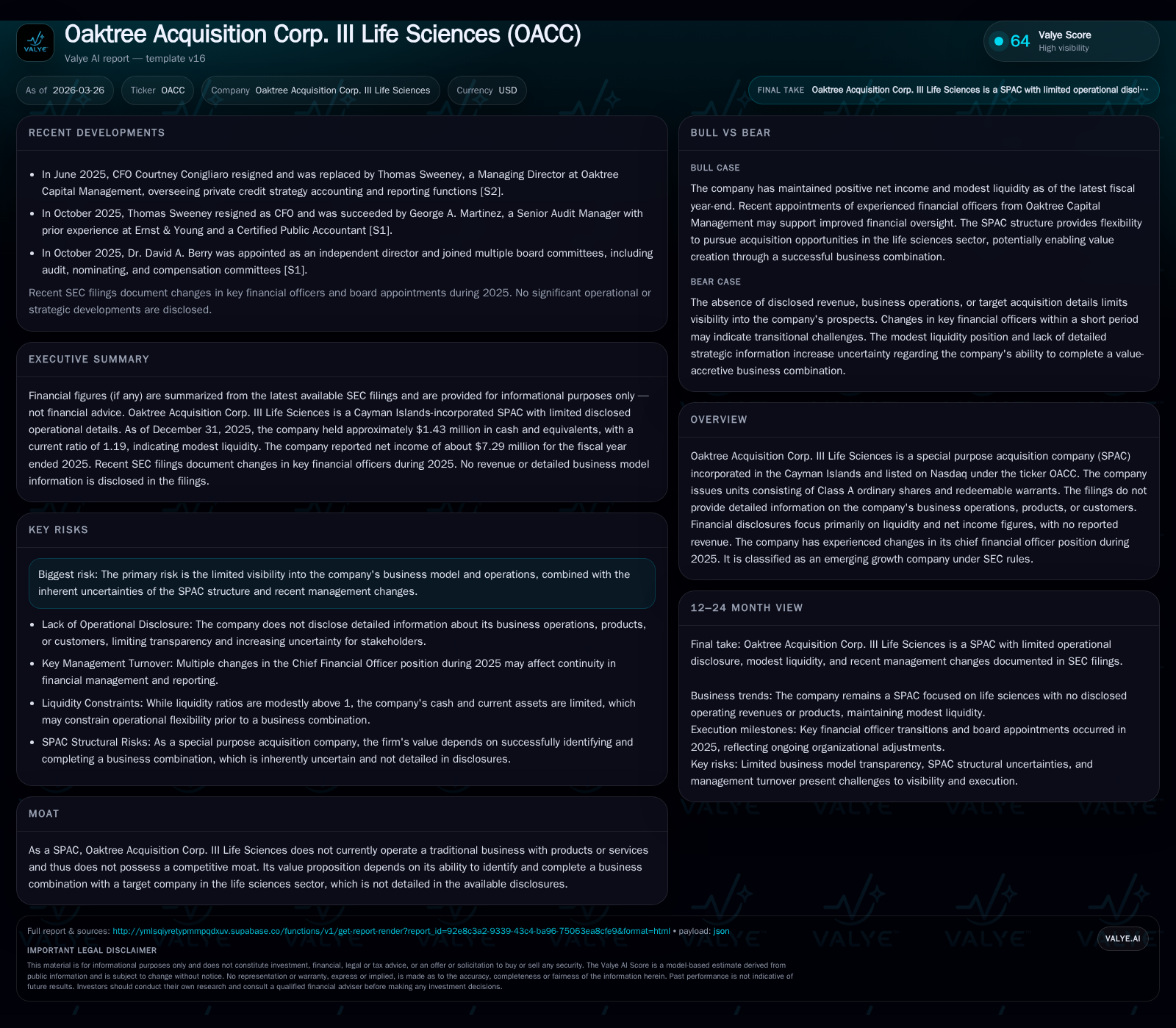
Oaktree Acquisition Corp. III Life Sciences (Nasdaq: OACC) operates as a special purpose acquisition company (SPAC) focused on acquiring a life sciences target. With no operating revenues, its historical performance reflects typical SPAC liquidity management and administrative expenses leading to a net income influenced by non-operational items. The company’s growth prospects depend entirely on identifying and consummating a business combination, with key governance and management changes occurring in 2025. Cash resources remain modest, with no dividends or buybacks planned, underscoring the imperative for a value-driving acquisition.
Company Overview and Structure
Oaktree Acquisition Corp. III Life Sciences (ticker: OACC) is a Cayman Islands exempted SPAC publicly traded on Nasdaq since its IPO in October 2024 [S1]. Designed exclusively to identify and merge with a life sciences company, it currently holds no operating subsidiaries or revenue-generating assets. The firm's business model is thus limited to managing liquidity and preparing for an initial business combination within the parameters set by its offering documents.
Historical Performance and Financial Overview
Reflective of typical SPAC operations prior to business combination, OACC reported no revenues through fiscal year ending December 31, 2025 [F1]. Operating income was negative $1.2 million primarily due to administrative costs. Meanwhile, net income stood positive at roughly $7.3 million—likely influenced by changes in fair value of warrants or other non-cash financial instruments rather than core operations [F1].
As of year-end 2025, the company maintained cash and equivalents at approximately $1.4 million with total current assets near $1.55 million against current liabilities of about $1.3 million, culminating in a current ratio near 1.19 [F1]. This conservative liquidity position aligns with SPAC norms intended to preserve capital until deployment.
Historical performance (annual)
| FY |
|---|
| 2025 |
Source: SEC companyfacts cache [F1].
Note: Revenue is not applicable due to the SPAC structure.
Management and Governance Changes
In June 2025, the company experienced its first CFO transition when Courtney Conigliaro resigned without conflict reasons, succeeded immediately by Thomas Sweeney from Oaktree Capital Management’s finance group [S8][S9]. Subsequently in late October 2025, Thomas Sweeney also resigned and was replaced by George A. Martinez, another senior Oaktree finance executive with public accounting background [S11][S12]. These rapid successions point towards strategic realignments as the firm prepares for a significant corporate step.
Additionally, on October 17, 2025, Dr. David A. Berry—a seasoned biotech investor and executive—was appointed as an independent director adding scientific acumen and sector insight critical for vetting potential merger candidates [S10][S14]. He serves on key board committees without receiving separate compensation.
Capital Allocation and Shareholder Rights
Consistent with early-stage SPAC practices, OACC has neither declared dividends nor engaged in share repurchases during this period [S6][S7][S8]. Capital allocation remains dedicated to preserving trust assets pending identification of a suitable business combination.
One potential investor concern centers on the warrant structure: public warrant holders face exercise restrictions contingent on registration status of underlying shares which may impair their ability to monetize holdings if registration does not occur timely [S1]. The company also retains right to redeem public warrants potentially disadvantaging warrant holders relative to private placement warrant holders who enjoy cash or cashless exercisability.
Growth Prospects and Risks
OACC’s growth outlook is entirely dependent on consummating an initial business combination within prescribed timeframes—typically up to two years post-IPO—as is common among SPACs [S1]. No target has been announced or detailed yet amid filings through Q4 2025.
Key risks stem from this uncertain pipeline alongside standard SPAC execution hazards: failure to complete a merger would trigger liquidation and return of funds net of expenses; prolonged absence of operational earnings compounds valuation ambiguity; warrant exercise mechanics may create asymmetric outcomes between sponsor insiders and public investors; recent CFO turnover could signal transitional challenges.
The company benefits from Cayman Islands tax exemption effective July 2024 for thirty years which should reduce transaction friction and enhance post-merger profitability prospects for eventual combined entities [S1]. Nonetheless, absence of disclosed synergy plans or integration paths leaves prospective investors reliant on future announcements.
What To Watch Next (Analysis)
- Announcement of definitive agreement with a life sciences target will be pivotal.
- Management stability post-CFO transition critical for executing diligence and deal steps smoothly.
- Investor reactions around warrant redemption policies could shape secondary market dynamics.
- Regulatory compliance related to securities registration essential for unlocking full warrant value.
- Potential capital raises or amendments to trust agreements indicative of changing strategic approach.
Conclusion
As a pre-combination vehicle, Oaktree Acquisition Corp. III Life Sciences presents limited conventional financial history but maintains adequate liquidity and experienced governance positioned for eventual deal execution in the life sciences sector. Its risk profile aligns tightly with typical SPAC structures emphasizing capital preservation over operating growth until merger completion. Close monitoring of forthcoming transaction disclosures will provide clearer insight into tangible value creation opportunities.
Disclaimer: This analysis is based exclusively on publicly filed data as of March 26, 2026, including SEC reports and financial statements without forecasted guidance or external news influence. It does not constitute investment advice.
Disclaimer: This is research-only, informational analysis and not investment advice. It may include AI-generated interpretation and general industry context. Always verify important details using primary sources.

Comments