
CapsoVision’s Growth Reliant on AI Integration and Colon Capsule Regulatory Milestones
CapsoVision advances its GI capsule endoscopy platform, balancing innovation investment with persistent financial and regulatory hurdles.
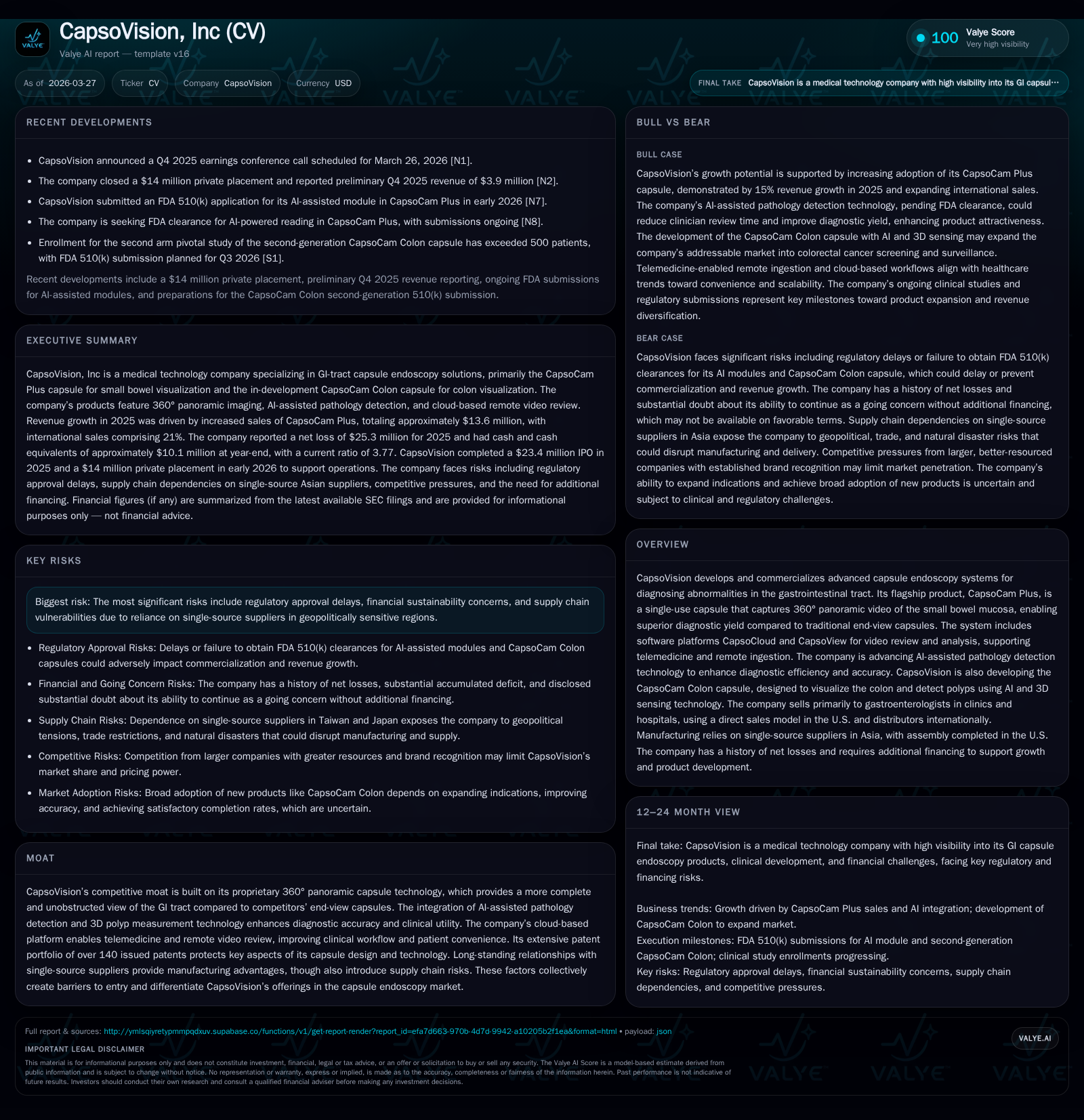
CapsoVision, a specialized medical technology company, has steadily grown revenues from its CapsoCam Plus small bowel capsule driven by increased unit sales and U.S. direct sales expansion. The company is investing heavily in AI-assisted pathology detection technology to enhance product differentiation but continues to incur substantial net losses and faces going concern risks. Future growth prospects hinge on FDA clearance of the second-generation CapsoCam Colon capsule and successful commercialization of updated AI-enabled small bowel capsules. Supply chain dependencies and competitive pressures from established players represent significant ongoing risks.
Company Overview and Historical Performance
Founded in 2005 and headquartered in Saratoga, California, CapsoVision specializes in advanced capsule endoscopy systems targeting the gastrointestinal (GI) tract. Its flagship offering is the CapsoCam Plus single-use capsule capturing a unique 360° panoramic view of the small bowel mucosa, improving diagnostic yield relative to conventional forward-viewing capsules. Coupled with proprietary software platforms such as CapsoCloud and CapsoView, CapsoVision enables remote ingestion models facilitating telemedicine workflows and asynchronous video reviews.
Financially, the company's revenues have exhibited consistent growth since initiating U.S. direct sales in 2020. For fiscal year 2025, revenue reached approximately $13.6 million representing a 15% increase over $11.8 million reported in 2024. This uplift was primarily attributable to an increase in units sold of the CapsoCam Plus capsule along with a geographical mix favoring the U.S. market which contributed about 79% of total revenue versus 77% previously [F1][S1][S16]. International sales accounted for around 21%, concentrated mainly on Europe with distribution agreements covering roughly 55 countries.
Despite top-line expansion, CapsoVision recorded a net loss of $25.3 million in 2025 compared to $19.9 million the prior year—a substantial widening indicated by its operating loss growing by almost 28%. This reflects significant investments in R&D ($18.3 million up from $15.1 million) aimed at next-generation technologies including AI integration and colon capsule development, as well as increased general & administrative expenses partly driven by costs related to compliance as a public company [F1][S12]. The company’s gross margin remained relatively stable at roughly 53%, slightly down from 54%, mainly due to increased tariffs impacting manufacturing costs as components are sourced predominantly from Asia (Taiwan and Japan) [S4][S16]. The current ratio stands robust at approximately 3.77, indicating short-term liquidity despite operational losses [F1].
Historical performance (annual)
| FY |
|---|
| 2025 |
Source: SEC companyfacts cache [F1].
Table: Summary of CapsoVision Annual Financial Performance
Business Model and Competitive Moat
CapsoVision operates primarily via two channels: direct sales within the U.S., targeting gastroenterologists in clinics and hospitals; and through exclusive distributors internationally who cover major markets including France, Germany, Colombia, along with broader geographic reach encompassing over fifty countries via distribution agreements [S1][S6][S10]. The company benefits from strong customer retention fostered through demonstrating superior diagnostic accuracy enabled by their patented panoramic imaging technology complemented by emerging AI capabilities.
Significant differentiation stems from their patented portfolio securing unique features like panoramic visualization enhancing lesion detection rates against flat or forward-viewing capsules prevalent among competitors such as Medtronic’s PillCam series [S21]. The integration of AI-assisted pathology detection tools proposes workflow efficiencies by reducing physician video review times while enhancing sensitivity for suspected abnormalities—expected commercially available post-FDA clearance targeted mid-2026 for the updated small bowel capsule product line [S1][S22]. Furthermore, cloud-based video storage platforms facilitate data centralization necessary for ongoing machine learning improvements while supporting telemedicine accessibility.
Future Growth Prospects: Pipeline Development & Regulatory Pathway
Expanding beyond small-bowel diagnosis remains critical to diversifying CapsoVision’s revenue streams.
The company's pipeline focus centers notably on the CapsoCam Colon capsule designed to visualize the colon using advanced features including AI-driven polyp detection combined with an embedded three-dimensional sensor to assess polyp size—a key cancer risk metric [S1][S22]. Initial FDA submissions for the first-generation colon capsule encountered regulatory challenges leading management to cease that effort in favor of developing a superior second-generation solution boasting enhanced imaging quality, broader field-of-view optics, and refined AI algorithms.
A pivotal clinical trial's second arm has enrolled over 500 patients across approximately twenty U.S.-based sites with plans for full enrollment (~800 patients). Management anticipates submitting this next-generation CapsoCam Colon capsule for FDA premarket clearance (510(k)) during Q3 of calendar year 2026 [S1]. Given this timetable, commercial launch would likely not materialize until late-2026 or early-2027.
Complementing colon capsule development are continued enhancements on the small bowel platform incorporating AI pathology detection capabilities submitted for FDA review late last year with clearance expected around mid-2026—a pivotal step toward closing competitive gaps against rivals like Ankon who have already launched FDA-cleared AI-enabled products internationally reinforcing urgency for CapsoVision to reach market entrance promptly [S1][S13][S21].
Longer term ambitions include exploratory indications such as pancreatic cancer screening via upper GI visualization capsules leveraging early pancreatic lesion detection algorithms under evaluation for breakthrough device designation—though regulatory complexity suggests timelines are highly uncertain at present [S1].
Capital Allocation & Liquidity Outlook
CapsoVision's balance sheet illustrates ongoing strain amid intensifying R&D funding needs coupled with limited operational cash flow generation.
Cash reserves stood at approximately $10.2 million at year-end December 31, 2025 following a public offering raising $23.4 million earlier that year alongside a recent private placement amounting to $14 million closed March 16, 2026 aimed at bolstering funds for clinical trials and product development activities scheduled throughout calendar years ’26 into ’27 [F1][N2][S1].
Free cash flow remains negative at approximately -$22.95 million annually reflecting heavy investment cycles coinciding with early-stage commercial penetration phases typical for medtech firms advancing disruptive diagnostics innovations without scale economies yet fully realized [F1].
The audited financial statements highlight substantial doubt regarding CapsoVision’s ability to continue as a going concern absent additional financing or meaningful revenue acceleration given accumulated deficits totaling roughly $155.7 million as of end-2025 which embody historic losses accrued over development milestones spanning nearly two decades [F1][S1].
Capital allocation priorities emphasize accelerating regulatory approvals particularly for colon capsule submissions while expanding sales infrastructure globally aligned with commercial roll-outs post-clearance—all bearing significant expense headwinds counterbalanced by potential step-function revenue contributions upon product launches.
Industry Context & Competitive Dynamics (Analysis)
The GI tract diagnostic space confronts increasing adoption of non-invasive screening modalities as alternatives or adjuncts to conventional optical colonoscopy given patient preference profiles favoring less discomfort or sedation requirements.
Key incumbents include Medtronic's PillCam portfolio commanding strong brand loyalty buttressed by first-mover advantage and entrenched supply contracts particularly within large GI practices across major U.S regions creating high switching costs restricting new entrants’ penetration velocity [S21]. Asian manufacturers such as Ankon leverage aggressive pricing strategies supported by state-backed scale economies complicating profitability models outside core domestic markets yet pressuring global pricing norms broadly within capsule endoscopy sectors—an ongoing challenge for mid-sized firms like CapsoVision aiming at innovation-driven premium differentiation rather than pure cost competition [S13][S21].
Simultaneously emerging reimbursement scrutiny amid evolving healthcare policies—especially within Medicare/Medicaid frameworks—and intensified GPO negotiating leverage constrains net realizable prices further underscoring execution risks tied closely to securing coverage decisions favorable to novel devices beyond existing use cases where reimbursement codes already exist implicitly affect adoption curves negatively if not proactively managed through payer engagement strategies [S6][S14][S15].
Risks Summary
Critical risks identified pertain primarily to:
- Regulatory uncertainty delaying product clearances which compresses commercialization timelines adversely impacting revenue prospects,
- Persistent financial sustainability concerns reflected in sizeable accumulated deficits coupled with narrow cash runway necessitating timely capital raises,
- Concentrated single-source Asian suppliers posing supply chain disruption vulnerabilities especially amidst geopolitical frictions affecting Taiwan and Japan where key components and assembly operate,
- Intense competition featuring incumbents with greater scale/resource advantage coupled with more mature AI offerings,
- Reimbursement variability potentially dampening provider uptake given bundled payment complexities,
- Execution risk associated with transitioning international business models from distribution towards direct sales channels which may disrupt existing customer relationships temporarily,
- Dependence on third-party clinicians for video reading services exposing operational continuity risks given regulatory environment governing such engagements.
These factors collectively require vigilant operational management alongside robust financial planning to mitigate adverse implications on growth aspirations detailed herein [S8][S14][S19][S20].
What to Watch Next (Analysis)
Investor attention should focus sharply on:
- FDA feedback regarding Q3/2026 submission of the second-generation CapsoCam Colon capsule pivotal trial results,
- Mid-2026 anticipated clearance timeline of the AI-assisted pathology detection update for CapsoCam Plus,
- Progress against patient enrollment targets within ongoing clinical studies particularly relating to colon capsule validation,
- Effectiveness in expanding direct sales capability internationally especially within major European markets transitioning from distributor partnerships,
- Movements in cash position relative to operating burn rate prompting potential capital market activity,
- Competitive landscape evolution specifically relating to rival advancements in integrated AI diagnostics impacting market share dynamics.
Conclusion
CapsoVision occupies a niche but promising segment within GI medical diagnostics harnessing panoramic imaging combined with advancing AI analytics poised to improve clinical outcomes through better polyp detection efficiency and accuracy. However, its historical financial performance marked by sustained losses compounded by regulatory headwinds tempers near-term optimism absent successful milestone achievements forthcoming primarily linked to colon capsule regulatory pathways and AI product launches. Supply chain concentration risk combined with intensifying competition underscores continuing challenges requiring strategic focus on operational resilience paired with effective capital deployment. Accordingly, maintaining awareness of key developmental progressions alongside financial health trends remains essential when assessing enterprise trajectory ahead.
Disclaimer: This analysis does not constitute investment advice or recommendations but reflects information available as of March/April 2026 derived from publicly filed sources.
Disclaimer: This is research-only, informational analysis and not investment advice. It may include AI-generated interpretation and general industry context. Always verify important details using primary sources.

Comments