
Polyrizon's Dual-Platform Hydrogel Strategy Faces Financial and Regulatory Crossroads
Innovative nasal spray hydrogel technologies underpin Polyrizon’s prospects, yet mounting losses and regulatory hurdles challenge near-term advancement.
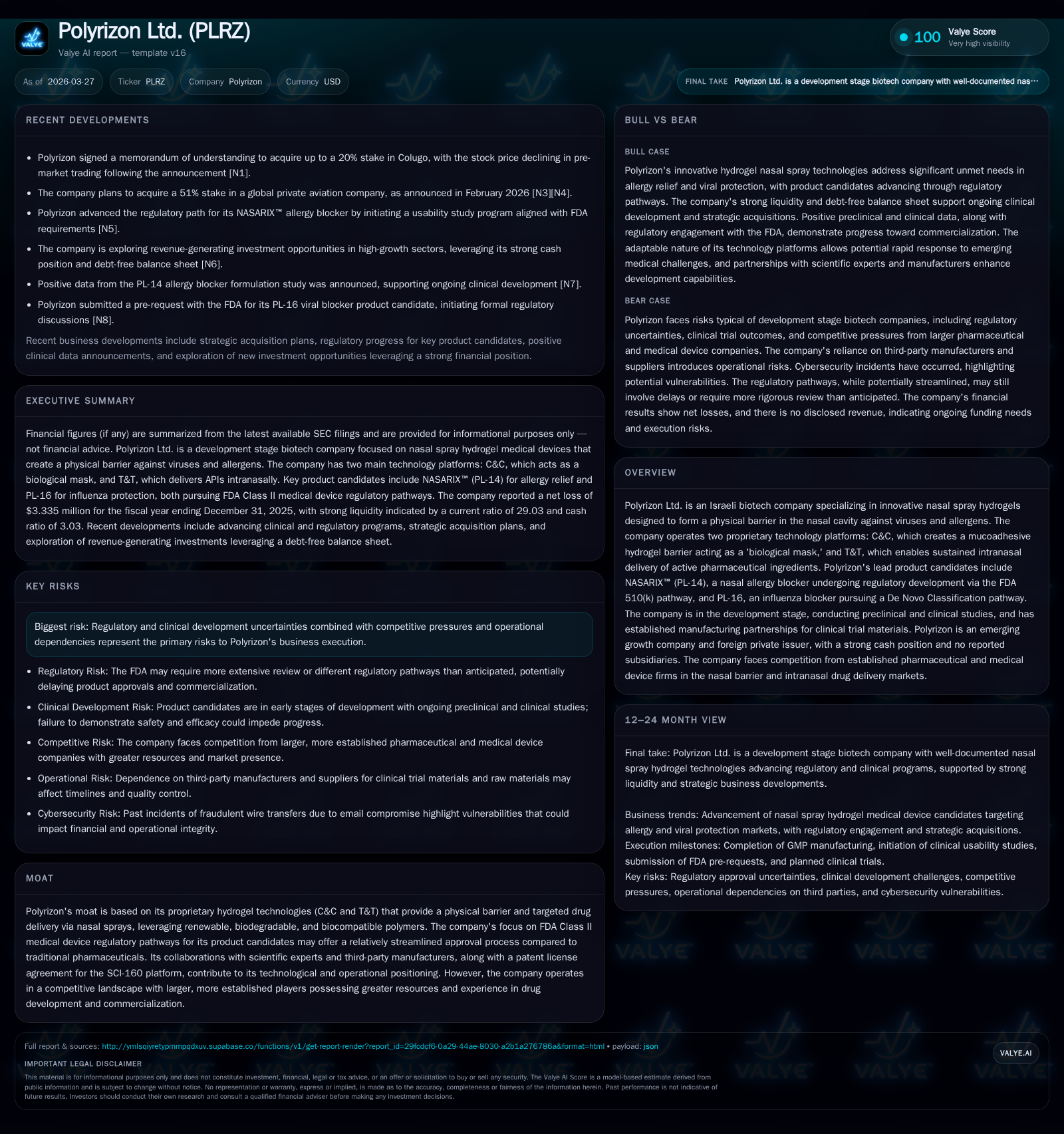
Polyrizon Ltd. leverages two proprietary hydrogel platforms—C&C and T&T—to develop nasal sprays acting as physical barriers and sustained drug delivery systems. Despite promising technology with distinct regulatory pathways via FDA Class II medical device designations, the firm’s operating losses deepened substantially in fiscal 2025, reflecting increased clinical development expenses. Strong liquidity cushions current cash burn, but regulatory uncertainty, competition from entrenched pharmaceutical players, and recent operational setbacks necessitate close monitoring of clinical milestones and capital management. Upcoming results from US clinical trials and regulatory submissions remain critical to the company’s growth trajectory.
Evolution of Polyrizon’s Hydrogel Technology Platforms
Polyrizon Ltd. integrates biotechnology innovation with medical device engineering through two proprietary hydrogel platforms designed for intranasal applications: the C&C (Contain & Cover) biological mask technology and the T&T (Trap & Treat) drug delivery system. The C&C platform utilizes renewable polymers forming a mucoadhesive hydrogel that creates a physical shield along the nasal epithelium, functioning as a 'biological mask' against airborne pathogens such as viruses and allergens without systemic exposure.
Complementing this is the T&T platform engineered for sustained release kinetics of active pharmaceutical ingredients directly within the nasal cavity, enhancing localized bioavailability while minimizing systemic side effects by modulating mucociliary clearance.
Both platforms have undergone preclinical safety and efficacy evaluations aligned with GLP standards as part of regulatory submissions [S1]. Polyrizon's lead candidates—NASARIX™ (PL-14), targeting allergy prevention via FDA 510(k) clearance typical for Class II devices, and PL-16, aimed at influenza virus blockade via De Novo classification—follow distinct regulatory pathways that may accelerate market entry relative to conventional pharmaceutical approvals [N1][S19].
Financial Performance Overview
Fiscal year 2025 saw operating income deteriorate sharply to a loss of $6.25 million from $1.3 million in the prior year, a decline of approximately 380% driven by increased R&D and clinical trial expenditures [F1]. Net loss more than doubled to about $3.3 million compared to the previous period. Operating cash flow also worsened significantly to -$4.53 million from -$1.15 million year-over-year [F1]. Capital expenditures remained minimal at $7,000 but increased relative to prior years.
Despite elevated cash burn typical of clinical-stage biotechs, Polyrizon preserved strong liquidity with a current ratio above 29x (current assets of $12.86 million versus current liabilities of $443 thousand), supported by equity rising markedly from $5.29 million in FY2024 to nearly $21 million at end-2025 [F1]. This financial position provides runway for ongoing development activities without immediate funding concerns.
Historical performance (annual)
| FY | Net ($mm) | CFO ($mm) | OpInc ($mm) | Capex ($) | Net YoY |
|---|---|---|---|---|---|
| 2025 | -3 | -5 | -6 | 7000 | -115.9% |
| 2024 | -2 | -1 | -1 | 3000 |
Source: SEC companyfacts cache [F1].
Capital returns and efficiency (annual)
| FY | FCF ($mm) | ROE% |
|---|---|---|
| 2025 | -5 | -15.9 |
| 2024 | -1 | -29.2 |
Source: SEC companyfacts cache [F1].
Approximate return on equity stood at -15.9%, reflecting developmental net losses against an expanded equity base [F1].
Regulatory Environment
Polyrizon's product development is shaped by FDA Class II medical device pathways distinct from traditional drug routes. The 510(k) clearance for NASARIX™ relies on demonstrating substantial equivalence to predicate devices facilitating potentially expedited review; meanwhile PL-16 pursues De Novo classification suitable for novel devices without existing predicates [N1][S19]. Both require comprehensive technical validation including biocompatibility testing and risk assessments per FDA guidance.
The company faces regulatory risks including evolving government pricing regulations affecting reimbursement frameworks such as Medicaid rebates and Medicare adjustments [S4][S5][S6]. Compliance complexities extend to anti-kickback statutes and false claims laws carrying significant penalties including monetary fines and exclusion from federal healthcare programs [S9][S11]. Post-market surveillance obligations may impose additional resource demands.
Clinical Development Progress
Recent SEC filings highlight agreements with leading global preclinical CROs advancing toxicology and pharmacodynamics evaluations essential for IND-enabling studies ahead of human trials [S2]. Engagement with Eurofins AmatsiAquitaine S.A.S., a recognized CDMO, supports GMP manufacturing readiness for clinical trial materials required in planned U.S.-based studies [S3]. These partnerships help mitigate common developmental bottlenecks related to manufacturing scale-up and trial resource provisioning.
Capital Allocation and Shareholder Returns
Equity capital increased substantially supporting growth investments while cash reserves stood at approximately $1.31 million despite operational deficits [F1]. Capital expenditures remain focused on research activities over fixed asset investments consistent with early-stage biotech norms [F1][S22]. No dividends or share repurchases have been issued aligning with reinvestment strategies during this emerging growth phase [F1][S20].
Risk Factors: Cybersecurity Incidents and Competitive Landscape
Polyrizon encountered significant cybersecurity incidents involving business email compromise resulting in fraudulent wire transfers totaling approximately $464K in late 2025. These events prompted swift remediation including enhanced transfer controls and ongoing FBI cooperation evidencing strong governance response [S15].
Legal exposures also arise from complex pharmaceutical regulations including anti-kickback statutes and government price reporting laws that could yield substantial penalties or program exclusions if violated [S4][S5][S6][S9][S12]. Environmental compliance represents additional contingent liabilities.
Competition is intense from established pharmaceutical companies in intranasal corticosteroids and barrier products markets. Differentiation rests on proprietary polymer technologies validated through rigorous clinical data demonstrating safety and efficacy advantages over incumbent offerings [S17].
Outlook: Key Milestones Ahead
Upcoming catalysts include U.S. clinical trial data releases for NASARIX™, FDA feedback on De Novo submissions for PL-16, as well as developments tied to strategic investments such as the memorandum of understanding for acquiring up to a 20% stake in Colugo—a transaction that has already influenced market sentiment [N1]. Progress on these fronts will be pivotal for sustaining investor confidence and advancing commercialization prospects.
This analysis is based solely on publicly available information as of March 27, 2026. It does not constitute investment advice or recommendations but aims to provide an informed perspective on Polyrizon Ltd.'s technological positioning, financial health, regulatory environment, risks, and prospective developments within its niche biotech domain.
Disclaimer: This is research-only, informational analysis and not investment advice. It may include AI-generated interpretation and general industry context. Always verify important details using primary sources.

Comments