
Quoin Pharmaceuticals: Clinical Advances and Capital Challenges Shaping Rare Disease Innovation
Quoin Pharmaceuticals is advancing QRX003 towards pivotal Phase 3 trials while managing financial pressures typical of clinical-stage biotech firms.
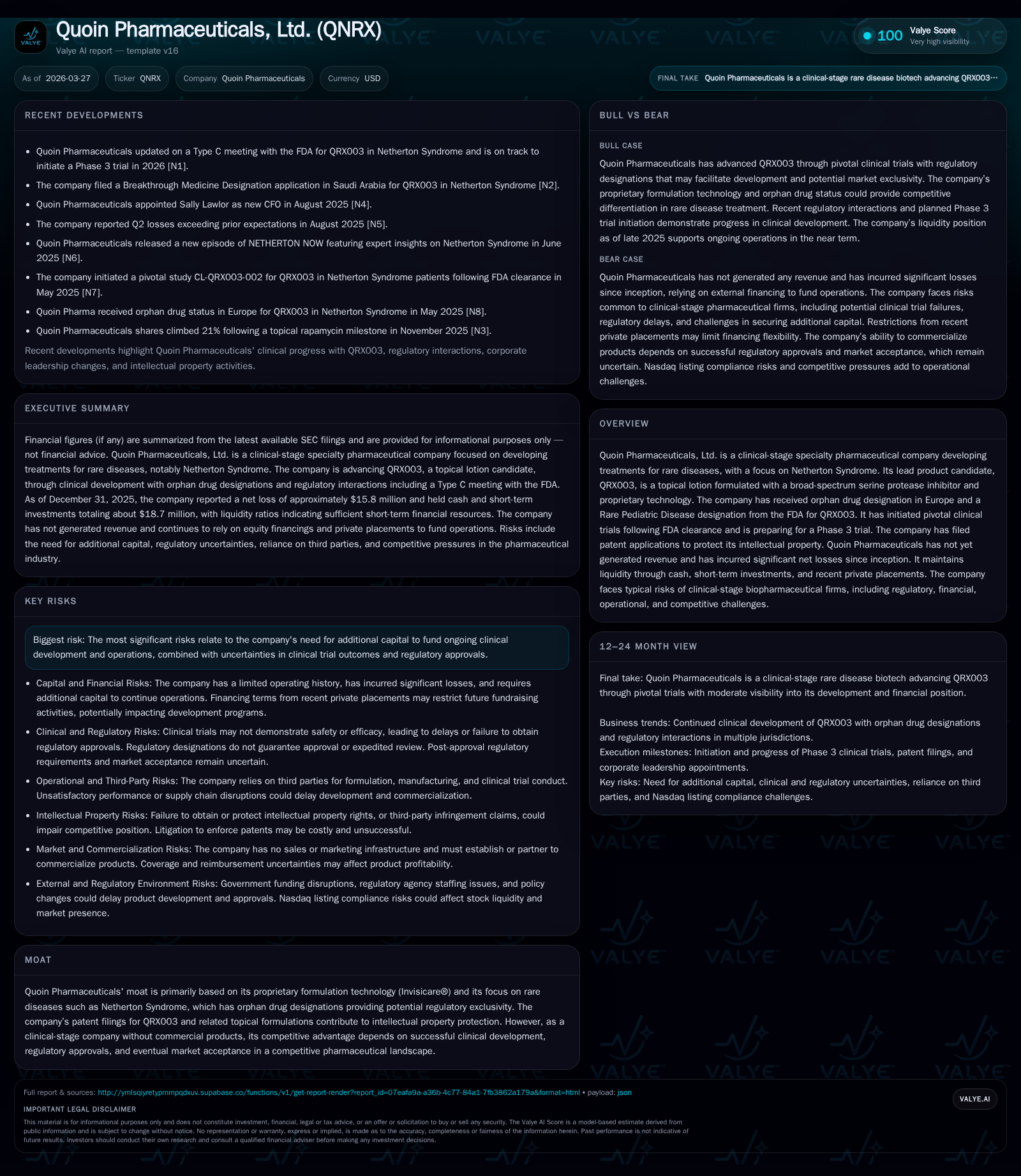
Quoin Pharmaceuticals, Ltd. is a clinical-stage specialty pharma company focused on rare diseases, notably Netherton Syndrome through its lead candidate QRX003. The company’s progress includes orphan drug designations in multiple jurisdictions and initiation of Phase 3 pivotal trials following FDA clearance in 2026. However, sustained operating losses exceeding $15 million in FY2025 and constraints on capital raising highlight substantial liquidity risks. Intellectual property protections through its Invisicare® technology bolster its moat, but continued clinical and regulatory success is essential to realize value.
From Inception to Present: Financial Trajectory and R&D Focus
Quoin Pharmaceuticals has consistently operated as a pre-revenue clinical-stage entity since inception. Its financial trajectory reflects deepening investment into R&D activities aligned with advancing their lead therapeutic candidate QRX003 through pivotal stages. As of fiscal year-end 2025, the company reported a net loss of approximately $15.8 million—marking a sharp decline of 76.3% compared to the prior year’s loss of $8.96 million [F1]. Operating cash flow reveals a similar trend, deteriorating by over 72% to nearly -$13.5 million in FY2025 from about -$7.86 million in FY2024 [F1]. These figures underscore intensifying resource deployment towards clinical development programs.
The company discloses no revenue streams currently as product candidates remain investigational with commercial launch contingent on regulatory approvals yet to be secured [S1]. Financial sustainability presently relies heavily on equity financing rounds and private placements that bolster available liquidity to fund operations [S7].
Historical performance (annual)
| FY | Net ($mm) | CFO ($mm) | Net YoY |
|---|---|---|---|
| 2025 | -16 | -14 | -76.3% |
| 2024 | -9 | -8 | -3.2% |
| 2023 | -9 | -8 | +7.4% |
| 2022 | -9 | -8 |
Source: SEC companyfacts cache [F1].
Capital returns and efficiency (annual)
| FY | ROE% |
|---|---|
| 2025 | -120.5 |
| 2024 | -97.4 |
| 2023 | -153.4 |
| 2022 | -126.7 |
Source: SEC companyfacts cache [F1].
Table: Quoin Pharmaceuticals’ key annual financial metrics illustrating deepening net losses and operating cash outflows aligning with R&D focus [F1].
QRX003 and Proprietary Technology: Differentiating in Orphan Drug Development
QRX003 represents Quoin’s flagship asset—a topical lotion containing a broad-spectrum serine protease inhibitor tailored for Netherton Syndrome (NS), a rare dermatological disorder characterized by defective skin barrier function [S9]. This molecule is delivered utilizing the company's proprietary Invisicare® technology platform which enhances dermal penetration and stability for therapeutic compounds.
Regulatory authorities have granted orphan drug designation for QRX003 in both Europe and the U.S., providing exclusivity mechanisms under the orphan drug framework aimed at encouraging development directed at rare diseases [S9][N1]. Additionally, the FDA has conferred Rare Pediatric Disease (RPD) designation—a status allowing eligibility for potential priority review vouchers upon approval although it does not expedite the review timeline per se [S11]. Such designations form an important part of Quoin’s intellectual property moat by protecting market share for an extended period post-approval.
The utilization of a serine protease inhibitor addresses the underlying pathophysiology of NS where excessive protease activity disrupts skin integrity—a mechanistically distinct approach differentiating QRX003 from symptomatic treatments [N1]. The sector increasingly values these targeted modalities given rare diseases often lack approved therapies.
Regulatory Interactions and Progress Towards Phase 3 Trials
Following recent Type C meetings with the FDA held in early 2026, Quoin confirmed clearance to initiate Phase 3 pivotal trials for QRX003 scheduled within this year [N1][S1]. Two whole-body pivotal studies are underway with anticipated completion of patient enrollment slated for H1 2026.
Top-line data readouts are expected in H2 2026; subject to positive outcomes contributing efficacy and safety validation consistent with regulatory expectations [N1]. Contingent upon these results, NDA filings are planned for late 2026 or early 2027 across major territories including the United States [S9][N1].
Importantly, these milestones bear significant weight for transitioning from development to commercial stages but remain dependent on favorable trial endpoints given the high attrition rates typical within specialty pharmaceutical clinical pipelines.
Expected Capital Demands and Funding Strategies
Quoin’s liquidity profile at end FY2025 comprised roughly $3.8 million in cash equivalents accompanied by short-term investments sufficient to maintain operational continuity for the ensuing twelve months as stated in filings [F1][S7]. However, increased spending levels attributed to late-stage clinical development will necessitate additional funding rounds.
Recent private placements closed in Q4 2025 injected critical capital but introduced notable covenants limiting certain financing activities such as equity offering price floors ($8.25 minimum per share post-initial standstill) and lockout periods constraining variable rate financings [S12][S15][S22]. These provisions combined with a prior reverse stock split (35-for-1 conducted April 9th, 2025) implemented to regain Nasdaq minimum bid compliance impose 'operating leverage' hurdles affecting capital markets access and investor appetite [S2][S18].
Moreover, Nasdaq regulations prevent further reverse splits within specified timeframes without risking delisting notices if minimum bid conditions falter again [S2][S18]. This scenario elevates refinancing risk potentially compelling less favorable or dilutive terms to satisfy cash needs required for completing Phase 3 trials and preparing commercialization infrastructure.
Financial Health Snapshot: Cash, Liquidity, and Operating Losses
Evaluating solvency metrics reveals Quoin holds a current ratio around 3.61 as of December 31st, 2025—indicative of adequate short-term liquidity to cover liabilities despite significant net losses [F1]. Equity increased to approximately $13.1 million from $9.2 million last year driven largely by financing inflows amid operational deficits.
Still absent revenues from commercial products imply an approximate return on equity (ROE) of negative 120%, reflecting extensive earnings deficits relative to shareholder equity base during FY2025 [F1]. Operating cash flow outflows near $13.5 million reinforce reliance on external funding sources rather than internal generation.
This financial profile typifies clinical-stage specialty pharmaceutical firms where capital-intensive R&D dominates resource allocation well before revenue ramps occur post-market entry.
Intellectual Property Protections Strengthening Moat
Quoin emphasizes safeguarding QRX003’s competitive position via patents covering both its active ingredient formulation incorporating broad-spectrum serine protease inhibitors as well as the proprietary Invisicare® delivery technology system [S6][S9]. These patent applications span composition-of-matter claims along with manufacturing protocols designed to deter generic or biosimilar encroachment.
Combined with statutory regulatory exclusivities afforded under orphan drug designations—usually extending market protection for up to seven years in the U.S.—these barriers enhance market entry hurdles for potential competitors thereby reinforcing Quoin's intellectual property moat [S9]. Nonetheless patent enforcement risks remain inherent along with periodic challenges that could erode exclusivity if litigation arises or patent validity is compromised.
Key Risks Facing Clinical Advancement and Market Entry
The company candidly outlines multiple risk vectors characteristic of specialized biopharma development:
- Uncertainty surrounding clinical trial success including safety signals or insufficient efficacy that could delay or halt product advancement [S1][S4].
- Regulatory approval unpredictability heightened by potential FDA staffing limitations tied to government shutdowns threatening timely reviews [S4][S16].
- Dependency on limited third-party suppliers and contract research organizations impacting manufacturing scale-up or trial execution reliability [S6].
- Competition against both larger biotechs and emerging entrants also targeting rare dermatological disorders potentially fragmenting market opportunity [S11].
- Necessity for incremental capital amidst restrictive Nasdaq listing rules raising dilution risk while possibly limiting access to new funds at acceptable terms [S2][S14][S18].
- No historical manufacturing performance at scale which increases execution risk transitioning from trials to commercial supply chains.
Such factors compound the inherent uncertainties differentiating early stage biotech ventures where upside is balanced by binary catalysts linked closely to scientific validation events.
What Analysts and Investors Should Watch Next
While formal management guidance remains cautious without explicit numeric targets beyond milestone intentions [N1], key developments warrant monitoring include:
- Confirmation of Phase 3 trial commencement dates following patient enrollment progression through mid-2026.
- Receipt of top-line efficacy/safety data scheduled for second half of calendar year impacting NDA submission planning.
- FDA feedback post-Type C meeting clarifying regulatory pathway timelines or requirements shaping approval trajectory.
- Outcomes of ongoing liquidity management efforts addressing financing covenant restrictions amidst evolving capital markets dynamics.
- Developments regarding international regulatory designations such as Breakthrough Medicine Designation applications filed with authorities like Saudi Food & Drug Authority potentially expediting regional approvals [N1][S19].
- Market response relative to trading volumes influenced by reverse split legacy effects combined with Nasdaq listing status oversight risks observed in recent quarters.
Overall these catalysts outline the inflection points defining Quoin’s path from clinical innovation towards potential commercialization in an intensely competitive rare disease space where treatment options remain scarce.
This analysis provides an independent review based solely on publicly available data including SEC filings and verified news reports as of March 27th, 2026. It contains no investment recommendations.
Disclaimer: This is research-only, informational analysis and not investment advice. It may include AI-generated interpretation and general industry context. Always verify important details using primary sources.

Comments