
Rani Therapeutics Builds on Oral Biologics Platform with Strategic Growth Initiatives
Rani Therapeutics is leveraging its innovative RaniPill oral delivery technology and strategic partnerships to advance clinical-stage biotherapeutics while navigating financial and regulatory challenges.
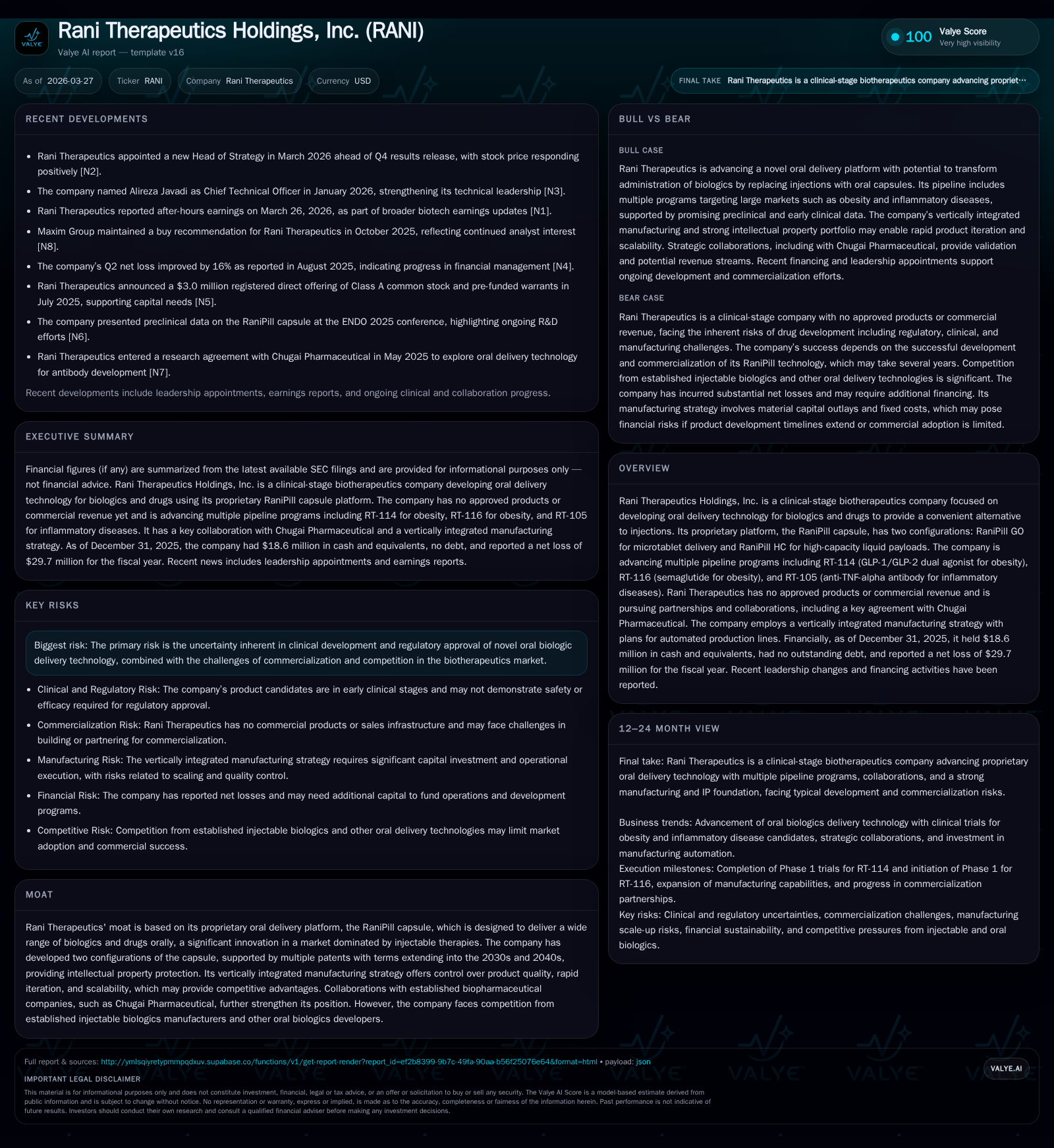
Rani Therapeutics is pioneering a transformative shift in biologic drug delivery through its proprietary RaniPill technology, aimed at replacing injections with oral capsules capable of delivering a broad range of biologics at high bioavailability. While still pre-commercial, the company has demonstrated steady financial improvement marked by narrowing operating losses and reduced cash burn over recent years, underscoring disciplined capital allocation amid substantial R&D investment. The recent collaboration with Chugai Pharmaceutical and ongoing clinical programs such as RT-114 for obesity signal potential catalysts, though regulatory, clinical validation, and commercialization execution remain key risks to watch.
Transforming Biologic Delivery: The RaniPill Platform’s Journey
Rani Therapeutics holds a unique position in the biopharmaceutical landscape through its proprietary RaniPill capsule, designed to facilitate the oral delivery of biologics—a market segment historically dominated by injectable formulations [S1]. This drug-agnostic platform consists of two configurations: the RaniPill GO, engineered for microtablet forms up to 3 mg, and the RaniPill HC (high capacity), which can carry liquid payloads reaching approximately 200 μL with high bioavailability.
The RaniPill GO formulation completed three Phase 1 clinical trials demonstrating feasibility in microtablet delivery. Complementing this, the RaniPill HC has shown promising preclinical results with various antibodies and peptides, validating its versatility across large molecule classes [S1]. In December 2025, the company initiated a Phase 1 trial for RT-114—a GLP-1/GLP-2 dual agonist encapsulated in the RaniPill HC addressing obesity—a therapeutic area where oral administration could unlock significant patient adherence improvements over injections.
This pill-based delivery approach capitalizes on enhanced bioavailability enabled through targeted capsule design innovations that overcome enzymatic degradation and absorption barriers in the gastrointestinal tract—a core obstacle for oral biologic platforms. Proprietary patents anchored globally extend into the late 2030s to mid-2040s, protecting device design and payload applications [S19]. By providing an alternative to injectable therapies spanning antibodies to oligonucleotides, Rani’s technology could significantly broaden clinical application scope.
Historical Financial Performance: Progress Toward Sustainability
Financially, Rani Therapeutics remains characteristic of a clinical-stage biotech firm balancing innovation-driven expenses with operational discipline. Operating income losses narrowed materially from -$66.1 million in FY2023 to -$38.3 million in FY2025—a near 42% reduction over two years—reflecting operational efficiencies despite persistent investment in research and development [F1]. Net income has stabilized around negative $30 million annually since FY2022.
Operating cash flows showed marked improvement from -$51.2 million in FY2023 to -$18.7 million in FY2025—a greater than 60% reduction—indicating improved cash management and reduced burn rate [F1]. Capital expenditures contracted sharply from $1.6 million in FY2022 to under $90,000 by FY2025, suggesting scaled-back fixed investments as manufacturing capacity approaches steady state or more automation gains are absorbed [F1].
Year-over-year operating income improved +28% between FY2024 and FY2025, signaling momentum toward narrowing development losses; however negative free cash flow remains entrenched at about -$18.8 million per annum considering ongoing operating deficits [F1]. Cash reserves as of December 31, 2025 stood at $18.6 million with current ratios exceeding 4x —comfortably covering short-term liabilities [F1]. These figures outline a trajectory of moderated spend without relinquishing critical pipeline progression.
Historical performance (annual)
| FY | Net ($mm) | CFO ($mm) | OpInc ($mm) | Capex ($) | Net YoY |
|---|---|---|---|---|---|
| 2025 | -30 | -19 | -38 | 88000 | +1.1% |
| 2024 | -30 | -35 | -53 | 268000 | +11.6% |
| 2023 | -34 | -51 | -66 | 1229000 | -11.1% |
| 2022 | -31 | -47 | -63 | 1619000 |
Source: SEC companyfacts cache [F1].
Capital returns and efficiency (annual)
| FY | FCF ($mm) | ROE% |
|---|---|---|
| 2025 | -19 | -89.9 |
| 2024 | -36 | -1506.9 |
| 2023 | -52 | -264.0 |
| 2022 | -48 | -83.0 |
Source: SEC companyfacts cache [F1].
Operating income improved steadily alongside continued negative net income reflecting early development stage loss trends.
Pipeline Developments and Strategic Collaborations Shaping Growth Trajectory
Rani’s pipeline focuses primarily on leveraging its platform to address markets with unmet needs or where oral dosing can materially improve therapeutic uptake. In addition to RT-114 (the GLP-1/GLP-2 dual agonist for obesity), pipeline assets include RT-116 (oral semaglutide also targeting obesity) and RT-105 (an anti-TNF-alpha antibody aimed at inflammatory conditions) [S1]. This suite exemplifies the platform’s flexibility from microtablets to high-capacity injections equivalency.
Partnerships play an essential role in de-risking commercialization efforts and accelerating market reach. Notably, a key collaboration agreement signed with Chugai Pharmaceutical Co., Ltd., encompasses development alongside Chugai’s proprietary antibody candidate for hemophilia using the RaniPill HC device [S11],[N2]. The deal involved a $10 million upfront payment received partly as cash with remaining receivables pending tax clearance.
Under this collaboration framework are sizeable milestone payments approaching $175 million across technology transfer achievements ($18M), development milestones ($57M), sales-based triggers ($100M), plus tiered single-digit royalties upon product approval [S11]. Such arrangements exemplify biotechnology industry norms where platform co-development reduces time-to-market risk while preserving upside potential for both parties engaged.
While other companies attempt oral biologics with chemistry-based low-bioavailability formulations or nascent alternative capsules (e.g., SOMA/LUMI devices from Novo Nordisk-MIT collaborations), Rani claims superior payload versatility enabling effective delivery of large molecules comparable to injected counterparts [S29]. This differentiation might prove pivotal should clinical data validate sustained bioavailability consequential enough for label claims surpassing existing oral peptide medicines limited by sub-one percent systemic exposure levels.
Clinical Milestones to Watch: RT-114 and Beyond
Although explicit regulatory milestones or commercial launch timelines are not disclosed by management publicly beyond March 2026 interim reporting cycles [N2],[S3], Phase 1 data readouts for RT-114 represent critical near-term inflection points validating high capacity capsule feasibility delivering combined GLP receptor physiology modulation—an increasingly sought-after modality given global obesity prevalence.
Success here would not only anchor internal development confidence but serve as proof-of-concept supporting outlicensing discussions for both internal assets like RT-116/RT-105 as well as further third-party candidate incorporation onto the platform. Nevertheless, the early clinical stage mandates attention to typical biotech risks such as dose optimization challenges for oral biologics subjected to gastrointestinal variability or patient tolerability issues while adhering to FDA regulatory standards governing safety evaluations [S6],[S26].
Given respective trial phase progression pacing common in this sector compounded by iterative capsule engineering advancements underway via vertical manufacturing control (discussed below), stakeholders should monitor quarterly disclosure updates for data slides indicating pharmacokinetic profiles meeting predefined endpoints that could accelerate advancement into later phases.
Vertical Integration: Balancing Manufacturing Control with Capital Outlays
Distinctive among developing biopharma technology firms, Rani pursues a vertically integrated manufacturing strategy encompassing design through pilot production line automation internally [S9]. This enables expedited product iteration cycles critical when refining capsule mechanical properties influencing payload release kinetics impacting bioavailability metrics.
Third-party suppliers remain integral for APIs; however manufacturing processes themselves—including assembly precision affected by micron-scale capsule components—require tightly controlled environments meeting cGMP compliance obligatory before marketing authorization [S6],[S12]. Duplication avoidance of supply chain disruption justifies sizable upfront capital allocated towards automated production lines.
Capex witnessed steep declines recently—from ~$1.6M in FY2022 down to only $88K in FY2025—as foundational infrastructure was likely established earlier reducing additional buildout need; yet these capitalized assets impose fixed cost burdens limiting operating leverage benefits until commercial scale volumes materialize [F1],[S9]. Moreover,single source suppliers introduce concentration risk mitigated through maintaining trade secret confidentiality within tightly controlled manufacturing expertise layers [S19].
Overall vertical integration offers competitive advantages over licensees or contract development/manufacturing organizations that generally lack agile product refinement cycles or intellectual property securing capabilities tied directly to capsule fabrication nuances fundamental for product differentiation.
Capital Allocation Strategy Amid Negative Cash Flows
Capital management remains paramount given ongoing net losses approximating $30 million annually offset partially by shareholder equity valued near $33 million as of year-end 2025 producing an approximately -89.9% ROE reflective of typical pre-revenue biotechs heavily investing ahead of commercial returns [F1],[S8]. A current ratio exceeding four times working capital requirements affords short-term liquidity cushioning operational demands including sustained clinical trials execution.
No dividends or share buybacks have been declared nor expected due to developmental stage funding priorities focusing on maximizing runway duration vis-à-vis pipeline maturation [F1],[S8]. External financing initiatives culminated recently with multiple private placements aggregating over $60 million inclusive conversion of existing debt instruments signifying investor confidence albeit diluted amid warrant issuances bearing strike prices under dollar thresholds reflecting share price realities.[S11],[N2]
Significantly,RANI terminated its prior Tax Receivable Agreement at year-end 2025 removing contingent future tax payment obligations which enhances financial flexibility going forward absent legacy encumbrances affecting net cash generation potential.[S8]
Regulatory and Market Risks in Oral Biologics Innovation
Navigating FDA regulatory pathways required for novel device-drug combination products incorporating biologics entails heightened uncertainty including possible clinical holds affecting trial continuity alongside extensive cGMP compliance overheads rigidly enforced upon scale-up manufacturing facilities [S6],[S26]. Given precedents around FDA warning letters or product holds related to process deviations within drug-device sectors,the company must maintain robust quality assurance regimes.[S12]
Healthcare reform trends further challenge pricing power especially within U.S.-centric markets where initiatives like recent One Big Beautiful Bill Act aim at constraining reimbursement levels impacting profitability potential post-launch.Despite incentives favoring patient convenience profiles,the pharmaceutical industry faces persistent scrutiny over pricing practices translating into variable payer coverage landscapes increasing commercialization complexity.[S7],[S22]
Data privacy statutes spanning HIPAA extensions alongside EU GDPR enforcement add governance layers necessitating dedicated cybersecurity oversight embedded within executive functions underscoring risk mitigation strategies mandated by board governance committees addressing reputational risk materialization from data breaches.[S4],[S14],[S17]
Competitive dynamics remain intense within oral biotherapeutic domains arrayed against legacy injectable manufacturers who innovate only incrementally; additionally emerging competitors employing chemistry-based oral peptide technologies suffer from inadequate systemic exposure levels relative to injection comparators thereby preserving opportunities if efficacy equivalence is proven.[S29]
Outlook: Charting Pathways to Commercialization and Profitability
Looking forward,Rani Therapeutics’ near-term outlook hinges on progressing RT-114’s clinical program alongside solidifying longer-term collaborations underscored by Chugai partnership milestone achievements anticipated across technology transfer completion through commercialization scaling steps.[N2],[F1] Concurrently,maturation of automated manufacturing lines will be critical for establishing cost structures amenable to competitive pricing models necessary within constrained healthcare payment frameworks.[S9]
Despite absence of concrete guidance regarding specific phase transition timelines or expected sales inception dates,risk-benefit profile evolution from upcoming data releases will strongly influence strategic licensing conversations alongside decisions about expanding commercialization infrastructure internally versus outsourcing sales distribution functions.[S1]
Stakeholders should closely monitor quarterly SEC disclosures highlighting trial progress metrics,cost management trends,and updates surrounding broader regulatory environment adaptations relating to FDA device-biologic combinations given their outsized impact on timeline certainty.
This analysis summarizes publicly available information up to March 27th, 2026 concerning Rani Therapeutics Holdings Inc., grounded strictly on documented facts without investment advice or speculative forecasts.
Disclaimer: This is research-only, informational analysis and not investment advice. It may include AI-generated interpretation and general industry context. Always verify important details using primary sources.

Comments