
SpyGlass Pharma's BIM-IOL System Advances as a Long-Acting Glaucoma Treatment with Key Development and Commercial Risks
SpyGlass Pharma is developing sustained drug delivery technologies for chronic eye conditions, focusing on the BIM-IOL System currently in late-stage clinical trials without commercial revenues.
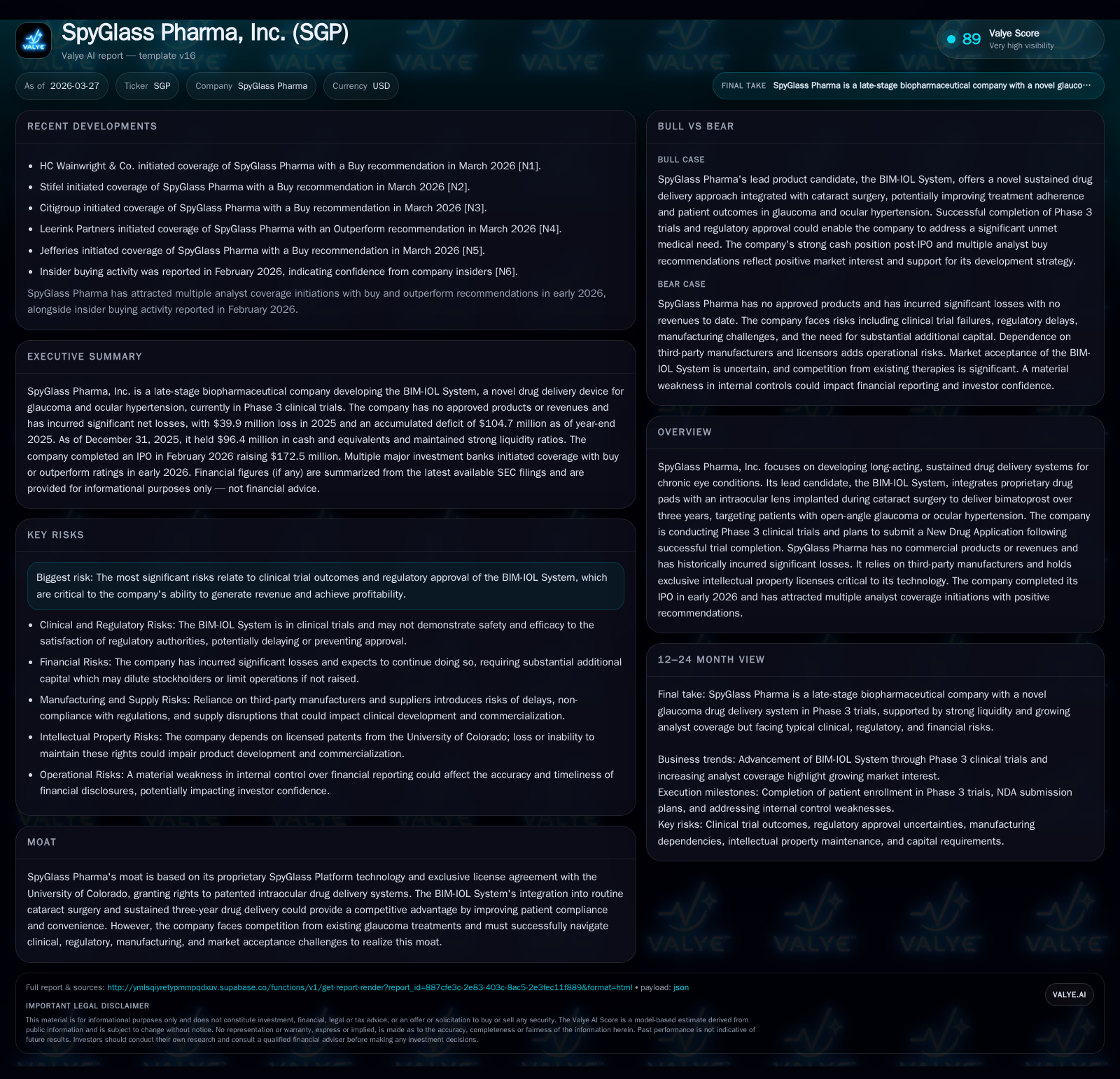
SpyGlass Pharma completed its IPO in early 2026, raising $172.5 million to support the BIM-IOL System’s Phase 3 trials, targeting sustained bimatoprost delivery over three years for glaucoma patients during cataract surgery. The company has no revenues and has sustained losses driven by increased R&D and G&A expenses. Its proprietary SpyGlass Platform is licensed exclusively from the University of Colorado, underpinning its product pipeline. SpyGlass faces risks including clinical trial outcomes, regulatory approval, manufacturing scale-up, intellectual property litigation with Glaukos Corporation, and future capital requirements.
Company Overview
SpyGlass Pharma is a late-stage biopharmaceutical company focused on developing sustained drug delivery solutions for chronic ophthalmic conditions. Its lead product candidate, the Bimatoprost Drug Pad-IOL System (BIM-IOL), integrates a proprietary drug pad attached to an intraocular lens implanted during routine cataract surgery. This system is engineered to deliver bimatoprost — an FDA-approved prostaglandin analog used topically since 2001 to reduce elevated intraocular pressure (IOP) — continuously over a three-year period targeting patients with open-angle glaucoma (OAG) or ocular hypertension (OHT).[S1]
The company completed its initial public offering (IPO) in February 2026, raising gross proceeds of approximately $172.5 million to finance late-stage development efforts.[S1]
Historical Performance and Financial Summary
SpyGlass has not generated any commercial revenues as of December 31, 2025. The company reported a net loss of $39.9 million for fiscal year 2025, reflecting continued investment in research and development alongside general and administrative expenses.[F1][S9]
Historical performance (annual)
| FY |
|---|
| 2025 |
Source: SEC companyfacts cache [F1].
Research and development expenses increased by approximately 46% year-over-year to $29.2 million in 2025 from $20.0 million in 2024,[S9] driven primarily by costs associated with clinical trials—including first-in-human feasibility studies and Phase 1/2 as well as Phase 3 programs—manufacturing supplies related to the intraocular lens and drug pads, and expanded personnel.
General and administrative expenses rose by about 73%, mainly due to increased headcount-related costs and higher legal and professional fees consistent with operating as a public company.[S9]
At December 31, 2025, cash and cash equivalents stood at approximately $96.4 million,[F1] supported by short-term investments generating interest income.[S9] The current ratio was robust at roughly 12.7x indicating strong near-term liquidity.[F1] The accumulated deficit was $104.7 million due to cumulative losses since inception.[S9]
No dividends have been paid nor share repurchases made as of the latest reporting period.[F1]
Product Development and Clinical Progress
The BIM-IOL System addresses limitations of current glaucoma care by embedding sustained release bimatoprost delivery directly into routine cataract surgery—a widely performed outpatient procedure—potentially expanding treatment access beyond specialized micro-invasive glaucoma surgery (MIGS)-trained surgeons.[S1]
Early clinical data demonstrated promising efficacy and safety: first-in-human feasibility trials showed mean IOP reductions of approximately 37% at 36 months without product-related adverse events.[S1] In Phase 1/2 multicenter randomized controlled trials evaluating two dose levels (78 mcg and 39 mcg), mean IOP reductions ranged from 36% to 37% at three months and were maintained at twelve months; nearly all treated patients (~97%) remained free from topical IOP-lowering drops at these time points.[S1]
Building on these data, SpyGlass initiated two registrational Phase 3 trials in July 2025 designed to enroll roughly 800 patients across approximately 45 sites. Enrollment is expected to conclude by the end of calendar year 2027 with plans to submit a New Drug Application under the FDA’s Section 505(b)(2) pathway in 2028 pending positive results.[S1]
Additionally, SpyGlass is developing a non-IOL-based ring-shaped bimatoprost implant intended for pseudophakic patients who have had prior cataract surgery or require retreatment post-BIM-IOL implantation; this could extend treatment options within broader patient populations.[S1]
Competitive Positioning and Intellectual Property
SpyGlass’s proprietary SpyGlass Platform technology is exclusively licensed from the University of Colorado,[S21] underpinning its sustained-release drug delivery approach embedded into ophthalmic implants.
This platform enables multi-year delivery durations surpassing existing treatments while integrating into standard cataract surgical workflows—potentially tripling the number of surgeons able to treat OAG or OHT at surgery without requiring specialized MIGS training.[S1]
Competition exists from branded drugs, generics, off-label therapies,[S13] other long-acting implants offered by established ophthalmic device companies such as Glaukos,[S12] as well as emerging therapies targeting similar indications.
Manufacturing scale-up poses execution risks given reliance on third-party suppliers.[S1] Additionally, SpyGlass faces ongoing intellectual property litigation filed by Glaukos Corporation alleging trade secret misappropriation related to competitive technologies; trial is scheduled for October 27, 2026.[S12][S15][S16]
Regulatory Environment and Risks
Approval hinges on positive Phase 3 clinical outcomes replicating earlier efficacy and safety signals.[S1] SpyGlass must navigate complex regulatory requirements including compliance with U.S. healthcare fraud and abuse laws such as the Anti-Kickback Statute,[S22] False Claims Act,[S22] REMS obligations,[S14] pricing transparency mandates,[S26] among others.
There are risks related to potential delays or difficulties scaling manufacturing under cGMP standards,[S14] uncertainties regarding coverage and reimbursement that may impact market uptake,[S14] possible post-approval safety findings necessitating further studies or restrictions,[S14] costly litigation diverting management focus[S16], as well as competitive pressures potentially limiting market penetration.[S19]
Intellectual property challenges remain material given active litigation combined with industry-wide patent validity uncertainties that could affect exclusivity duration for approved products.[S19][S20][S23][S24]
Insider buying activity reported in February indicates some internal confidence despite external uncertainties.[N6]
Capital Allocation and Financial Outlook
As a clinical-stage biotech entity without product sales or positive cash flow generation,[F1][S9] SpyGlass continues to invest heavily in R&D leading to negative free cash flow estimated at approximately $33.5 million for fiscal year ended December 31, 2025.[F1]
Capital raised through the February 2026 IPO supports ongoing clinical development activities but management indicates additional financing will be necessary ahead of any commercialization efforts.[S11]
Key financial watchpoints include:
- Completion of Phase 3 enrollment targeted for late 2027.
- Positive pivotal trial data enabling NDA submission around calendar year 2028.
- Resolution of intellectual property litigation affecting freedom-to-operate.
- Regulatory interactions shaping labeling, REMS requirements, post-marketing commitments.
- Market access strategies navigating pricing/reimbursement amid cost containment pressures.
Industry Context Analysis
Glaucoma remains a leading cause of blindness globally where patient adherence challenges limit effectiveness of daily topical therapies over decades. Innovations delivering sustained-release therapies integrated into widely performed cataract surgeries present an opportunity for paradigm shifts in disease management if successful clinically and commercially.
With millions of cataract surgeries annually in the U.S., embedding therapeutic implants during this procedure leverages procedural frequency enabling broad potential reach while addressing adherence barriers inherent in topical regimens.
Nevertheless ophthalmic drug-device combination products face demanding clinical validation thresholds alongside challenging reimbursement environments characterized by payor scrutiny over novel high-cost technologies versus generics.
Existing competition includes established long-acting ocular implants such as steroid implants or MIGS devices requiring specialized surgical skills; demonstrating clear efficacy/safety advantages over convenience alone will be critical for broad adoption.
Conclusion
SpyGlass Pharma advances an innovative approach addressing unmet needs in chronic eye disease management through a proprietary sustained drug delivery platform integrated into routine surgeries. Early clinical results are encouraging while registrational Phase 3 trials are underway funded through recent public equity issuance.
Substantial risks remain spanning pivotal trial outcomes, regulatory hurdles including post-market safety monitoring obligations, intellectual property disputes notably with Glaukos Corporation scheduled for trial later this year, manufacturing complexities involving third-party suppliers, evolving reimbursement landscapes influencing commercial viability, and execution challenges related to surgeon adoption beyond subspecialist domains.
Investors should monitor closely enrollment progress through calendar year 2027 followed by interim data readouts critical for NDA submission timing around one year thereafter. Litigation developments around October 2026 will also materially impact business assumptions regarding licensing freedom-to-operate.
Financially the company continues incurring net losses reflective of pipeline stage investments absent revenues alongside elevated administrative costs typical of transitioning to a public company environment with further capital raises anticipated before commercialization milestones.
Overall SpyGlass represents a technically differentiated endeavor pursuing clinically meaningful improvements but faces customary biopharma risks compounded by nascent commercial footprint plus specific operational dependencies requiring disciplined execution.
Disclaimer: This analysis is based solely on publicly available information as of March 27, 2026; it does not constitute investment advice or recommendations. Readers should review all risk factors disclosed by the company before forming opinions related to SpyGlass Pharma’s business prospects or securities.
Disclaimer: This is research-only, informational analysis and not investment advice. It may include AI-generated interpretation and general industry context. Always verify important details using primary sources.

Comments