
Ferroglobe PLC Faces Market Headwinds with Strategic Safeguards Fueling Recovery
After swinging from profit to substantial loss in 2025, Ferroglobe levers trade protections and energy contracts to stabilize its volatile earnings.
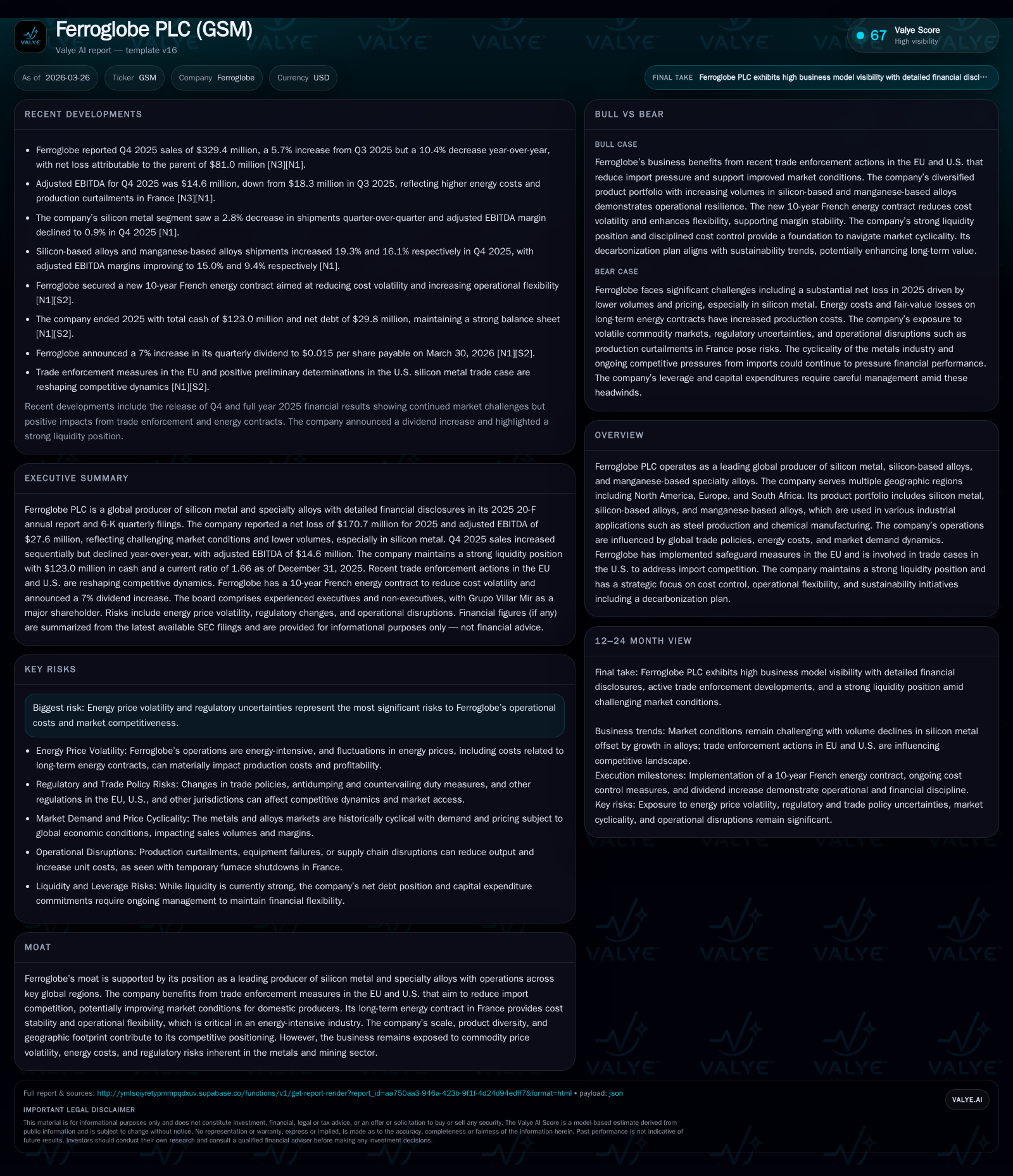
Ferroglobe PLC experienced a sharp earnings downturn in 2025, transitioning from positive net income in prior years to a significant net loss, driven primarily by commodity price declines and oversupply. The company’s deployment of European Union safeguard measures and ongoing U.S. trade cases aims to mitigate import competition and improve pricing power. Stable energy procurement via long-term contracts in France further buffers operational costs. Despite financial pressures reflected in increased net debt, Ferroglobe maintains strong liquidity supported by cash reserves and factoring programs, while continuing capital expenditures focused on decarbonization. Key risks remain energy price volatility and regulatory uncertainty, but strategic safeguards and operational flexibility provide a foundation for recovery.
From Profit to Loss: A Turbulent Earnings Trajectory
Historical performance (annual)
| FY | Net ($mm) | Net YoY |
|---|---|---|
| 2025 | -177 | -951.5% |
| 2024 | 21 | -78.9% |
| 2023 | 98 | -77.8% |
| 2022 | 444 |
Source: SEC companyfacts cache [F1].
Capital returns and efficiency (annual)
| FY | Div ($mm) | ROE% |
|---|---|---|
| 2025 | 10 | -25.6 |
| 2024 | 10 | 2.5 |
| 2023 | 6 | 11.3 |
| 2022 | 3 | 58.6 |
Source: SEC companyfacts cache [F1].
Ferroglobe PLC's financials for the year ended December 31, 2025 illustrate a stark reversal from profitability into deep loss territory. Net income attributable to the parent plummeted from $23.5 million in 2024 to a negative $177.1 million in 2025 [F1][S1]. This swing coincides with a broad EBITDA decline from $127.2 million down to negative $72.4 million over the same interval [F1][S12]. FX adjusted EBITDA similarly collapsed by approximately $160 million, signaling severe operational challenges beyond currency effects.
These results reflect sharp falls in average selling prices across Ferroglobe's product lines coupled with global demand weakness and rising cost pressures that could not be offset fully by cost containment efforts or volume adjustments reported during the year [N2][S1].
Commodity Cycles and Trade Policy: Drivers of Past Performance
Silicon metal pricing experienced sustained deterioration through 2024 into 2025 due to chronic oversupply resulting from increased capacity additions worldwide amid shifting end-market demand drivers spanning chemical sectors, aluminum smelting, and emerging electric vehicle supply chains [S1]. The convergence of European and Asian prices—impacted heavily by Chinese exports—intensified competition against Western producers maintaining higher cost bases.
Manganese alloy prices suffered similar downward pressure as aggressive output from Indian producers combined with lower steel demand exerted margin compression throughout key consuming regions [S1][N1]. The company's sales mix adjustments yielded only marginal improvements.
Trade policy has become a crucial lever amidst these cycles; Ferroglobe pursues a balanced exposure across term contract volumes tied to formula pricing versus spot-derived sales to flexibly manage market fluctuations. The EU safeguard measures introduced late in 2025 aim explicitly at curbing injurious imports while U.S. antidumping proceedings carry potential for further tariff relief—both viewed internally as essential catalysts for stabilizing pricing levels [N2][S1][N1].
Operational Adjustments in Response to Pricing Declines and Demand Shifts
Facing declining volumes linked to lower customer activity in automotive and construction sectors as well as inventory buildups along global value chains, Ferroglobe strategically cut silicon metal production rates to avoid exacerbating oversupply conditions [S1]. Concurrently, raw material sourcing adapted with increased reliance on externally procured sinter rather than internal production for manganese alloys—helping manage input costs more efficiently.
Cost components exhibited mixed dynamics: manganese ore expenses rose slightly on higher purchase volumes but benefited from lower unit prices ($115 million total vs prior years), coal consumption shrank alongside plant utilization albeit at falling unit costs ($148.6 million total), metallurgical coke prices retreated reflecting ample supply whereas wood outlays remained significant due to South African operations carbon reductant needs [S1]. Quartz consumed decreased on volume but saw unit price upticks driven by inflationary factors.
Safeguard Measures and Legal Actions: Reinforcing the Competitive Moat
Late 2025 marked an important inflection with the implementation of EU ferroalloy safeguard measures which actively reduced import pressure into European markets. This action bolstered market pricing conditions after months of sustained weakness punctuated by import-driven undercutting [N2][S1]. In parallel, ongoing U.S. trade litigation delivered preliminary antidumping and countervailing duty determinations favorable to the company’s position, underpinning efforts toward equitable competitive dynamics.
Such trade instruments serve as crucial defensive barriers protecting Ferroglobe’s regional portfolios from low-cost incumbents during periods of global commodity saturation—a moat supported further by geographic diversification that tempers region-specific risks [N2][N1].
Energy Procurement Strategy: The Role of Long-Term French Contracts
Energy is among the largest expenditure categories for Ferroglobe’s high-temperature metal production processes. To contain this inherent cost volatility, the firm secured a landmark ten-year energy contract with suppliers in France effective early 2026 which provides both price stability and operational flexibility critical for managing cash flows tightly linked to electricity consumption patterns [N2][S1].
This forward-looking contract mitigates risk associated with fluctuating spot power prices that have historically undermined margin predictability across silicon metal plants. By locking favorable terms combined with consumption flex provisions, Ferroglobe enhances its operational leverage amidst unpredictable external cost environments.
Financial Position Under Pressure: Debt Dynamics and Liquidity Overview
Balance sheet metrics reflect the operational stress felt throughout 2025: Ferroglobe moved from net cash of approximately -$28.3 million (net cash) at end-2024 into net debt of about $39.6 million by year-end 2025 [F1][S3][S5]. This shift stems primarily from increased bank borrowings—from $22.1 million to over $103 million—and greater other financial liabilities partially offset by sustained cash holdings near $123 million.
Liquidity remains robust given access to factoring facilities that finance receivables alongside an asset-based revolving credit line capped at $100 million available through North American subsidiaries [S3][S6][S7]. Management maintains working capital sufficiency amid forecasted positive cash flows despite certain covenant constraints [S8][S9].
Capital expenditures declined slightly to about $61.7 million focused mainly on productivity upgrades and environmental sustainability projects including a decarbonization plan targeting a reduction of combined scope 1 & 2 emissions per ton by at least 26% by 2030 from a 2020 baseline. Government grants contributed approximately $12 million toward these initiatives [S8][S17].
Capital Allocation Choices: Dividends and Cash Flow Generation
Despite reported losses, Ferroglobe declared a quarterly dividend increase of around 7% (to $0.015 per share) payable March 30, signaling confidence in liquidity management and ongoing cash flow generation reflective of controlled capex outlays [N2][S22]. No major share repurchase programs were disclosed.
Free cash flow generation remains challenged but improved working capital management through enhanced receivables collection and inventory controls supports selective positive contributions [N1][S23].
Looking Ahead: Catalysts and Risks
Key catalysts include resolution of U.S. trade cases potentially expanding protective tariffs supporting Silicon Metal segment pricing domestically alongside continued enforcement of EU safeguards sustaining market equilibrium.
Operationally, flexible production aligned with demand signals combined with locked-in energy pricing provides leverage potential as markets recover post-pandemic.
Risks persist notably around global energy price volatility which could erode margin gains if wholesale prices spike unexpectedly; regulatory changes across multiple jurisdictions add execution complexity especially concerning environmental compliance.
Monitoring trade case developments alongside commodity price trends will be essential for assessing sustainable recovery or need for further operational adaptation.
Disclaimer: This is research-only, informational analysis and not investment advice. It may include AI-generated interpretation and general industry context. Always verify important details using primary sources.

Comments